To correct a manuscript is to do something audacious. It means looking at a text that has been copied and recopied across centuries, that has been treated as received and authoritative, and deciding that the scribes got it wrong and you can see why. It means trusting your own reading over the accumulated weight of received tradition. Most scholars hesitate. Rabbi Elijah ben Shlomo Zalman Kremer, known to the Jewish world as the Vilna Gaon - the Genius of Vilna - did not hesitate. He worked through the Talmud, the legal codes, the kabbalistic classics, and the grammatical texts, and he marked them up. He found corruptions, transpositions, missing words, sentences that had drifted from their original meaning through generations of inattentive copying. He corrected them. And he was, by the broad consensus of the scholars who came after him, almost always right.
That is the Gaon's intellectual signature: not just breadth - though the breadth was extraordinary - but precision. The conviction that if a Talmudic passage appeared to contradict another passage, the answer was probably not a forced reconciliation but a careful look at the manuscripts. That apparent problems dissolved once the text was read properly. That rigour was not the enemy of tradition but its highest expression. This was not the approach of a doubter. It was the approach of a man who believed so completely in the coherence of the tradition that he could not accept careless transmission of it.
He was born in 1720 in Selts, near Grodno, into a family already known for scholarship, and he lived almost his entire life in Vilna - a city already recognised as a centre of Jewish learning before his arrival, and one whose reputation his presence would permanently cement. He died there in 1797. In between, he studied.

The prodigy and the practice
The accounts of Elijah's childhood are the kind that attach themselves to later greatness and should be treated with appropriate caution - but the broad picture is consistent enough to take seriously. He was reading Talmud by the age of six or seven; by his early teens he had, by all accounts, covered the canonical body of rabbinic literature to a degree that left his contemporaries without comparison. There are stories of him as a small child lecturing in the Great Synagogue of Vilna, of distinguished scholars already treating him as a peer. The stories may be embellished. The underlying fact - that his gifts were recognised as exceptional from the beginning - is not in serious dispute.
What is more distinctive, and more reliably attested, is what he chose to do with those gifts as an adult. He did not take a communal rabbinic post. He did not head a yeshiva. He studied alone, which was unusual for a scholar of his stature - the normal expectation was that a great scholar would gather students around him, would teach as a matter of course. The community of Vilna, recognising what they had, supported him financially so that he could study without institutional obligation. He accepted the arrangement and used it without reserve.
The Gaon is reported to have slept in short intervals adding to perhaps two hours in every twenty-four, a practice he maintained because he regarded sleep as time taken from study. Whether this figure is literally accurate or somewhat legendary, it points at something real: the intensity of his practice was not ordinary. He kept candles burning through the night. He worked in a room kept cold, reportedly to prevent drowsiness. The engagement with text was not what we would call scholarship as a profession; it was closer to an ascetic practice, the study itself understood as a form of worship.
The method: going back to the text
The Gaon's scholarly approach had a name in the tradition: peshat, the plain or direct meaning of a text, as opposed to elaborate pilpul - the dialectical casuistry that had become the dominant mode of advanced Talmudic study in Poland and Lithuania by his time. Pilpul, at its extreme, could produce dazzling constructions of logic built on finely balanced distinctions, vast edifices of argument that demonstrated their author's ingenuity without necessarily illuminating the text being discussed. The Gaon regarded this with something approaching contempt. He wanted to know what a passage actually said, which meant knowing what the passage actually was - which meant going back to the manuscripts.
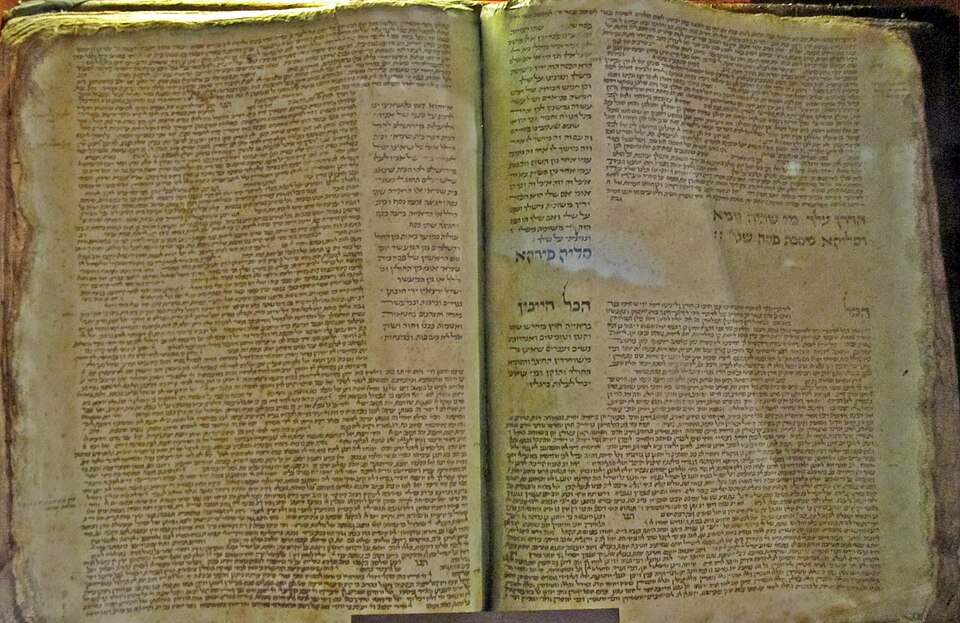
His emendations - the Hagahot HaGra, his marginal corrections to the Talmud - are printed in most standard editions of the Babylonian Talmud to this day. His commentary on the Shulchan Aruch, the great 16th-century legal code of Rabbi Joseph Karo, is known as the Biur HaGra and appears in virtually every subsequent edition of that work. This is the mark of a scholar who has been absorbed into the tradition rather than simply admired from a distance: his corrections became part of the apparatus through which later generations read the source texts.
The scope of his writing is almost implausible in retrospect. He wrote commentaries on the Talmud, the Jerusalem Talmud, the Mishnah, the Shulchan Aruch, the Zohar, the Sefer Yetzirah, the biblical books of Proverbs and Song of Songs and Esther, the Passover Haggadah, and numerous other texts. He wrote on Hebrew grammar and on mathematics and on geometry - because he believed, with genuine conviction, that secular knowledge was necessary for the proper understanding of Torah. Astronomy, he held, was needed to understand the calendar. Geometry was needed to understand certain tractates. The separation between sacred and secular learning that other authorities maintained was, to the Gaon, a category error.
Biur HaGra & Hagahot HaGra
The Biur HaGra (Elucidation of the Gaon) is the Gaon's commentary on the Shulchan Aruch, the authoritative code of Jewish law compiled by Rabbi Joseph Karo in Safed and first published in 1565. The Gaon's commentary traces each ruling back to its Talmudic source, often offering corrections or alternative readings. It has been included in standard editions of the Shulchan Aruch since its publication. The Hagahot HaGra are his marginal emendations to the Babylonian Talmud, appearing in the margins or apparatus of most standard modern editions. Together they represent the most widely distributed portion of his work - present in the study houses of scholars who may never have read any other text by him.
Standard editions of Shulchan Aruch and Babylonian TalmudThe great controversy
In the mid-18th century, a new religious movement was spreading across the Jewish communities of Poland, Ukraine, and Lithuania. The Hasidic movement - founded by Rabbi Israel ben Eliezer, known as the Baal Shem Tov, who died in 1760 - emphasised ecstatic prayer, joy in divine service, and the spiritual accessibility of God to every person regardless of their level of learning. The Hasidim taught that a simple man who prayed with complete fervour stood closer to God than a scholar who studied without devotion. They introduced changes to the prayer liturgy, shifted the relative importance of study and prayer, and developed a model of religious leadership - the rebbe or tzaddik, the righteous leader - quite different from the conventional rabbinic model.
The Gaon regarded this as dangerous. Not the joy, exactly - the tradition had always valued joy in religious life - but the implied demotion of learning, the changes to liturgical practice, what he saw as insufficient rigour in the movement's relationship to Talmudic authority, and the elevation of charismatic leadership over scholarship. In 1772, the leadership of Vilna issued a formal cherem - a proclamation of excommunication - against the Hasidic movement. The Gaon was the central rabbinic authority behind it. A further cherem followed in 1781.
The controversy was fierce and, for a time, genuinely alarming to both sides. The opponents of Hasidism came to be called mitnagdim - the "opposers" - a label that captures the reactive quality of their position, organised as it was primarily around what they were against. The Gaon was their intellectual anchor. It is reported that he began, at some point, to travel toward the Land of Israel with the intention of confronting Hasidic leadership there, but turned back before completing the journey; the reasons for this remain unclear, and the episode has attracted much subsequent discussion. Whether the confrontation would have altered anything is impossible to know.
By the 19th century the controversy had softened considerably. The two movements found, gradually, a rough modus vivendi - partly through shared adversity under Tsarist rule, partly through the natural accommodation of communities that had to coexist. The sharp edges of the 18th-century dispute did not disappear but they were no longer cutting. Both traditions survived, and both survive today, each internally diverse, each having evolved in ways the original combatants would not entirely recognise.
What the dispute reveals, from the perspective of the Tribe of Learning series, is the depth of the tradition's investment in the argument itself. The Gaon's opposition to Hasidism was not the opposition of a conservative to novelty as such - he was himself innovating, in his way, in his insistence on going back to the sources. It was the opposition of a man who believed that the tradition's survival depended on its being done right: that the text had to be read accurately, the law derived carefully, and that no movement, however spiritually alive, could substitute fervour for rigour.
He found errors in texts that had been treated as untouchable for generations. He corrected them. The corrections are still in the margins.
The Cherem Against Hasidism
The rabbinical leadership of Vilna issued a formal cherem (excommunication) against the Hasidic movement in 1772, renewed in 1781. The proclamations condemned several practices: changes to the traditional prayer liturgy (the Hasidim had adopted the Lurianic rite in preference to the Ashkenazic), what was characterised as excessive joy and bodily movement during prayer, and the elevation of the tzaddik as an intermediary figure. Copies of the proclamation were sent to other communities. The Gaon was the central rabbinic authority behind the action, though he was not its sole instigator. The texts of the various proclamations are collected and analysed in Mordecai Wilensky's Hasidim u-Mitnagdim (2 volumes, Bialik Institute, Jerusalem, 1970).
Wilensky, Hasidim u-Mitnagdim · Bialik Institute, JerusalemThe yeshiva that the Gaon built by not building it
The Gaon never founded a yeshiva. He studied alone, declined institutional positions, and did not, in any conventional sense, build an institution. What he built instead was a model - an approach to learning so compelling that his students took it and built with it after he died.
The most consequential of those students was Rabbi Hayyim of Volozhin, who had studied with the Gaon in the 1770s and 1780s and absorbed his approach with unusual depth. In 1803, six years after the Gaon's death, Hayyim founded a yeshiva in the small town of Volozhin in Lithuania - now in Belarus. The Volozhin Yeshiva was not the first yeshiva, but it was, in an important sense, the prototype for what a yeshiva would become in Eastern Europe: an autonomous institution, supported by donations from the wider Jewish community, dedicated to full-time Talmud study, drawing students from across the region and eventually from beyond it. Its ethos was directly the Gaon's - rigorous, text-focused, broad in its engagement with the whole of rabbinic literature, suspicious of the kind of ingenuity that substituted cleverness for accuracy.
Volozhin became the model. Over the 19th century, yeshivot on its pattern spread across Lithuania, Belarus, Poland, and eventually further afield. The names of some of them - Mir, Slabodka, Telz, Slobodka, Ponevezh - became markers of a particular world of learning, demanding and serious, shaped by the Lithuanian tradition the Gaon had founded by example. Students would travel hundreds of miles to study in these institutions. The best of them produced scholars who would in turn head yeshivot or serve as rabbinic authorities across the Jewish world. The Volozhin Yeshiva itself was closed by the Tsarist authorities in 1892 - ordered to add secular subjects to its curriculum, the administration chose closure - but the institutions it had inspired continued, and many survive to this day in Israel, America, and elsewhere.
The Volozhin Yeshiva
Founded by Rabbi Hayyim of Volozhin in 1803 in the town of Volozhin (now Valozhyn, Belarus), the yeshiva became the model for the autonomous Eastern European yeshiva: fully supported by community donations, dedicated to intensive Talmud study without compulsory secular education, drawing students from across the Ashkenazic world. At its height it enrolled several hundred students at a time. Among its alumni were many of the leading rabbinic figures of the late 19th and early 20th centuries. The Tsarist government ordered the institution to incorporate secular subjects; the administration refused and closed the yeshiva in 1892. It briefly reopened before World War One and then permanently closed. The tradition it had established by then existed in dozens of successor institutions. Many yeshivot in Israel and North America trace their lineage directly to the Volozhin model.
Immanuel Etkes, Rabbi Israel Salanter and the Mussar Movement · Jewish Theological SeminaryVilna, Jerusalem of Lithuania
The city itself matters to this story, and it is worth pausing over it. Vilna - Vilnius today, the capital of Lithuania - had been a centre of Jewish scholarship well before Elijah ben Shlomo Zalman was born there. The community had a long tradition of learned leadership; the city's study houses were already known across the Ashkenazic world. The Gaon's presence intensified and in some sense crystallised that reputation: Vilna became, under his shadow and after his death, the model of what a Jewish intellectual community could look like. Its title - the "Jerusalem of Lithuania" - was not modest, and it was not unearned.
The Jewish community of Vilna grew through the 19th century into one of the most culturally and intellectually rich in Eastern Europe. It was not only the world of the yeshiva and the study house: Vilna also became a centre of the Haskalah, the Jewish Enlightenment, and later of secular Yiddish culture. The YIVO Institute for Jewish Research, dedicated to the study of Yiddish language and Eastern European Jewish life, was founded there in 1925. The tensions between the different Vilnas - the strictly observant and the secular, the Hebraist and the Yiddishist, the traditional and the modernising - were themselves a kind of argument, conducted in the tradition of a city that had always argued.
That world was destroyed in the Holocaust. The Jewish population of Vilna, which had numbered somewhere around 55,000 on the eve of the German occupation in 1941, was almost entirely murdered at Ponary, outside the city, over the course of the occupation. The city whose title evoked Jerusalem met a destruction that itself evoked an older one. The Gaon is now a figure who belongs, in the most literal sense, to a world that no longer exists in its original form - though the institutions and the learning that derived from him persist, transplanted and transformed, elsewhere.
What the Gaon's thread connects to
In the logic of this series, the Tribe of Learning carries a continuous thread: from the schoolrooms planted by Joshua ben Gamla's decree, through the academies that produced the Mishnah and Talmud, through the medieval community whose ordinary literacy produced the Cairo Geniza, and now to Vilna. What the Gaon represents in that chain is a particular moment of intensification and clarification - a point at which the tradition examined itself and insisted on the highest possible standard for its own transmission.
The act of emendation - of looking at a received text and correcting it - is an act of enormous confidence in the tradition's coherence. The Gaon was not sceptical of the Talmud; he believed in it completely. That belief was precisely what made him unwilling to accept corrupted or sloppy transmission of it. A text you distrust can be left with its errors. A text you revere has to be got right. The corrections are a form of devotion.
The Lithuanian yeshiva tradition he spawned, for all the controversy of its origins and the violence of the 20th century that interrupted it, did not end. Yeshivot on the Volozhin model study the same Talmud, with the Gaon's corrections in the margins, from Jerusalem to Brooklyn to Buenos Aires. The Hasidic tradition he opposed with such force also survived - and its own schools study the same texts, through a different lens, in the same cities. The 18th-century argument was never resolved; it produced two living traditions instead of one, which is, in the event, a kind of result the tradition might recognise as appropriate.
The thread runs gold not because everything worked out tidily, but because the commitment to the text - to reading it carefully, transmitting it accurately, and being willing to correct it when it has been got wrong - has proven more durable than any of the political and communal upheavals that surrounded it. The Gaon never held office. He founded no institution. He slept two hours a night and filled his margins with corrections, and the corrections are still there.
Further reading