In 1896, two Scottish sisters arrived in Cambridge with a bag of manuscript fragments they had bought in Cairo. Agnes Smith Lewis and Margaret Dunlop Gibson were identical twins, widows, largely self-taught orientalists who had acquired their languages without institutional support, and among the most formidable scholars of their generation - even if formal academic positions were not then available to them. They had been to the Holy Land and Egypt before, and they had the eye for old things. They brought the fragments to Solomon Schechter, Reader in Rabbinics at Cambridge, and watched him look at them. He recognised what they had. He later said he turned pale. That is plausible. What he was looking at was a scrap of the original Hebrew text of the book of Ecclesiasticus - a text whose Hebrew had been believed lost for centuries, surviving only in translation, chiefly the Greek. It had come from a storeroom in a synagogue in Fustat, the old city of Cairo. There was, he now understood, very much more where it came from.
The word geniza comes from Hebrew ganaz, to store or conceal. A geniza is a repository attached to a synagogue where worn-out or damaged texts are placed once they can no longer be used - any document that might carry a name of God may not simply be thrown away. The practice is a form of reverence extended, over time, to anything written in Hebrew characters: sacred texts, to be certain, but also letters, contracts, and eventually almost anything the community set down on paper or parchment. The Ben Ezra Synagogue in Fustat, built on a site associated with Jewish antiquity and rebuilt in the eleventh century, had maintained a geniza in its upper storey. At some point the room was sealed. The contents stopped being disturbed. The Cairo climate - dry, warm, enclosed - did the rest.
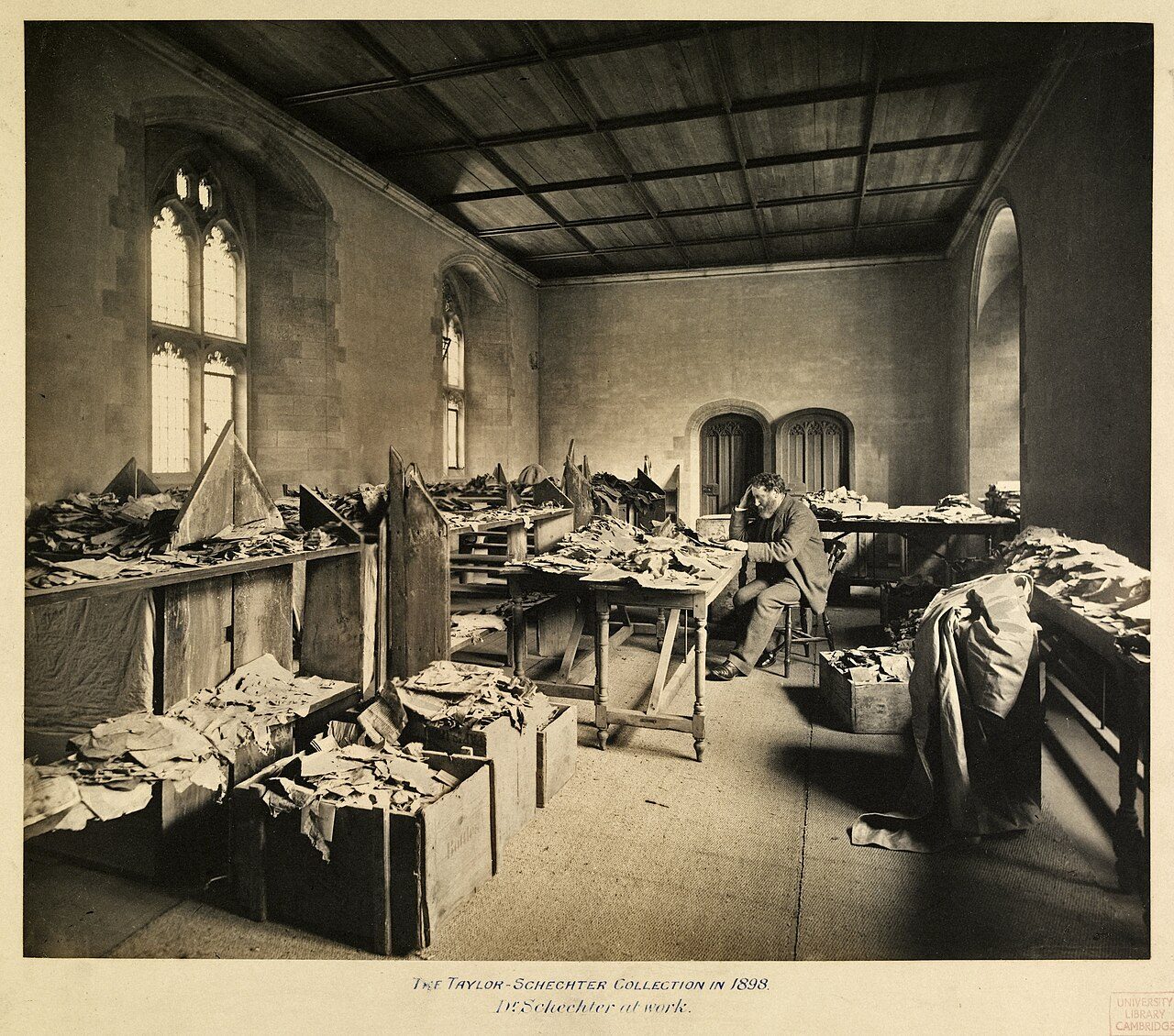
What the room contained, when Schechter arrived in 1896 and arranged with the synagogue's leadership to examine it, was the better part of a thousand years of medieval Jewish literary production and daily life, accumulated and then left untouched. He described working in the geniza as a battle: "Egyptian climate, the dreadful smell, dark, and general uncleanliness." He worked through it anyway, for weeks. He brought back some 193,000 fragments to Cambridge. Additional fragments made their way to other European institutions - the Bodleian Library at Oxford, the Alliance Israélite in Paris, collections in St Petersburg, New York, Philadelphia. The total across all repositories is estimated at around 400,000 fragments. It is the largest medieval archive of any kind to survive from the Islamic world, and its existence was entirely accidental.

Everything a community wrote down
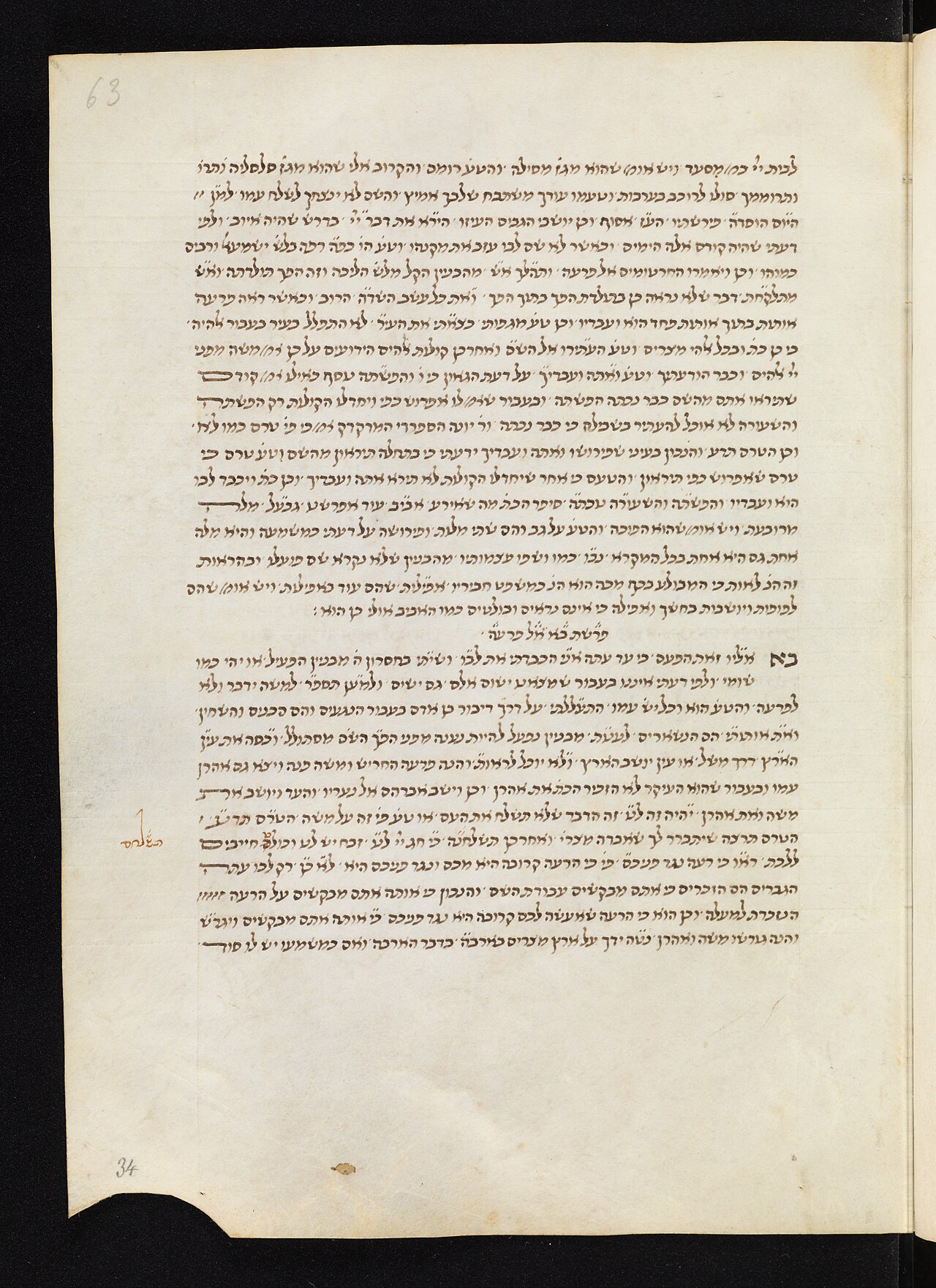
The content of the Geniza defeats summary. It contains Talmudic commentaries and biblical manuscripts. It contains liturgical poetry - piyyutim - by poets known and unknown, including many compositions that existed nowhere else. It contains rabbinic responsa: the question-and-answer correspondence through which the great legal authorities of the medieval Islamic world advised communities from Spain to Persia on matters of religious law. A scholar in Babylon would write a responsum on a scrap of paper and then, apparently, use the back of it to write a shopping list. Both sides ended up in the geniza. Both sides survived.
There are marriage contracts, divorce documents, court records, property deeds. There are letters between merchants in Egypt and Sicily and Tunisia and Yemen and India, tracking the movement of spices and textiles across five thousand miles of Mediterranean and Indian Ocean trade routes. There are medical prescriptions and charitable accounts - the community's records of what it gave to its poor, and who they were. There are children's handwriting exercises on the backs of pages that were too worn for regular use but still too sacred to destroy. A child in eleventh-century Fustat practised his letters on the reverse of a manuscript that was itself centuries old, and both the manuscript and the exercise survived together in a room that nobody opened for eight hundred years.
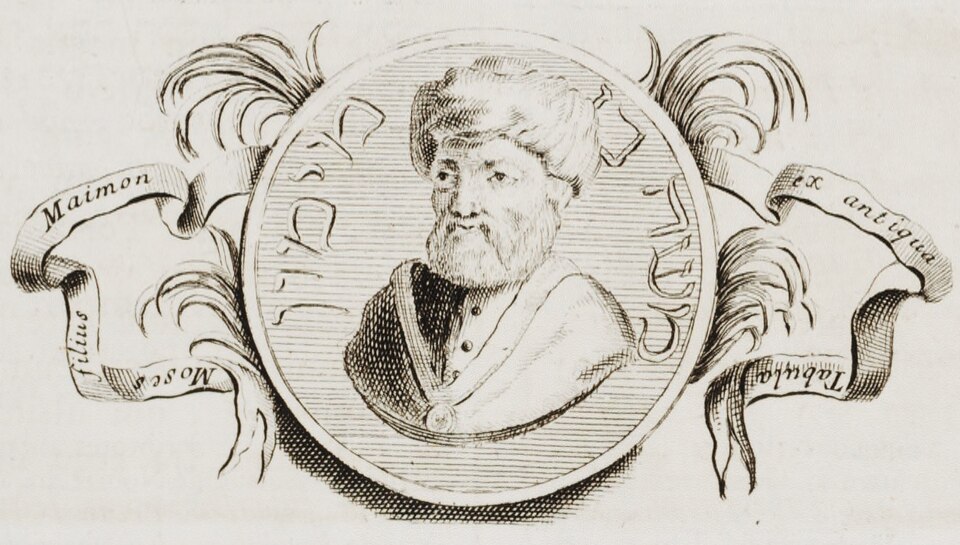
Among the fragments are documents in Maimonides' own hand. Moses Maimonides - philosopher, physician, the greatest codifier of Jewish law in the medieval period - lived and worked in Fustat in the late twelfth century. Drafts of his letters, legal rulings, private correspondence: some of these ended up in the geniza. They are checkable, datable, handwritten. They are among the most direct survivals from any major medieval thinker of any tradition.
The Taylor-Schechter Genizah Collection
The Ben Ezra Synagogue geniza accumulated material from roughly the tenth century onward; the earliest fragments are somewhat earlier. The room appears to have been sealed and its contents left undisturbed by the mid-nineteenth century, though European travellers and dealers had been acquiring fragments for decades before Schechter's arrival. Schechter brought approximately 193,000 fragments to Cambridge University Library in 1897. The collection was catalogued and named in honour of Charles Taylor, who underwrote the expedition's costs. It remains one of the richest medieval archives in the world, still yielding new material as conservation and digitisation proceed. The Friedberg Genizah Project has created a searchable database linking fragments across institutions.
Cambridge University Library · Taylor-Schechter CollectionA letter from India, a king who converted
S.D. Goitein, an Israeli-German-American historian working at the Hebrew University and later at Princeton's Institute for Advanced Study, spent thirty years with the Geniza. He arrived already a serious scholar; the material remade him. What he extracted from the merchant letters alone constitutes one of the most extraordinary reconstructions in the history of scholarship. Goitein identified a sub-archive of over 300 documents from Jewish merchants operating between Egypt, Aden, and India in the eleventh and twelfth centuries - traders who wrote to each other across five thousand miles about pepper and indigo and silk and debt and weather and family, mixing business with news with complaint in the manner of merchants everywhere and always. He called them the India Traders. Before these letters were deciphered, scholars knew that Jewish merchants had traded across the medieval Islamic world; they did not know in anything like this detail what that trade actually looked like from the inside.
A woman in eleventh-century Fustat wrote to her husband, who was away on business, about the price of indigo. A merchant in Aden warned his partner about a ship that had gone down with cargo aboard. A trader wrote from the Malabar coast reporting on local conditions. These are ordinary commercial communications, no different in kind from the correspondence of merchants anywhere in the medieval world - except that they survived, and the vast majority of comparable material from the same period did not. The Geniza is what fills the silence.
Among the Geniza's more remarkable survivals is a document known as the Schechter Letter - an anonymous Khazar letter found in the Cambridge collection, linked to the correspondence between Hasdai ibn Shaprut, the Spanish Jewish courtier and scholar (c. 915-970), and Joseph, king of the Khazar polity. The Khazars were a Turkic kingdom in the region of the Caucasus and the lower Volga that had, in the eighth or ninth century, converted to Judaism. Hasdai wrote to Joseph seeking information about the conversion and about Jewish political independence; the correspondence, in various copies, survives both in the Geniza and in the Bodleian Library at Oxford. The exchange is one of the most significant documents for understanding the Khazar story, a puzzle of Jewish historiography that remains genuinely contested, and the existence of multiple copies - in different collections, in different countries - is itself a small testimony to how widely the story circulated.
Goitein's great work, A Mediterranean Society (University of California Press, six volumes, 1967-1993), is the summation of those thirty years. The subtitle describes it as "the Jewish communities of the Arab world as portrayed in the documents of the Cairo Geniza," and the word "portrayed" understates what he achieved. The Geniza gave him - and through him, us - not the Jewish medieval world as its legal and liturgical authorities described it, but the Jewish medieval world as its inhabitants actually lived it: what they bought, what they worried about, what they wrote to their families, what the community did when one of its members fell into poverty. Before Goitein, the history of medieval Jewry was largely reconstructed from legal responsa and rabbinic texts - the official record, the formal voice. The Geniza supplied the informal record. The two together make something much closer to the full picture.
A scholar wrote a responsum on a scrap of paper and used the back of it for a shopping list. Both sides survived. The dry air of Cairo kept everything.
The India Traders Archive
Goitein identified over 300 documents within the Geniza relating to Jewish merchants trading between Egypt, Aden, and the Indian subcontinent in the eleventh and twelfth centuries. The letters are written in Judaeo-Arabic - Arabic in Hebrew characters, the everyday written language of much of the medieval Jewish Mediterranean world - and document a commercial network spanning roughly five thousand miles. They record prices, shipwrecks, partnerships, family news, and the texture of daily mercantile life with unusual immediacy. Goitein published selections in Letters of Medieval Jewish Traders (Princeton University Press, 1973) and analysed the network in depth in A Mediterranean Society. The full scholarly edition of the India Book letters was completed by Mordechai Akiva Friedman (Tel Aviv University) in collaboration with Goitein's notes.
Taylor-Schechter Collection, Cambridge · Goitein, A Mediterranean SocietyThe accident that was not accidental
There is a question worth sitting with: why did the Ben Ezra Synagogue's geniza preserve material so far beyond what a geniza was designed to hold? The answer is the same thing that produced the archive in the first place. Jewish law required that any document which might carry a name of God must be stored rather than destroyed. In practice, this meant that almost anything written in Hebrew characters ended up in the geniza - because any document might contain a divine name, and the cost of being wrong was serious. A shopping list written in Hebrew went into the geniza alongside a Torah scroll. A letter to a business partner went in alongside a page of Talmud. The reverence was indiscriminate, and its indiscriminacy was the archive's salvation.
This is what literacy looks like from the inside, not as a cultural achievement viewed from outside, but as an ordinary fact of daily life. The community that generated the Geniza was a community where writing was normal enough that the shopping list ended up in the same room as the Torah. Children's handwriting exercises were common enough to be used as scrap on both sides. Merchants wrote to each other across the Indian Ocean as a routine matter of business. The Geniza is not a monument to Jewish learning in the sense of high scholarship alone; it is a monument to a community where the act of writing was so ordinary that everything written was, in the end, worth keeping.
The tribal transmission thread runs straight through the accidental archive. The schoolroom norm - the ideal established after the Temple's fall that every Jewish boy should be able to read - had, by the eleventh and twelfth centuries, produced exactly what a functioning literate community looks like: not a society of scholars only, but a society where a merchant in Aden wrote his own letters, where a woman in Fustat wrote to her husband, where a child practised his alphabet on the back of a discarded manuscript. The Geniza is the evidence that the educational ambition, planted after the destruction of 70 CE, had become something like ordinary reality a thousand years later.
What Solomon Schechter found in that dark, malodorous room in Cairo was not a library curated for posterity. Nobody planned the Geniza as an archive. It accumulated as all archives do - by the small, repeated choices of people who thought they were simply putting things away. The synagogue kept everything because everything might contain God's name, and the dry air kept it all intact, and the room stayed sealed long enough for history to need it. The accident of preservation has, in the end, proved more durable than most acts of deliberate monument-building. The Torah scrolls decayed and were replaced over the centuries. The shopping lists survived.
S.D. Goitein — A Mediterranean Society
Goitein's six-volume work (University of California Press) is the defining scholarly synthesis of the Cairo Geniza material. Volume I covers the economic foundations of the Jewish communities of the Arab world; Volume II, the community; Volume III, the family; Volume IV, daily life; Volume V, the individual. A sixth volume, an index, was completed posthumously. The work draws on tens of thousands of Geniza documents and constitutes the most complete reconstruction of medieval Jewish daily life available in any language. Goitein's earlier Letters of Medieval Jewish Traders (Princeton University Press, 1973) provides an accessible entry point to the merchant correspondence. The Friedberg Genizah Project (genizah.org) has digitised and made searchable the fragments across all major collections.
University of California Press · 6 volumes · 1967-1993What the storeroom kept
The Geniza's significance extends in two directions simultaneously. As a collection of sacred and legal texts, it has rewritten the history of medieval Jewish intellectual life - filling gaps in the transmission of biblical manuscripts, recovering lost liturgical poetry, providing autograph documents from figures previously known only through copies. As an archive of daily life, it has done something rarer: it has given medieval Jewish communities back their ordinary existence, their commerce and their arguments and their family letters and their shopping lists.
History written mainly from elite sources - from the records of rulers and the decisions of legal authorities and the works of great thinkers - tends to give a picture of a tradition carried by its most distinguished members. The Geniza gives a different picture: a tradition carried by everyone, including merchants who worried about the price of indigo, and children who needed to practise their letters, and women who wrote to absent husbands, and scholars who recycled their own responsa as scrap paper because paper was expensive and Hebrew was Hebrew and nothing in Hebrew was worthless enough to throw away. The Geniza is the whole tribe, not just its leadership.
What Agnes Lewis and Margaret Gibson brought back to Cambridge in a bag of fragments turned out to be one of the great scholarly discoveries of the modern era - not because the fragments were spectacular, though some of them are, but because of what their accumulation revealed. A sealed room, a dry climate, a religious prohibition on destroying any text that might carry God's name, and a thousand years of an ordinary literate community going about its ordinary life. The archive was not built. It grew. And when it was finally opened and examined, it turned out that the accident of its survival was the greatest act of historical preservation in medieval Jewish history.
Further reading