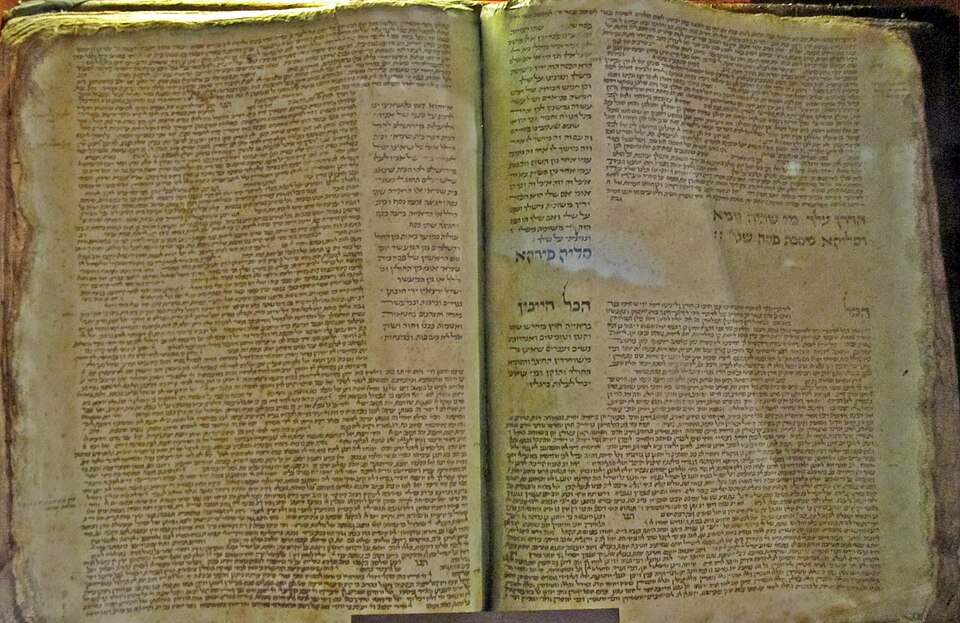
Open any page of the Babylonian Talmud - any folio, in any edition printed over the last five centuries - and the layout tells you something about one man's place in the tradition. In the centre column, the text of the Talmud itself. In the inner margin, to the right of the text, a commentary in a distinctive semi-cursive typeface. In the outer margin, to the left, a second body of commentary in the same typeface but attributed to a different school. The inner margin is Rashi. The outer margin is his grandsons. The page is, in some sense, a family argument that has never ended - and the grandfather's voice has held the position closest to the text, uninterrupted, for five hundred years of print and the generations before it.
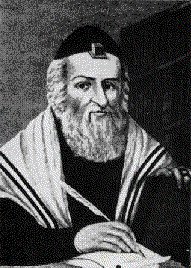
Rabbi Shlomo Yitzhaki - known universally by the Hebrew acronym Rashi, from the initial letters of Rabbi SHlomo Itzhaki - was born in Troyes, Champagne, in 1040 and died there in 1105. His life was not dramatic by the standards of the great figures of this series: no expulsion, no enforced wandering, no years of concealment. He left Troyes to study and returned to found his own academy there. He wrote. He taught. He corresponded with other scholars. He made wine, probably - the Jews of the Champagne region were frequently involved in viticulture, and later tradition credits him with it, though the precise detail is not documented with certainty. What he produced in that provincial French city, in a community small enough to be overlooked and a world violent enough to destroy its neighbours, was a commentary so thoroughly useful that it has been in continuous use ever since: through every change of language, geography, and political circumstance, through the invention of print, through translation and migration and catastrophe.
That is the remarkable thing about Rashi. Not that he was a prodigy, though he was learned from youth. Not that he was bold in his interpretations, though he was sometimes bold. But that he got the pitch exactly right - the balance between the plain meaning of the text and the traditional interpretation of it, between clarity and depth, between brevity and completeness - and sustained that pitch across the Five Books of Moses, most of the rest of the Hebrew Bible, and most of the Babylonian Talmud. The commentary is not a monument. It is a tool. And tools endure because they work.

Troyes, Champagne, and the Rhineland world
To understand what Rashi was writing for, you need to understand where he came from. Troyes in the 11th century was not a backwater. It was an administrative and commercial hub of the county of Champagne - the city that would later host the great Champagne fairs that drew merchants from across Europe and beyond, though those fairs reached their famous pan-European scale in the 12th and 13th centuries, after Rashi's death. In his time, Troyes was a prosperous city at a significant crossroads, and its Jewish community was part of a broader Ashkenazi world that was itself prospering. The Jewish community of Troyes was part of the broader Ashkenazi world of northern France and the Rhineland: the communities of Mainz, Worms, and Speyer in particular, which in the 10th and 11th centuries had developed into the intellectual centres of European Jewish life. These communities were producing scholars and legal decisions and a culture of Torah study that would eventually define Ashkenazi Judaism for centuries.
Rashi went to study in that world. He learned at the academies of Worms and Mainz under the leading scholars of the Rhineland, including Rabbi Yaakov ben Yakar and Rabbi Isaac ha-Levi in Worms, and Rabbi Isaac ben Judah in Mainz. These were communities at the height of their confidence and productivity - the scholars of the Rhineland were producing the legal rulings, the biblical interpretations, and the Talmudic analysis that formed the backbone of Ashkenazi practice. Rashi absorbed all of it, and then - unusually for a scholar of his stature, who might have remained in the established academies - he returned to Troyes and built his own.
The academy he founded in Troyes became a centre of learning that drew students from across France and beyond. Rashi taught, responded to legal questions sent from other communities, and wrote. The commentary on the Torah and on the Talmud were not composed as separate projects but built up over years of teaching, corrected and revised as his understanding deepened. There is evidence in the manuscripts that the Torah commentary in particular was revised more than once; the versions that circulated during his lifetime were not always identical to the versions that later became standard. What we read today as "Rashi" is the tradition's consolidation of that ongoing work.
The commentary on the Torah: pshat and midrash in balance
Rashi's commentary on the Torah - the Five Books of Moses - is the achievement that most people encounter first, usually in childhood. It has been printed alongside the Hebrew text of the Chumash (Pentateuch) in virtually every edition since the beginning of Hebrew printing, which is itself a significant fact: from the very first printed Hebrew books, editors and publishers assumed that the Torah required Rashi's commentary alongside it. This was not an arbitrary choice. It reflected the reality of how the text was taught - with Rashi as the indispensable first interlocutor.
The commentary does two things simultaneously, and it is the combination that made it irreplaceable. It explains the peshat - the plain, direct meaning of the text - with an economy and clarity that cuts through difficulty without appearing to labour at it. Where a word is ambiguous, Rashi says which meaning to take and briefly why. Where a verse is grammatically difficult, he resolves it. Where a narrative sequence raises a question that any attentive reader would notice, he addresses it directly. He does not avoid the question; he does not retreat into pious evasion. He answers.
And then, where the plain meaning alone is insufficient - where the text raises a problem that only Midrashic interpretation can resolve, or where the tradition has attached a reading to a passage that the plain text does not quite yield on its own - Rashi weaves in the Midrash. He does so with the same economy. He does not pile up interpretations or display his range; he selects the one that illuminates the passage and presents it cleanly. The result is a commentary that is simultaneously a guide to reading the text and a guide to how the tradition reads the text: the two things held in balance, neither overwhelming the other.
This was not a simple achievement. The tension between peshat and Midrash was a live question in Rashi's day and remained live after him. His grandson and student Rashbam - Rabbi Samuel ben Meir - pushed the peshat approach further than Rashi had, sometimes reaching interpretations of plain meaning that were at odds with traditional rulings or Midrashic readings that had legal force. Rashbam records that when he argued his peshat conclusions with his grandfather, Rashi acknowledged that he himself had arrived at more literal interpretations than his commentary showed, and that if he had had time he would have revised accordingly. The comment is remarkable for its combination of intellectual openness and practical judgement: Rashi knew the peshat could go further. He judged that his commentary's purpose required the balance he had struck. The reader for whom he was writing needed both registers, and he gave them both.
Peirush Rashi on the Torah
Composed and revised over the course of Rashi's teaching career in Troyes, Champagne. Written in a clear, economical medieval Hebrew with explanatory glosses in Old French (the Laaz glosses) where Rashi renders Hebrew terms in the contemporary vernacular. The commentary balances peshat (plain meaning) with Midrashic interpretation. Manuscript evidence suggests at least two recensions circulated during Rashi's lifetime; the version in standard printed editions reflects the tradition's consolidation of this material. The commentary has appeared alongside the Torah text in printed Chumashim continuously since the earliest decades of Hebrew printing. Available in full with English translation on Sefaria.org.
Medieval Hebrew · Laaz glosses · Sefaria.orgThe Laaz glosses: a medieval French scholar's vernacular
Scattered across Rashi's commentaries - on the Torah and on the Talmud both - are explanatory glosses in Old French. When a Hebrew or Aramaic word was likely to be unclear to his students, Rashi sometimes translated or explained it using the contemporary vernacular of his community, writing the French word or phrase in Hebrew characters. These glosses are called Laaz glosses (from the word lo'ez, meaning a foreign or vernacular tongue), and they number in the thousands across the full commentary corpus.
For the scholar of Jewish texts, the Laaz glosses are a window into how Rashi's community actually spoke and thought - the Hebrew word anchored to its living counterpart, the abstract made immediate. But the glosses have a significance that extends beyond Judaic scholarship. Because Old French is a language of which relatively little documentation survives from the 11th and 12th centuries, Rashi's glosses - preserved in Hebrew characters in manuscripts that were copied carefully throughout the medieval period - constitute one of the most substantial surviving records of medieval Old French dialects. They are studied by Romanists and medieval linguists as primary source material for the history of the French language.
The man who wrote a commentary to make the Torah accessible to his own community inadvertently preserved a substantial portion of the vernacular his community spoke. The medieval French scholar and the medieval French language are bound together in the inner margin of the Chumash, a few words at a time.
The commentary on the Talmud: making the text learnable
The Babylonian Talmud, compiled and edited over several centuries and reaching its approximate final form around the 6th or 7th century CE, is a demanding text. It is written largely in Aramaic - a dialect of Aramaic, specifically, that is not the same as any spoken version of the language and that requires substantial study to read with comprehension. It is compressed: arguments are presented in the shorthand of scholars who assume that the reader already knows the background, already knows who is speaking, already knows the legal principle under discussion. It is allusive: references to cases, opinions, and earlier rulings appear without extended explanation, because the original audience did not need the explanation. And it is not organised in a way that a student approaching it without preparation can navigate easily.
Rashi's commentary on the Talmud addressed all of this. It explains words, both the Aramaic and the Hebrew scattered through it. It identifies speakers in passages where the text moves between voices without explicit marking. It fills in the implied context - the case being discussed, the principle at stake, the line of argument that connects one statement to the next. It does so in the same economical style as the Torah commentary: never more than is needed, always enough to keep the reader moving through the text rather than stranded by it. Without Rashi's commentary, the Talmud is possible but forbidding, and for most students throughout history it would have been effectively inaccessible. With it, the Talmud is learnable.
The significance of this for the continuity of the tradition cannot be overstated. The Talmud is the central document of rabbinic Judaism - the text from which halakha (Jewish law) is derived, the record of the tradition's development through the rabbinic period, the intellectual inheritance that every subsequent generation of scholars engaged with. If the Talmud is inaccessible, the tradition narrows to those who can work through it unaided. Rashi's commentary widened the access. It did not simplify the Talmud - the difficulty of the Talmud is genuine, and Rashi's commentary does not pretend otherwise - but it removed the obstacles that were obstacles of presentation rather than obstacles of genuine intellectual difficulty. The hard thinking remained hard. The unnecessary confusion was cleared away.
Without Rashi's commentary, the Talmud is possible but forbidding. With it, the Talmud is learnable. The hard thinking remained hard. The unnecessary confusion was cleared away.
The Talmud page: a grandfather and his grandsons in argument
The standard layout of the printed Talmud page - established in the famous Bomberg edition printed in Venice between 1519 and 1523, and reproduced with only minor variations in virtually every printed Talmud since - places Rashi's commentary in the inner margin, adjacent to the text, and places the Tosafot commentary in the outer margin. The Tosafot are the product of the school of Talmudic scholarship that flourished in France and Germany in the 12th and 13th centuries, in the generation after Rashi. Their founders and leading figures included Rashi's own grandsons: Rashbam (Rabbi Samuel ben Meir) and Rabbenu Tam (Rabbi Jacob ben Meir), both sons of Rashi's daughter Yocheved.
Rashi had no sons. He had three daughters - Yocheved, Miriam, and Rachel - at least one of whom, Yocheved, was herself credited with scholarly learning, though the accounts of her practice are tangled with later legend and should be treated carefully. What is clear is that his grandchildren received an exceptional education and became exceptional scholars. Rashbam and Rabbenu Tam, in particular, went further than their grandfather in the analysis of the Talmud - they pushed the arguments, questioned conclusions, identified tensions between different passages, and extended the dialectical method that Rashi's commentary had made possible. The Tosafot frequently open a discussion by noting that Rashi's explanation creates a difficulty, and then working through that difficulty at length. It is, literally, a marginal argument: the inner margin speaks, the outer margin responds, pushes back, qualifies, extends.
The conversation across the two margins of the standard Talmud page is one of the most visually distinctive things in all of scholarship - a medieval grandfather's careful explanations facing his grandsons' energetic critique, the two voices balanced on either side of the authoritative text they are both trying to illuminate, the architecture of the page making visible the architecture of the tradition. It has looked essentially like this, in every significant edition, for five hundred years.
The Bomberg Talmud and the page layout
The Babylonian Talmud printed by Daniel Bomberg in Venice between 1519 and 1523 established the page layout that has been reproduced in virtually every subsequent printed edition: the Talmudic text in the central column, Rashi's commentary in the inner margin (in the semi-cursive typeface that became known as Rashi script), and Tosafot commentary in the outer margin. The Bomberg edition also standardised the folio and line numbering system used to cite Talmudic passages to this day. The three-column layout itself originated with the Soncino family printers, who used it for individual tractates from 1483; Bomberg adopted and standardised it across the first complete printed Shas (the full Babylonian Talmud). The layout has been reproduced in the Vilna Shas (1880-86), in the Oz ve-Hadar edition, and in the widely used ArtScroll Schottenstein edition, among many others. Digital editions with English translation are available on Sefaria.org.
Bomberg Venice · 1519-1523 · Vilna Shas 1880-86The first dated printed Hebrew book: Rashi as the vehicle
In 1475, a Hebrew book was printed in Reggio di Calabria, in southern Italy, by the printer Abraham ben Garton. The book was Rashi's commentary on the Torah. This printing - which carries a colophon giving the date and the printer's name - is widely cited as the first dated and identified printed Hebrew book, though the question of absolute priority in early Hebrew printing is genuinely complex: earlier Hebrew printing had occurred, and the exact boundaries of the claim (first complete book, first with a full dated colophon, first with an identified printer) have been discussed by bibliographers. What is not in dispute is that the Reggio 1475 printing is among the earliest printed Hebrew books by any measure, and it is the one that is most consistently cited as the landmark.
The choice of Rashi's commentary as the text for this moment was not accidental. The printers of the first era of Hebrew movable type were serving communities that needed certain books above all others: the Torah, the Talmud, the prayer books. A Torah with Rashi was the most standard and most useful of educational texts. If you were going to demonstrate what Hebrew movable type could do, you demonstrated it on something people would actually use. Rashi's commentary was that text.
The typeface used for Rashi's commentary in that 1475 printing - and in subsequent printings of the Talmud and of rabbinic literature generally - was based on an existing Sephardic semi-cursive manuscript hand, adapted for print as a way of distinguishing commentary from the square script of the biblical or Talmudic text. This typeface became known as Rashi script (ktav Rashi), and it remains the standard typeface for Talmudic commentary and rabbinical responsa in traditional printing today. Every page of the Talmud, every page of a traditional responsum, carries this typeface - the man's name attached to a visual form that outlasted everything else he could have left behind.
The shadow of 1096
Rashi was fifty-six years old when the First Crusade reached the Rhineland. In the spring and summer of 1096, crusading armies and associated mobs moving through the Rhine valley attacked the Jewish communities of Speyer, Worms, and Mainz - the very cities where Rashi had studied, the centres of the Ashkenazi world whose scholars had formed him. The massacres killed thousands. Some communities chose collective death over forced baptism. Some were protected or assisted by local bishops, with mixed results. The communities that had been the intellectual heart of Ashkenazi Judaism were devastated.
Rashi wrote elegies - kinot - for these communities. They have been preserved, and they are not the work of a man writing at a safe distance: they are the work of someone mourning teachers and colleagues and the places that had shaped him, communities whose destruction he had lived to see. The elegies are, by most scholarly accounts, not the most artistically accomplished of the kinot that the tradition has produced; they are the work of a great commentator, not a great poet. But they are genuine, and their existence is important for understanding the context of the commentary.
The commentary on the Torah and the Talmud was being composed and refined in the years around 1096, in the shadow of what had happened. This does not mean the commentary is about 1096 - it is not, and Rashi does not introduce the events of his own time into the biblical or Talmudic text. But it was written for a community living under the weight of those events, and it was written by a man who had seen what happened to the communities that formed him. The act of writing a commentary that made the tradition accessible and transmissible - that gave the next generation the tools to continue learning even if its great centres had been destroyed - is not merely a pedagogic project in that context. It is something closer to a rescue operation.
The persistence of the commentary
Rashi died in 1105. Within a generation his commentary had spread across the Jewish world, copied and carried from community to community, used in every Ashkenazi academy that had access to it. Within a century it was indispensable. When Hebrew printing began in the 1470s, Rashi's commentary was among the first things printed - not because of institutional decision or formal canonisation, but because the communities that used it simply could not imagine teaching the Torah or the Talmud without it.
This is the shape of genuine pedagogic success: not a work that is declared authoritative and therefore used, but a work that is so useful that it is used everywhere, and that becomes authoritative because of what it has done. The Mishneh Torah was controversial from the moment of its composition. The Guide for the Perplexed was banned in some communities. Rashi's commentary generated criticism at the margins - Rashbam's peshat arguments are, in effect, an extended critique of certain of Rashi's interpretive choices - but it was never seriously challenged as the primary commentary. The challenge was always to specific readings, not to the project itself or to its place in the tradition. The tradition had absorbed it before anyone had a chance to contest it.
The gold thread in this series has been the persistence of learning across catastrophe - the thread of transmission that carries the tradition from generation to generation, through exile and destruction and the loss of centres and the building of new ones. Rashi sits near the centre of that thread. The communities he had studied in were destroyed in his own lifetime. He had written their elegies. And the commentary he had produced in the years before and after that destruction gave the next generation, and the generation after that, and every generation since, the means to continue engaging with the text. The Talmud he had made learnable is still being learned. The commentary is still in the inner margin. The argument with his grandsons is still happening, across the two margins of every page.
Further reading