Imagine a line on a map - not a border between nations but a cage drawn around a people, 472,000 square miles of it, running from the Baltic to the Black Sea. Inside it, by the close of the nineteenth century, lived perhaps five million Jews. They were not supposed to be comfortable there. The line was drawn in 1791 by Catherine II with the specific intention of keeping Jewish traders out of the Russian heartland, away from Moscow, away from the interior provinces where their commercial competition was unwelcome. The policy was called the Pale of Settlement, and it lasted until 1917. What it produced - what any confinement of sufficient density and duration tends to produce among people who refuse to stop thinking - was a civilisation.
The Pale was not one thing. It was shtetlakh and cities, Hasidim and rationalists, socialists and Zionists, pamphleteers and poets. It was the Jerusalem of Lithuania and the cosmopolitan boulevards of Odessa. It was a grandmother lighting Shabbat candles in a timber house in Berdichev and a hot argument in a Warsaw study house about whether Marxism or emigration was the better answer to the question the Tsar kept asking with his boots. It was, in short, a world - one of the densest and most characterful the Jews have ever made. And when the walls finally came down, that world did not evaporate. It dispersed, and it seeded everywhere it landed.
The cage and its dimensions
Catherine II's decree of 23 December 1791 was blunt in its purpose. Jews were prohibited from settling or trading in Moscow, Smolensk, and the other interior provinces of the empire. They were to remain in the western territories Russia had absorbed through the partitions of Poland - Lithuania, Belarus, and Ukraine - and in the newly acquired southern lands. Later adjustments added Congress Poland and parts of the Caucasus. By the time Nicholas I's Statute on Jews codified the whole apparatus in 1835, the Pale covered fifteen provinces of western Russia and ten of Congress Poland. Its western frontier was effectively the border with the Habsburg and Prussian empires; its eastern frontier was an internal wall, invisible but absolute.
Even within the Pale, freedom of movement was constrained. The May Laws of 1882, issued by Alexander III in the aftermath of the 1881 assassination of his father and the pogrom wave that followed, pushed the screws tighter still. Jews were now forbidden to settle anew in rural areas even inside the Pale - they could live only in towns and townlets, with limited exceptions for existing agricultural colonies. The laws were framed as "temporary regulations" and stayed on the books for 35 years. Separately, later legislation - most notably the numerus clausus of 1887 - capped Jewish admission to secondary schools and universities by percentage. Together these measures crammed an already crowded people into an ever-narrower urban corridor.
What the empire did not anticipate - what empires rarely do - is that crowding people together who share a language, a legal tradition, a taste for argument, and several millennia of practice at surviving unfavourable conditions tends to produce something other than docility. It produces culture.

The Founding Decrees of the Pale
On 23 December 1791, Catherine II issued the decree that created the Pale of Settlement, barring Jews from permanent residence or trade in the empire's interior provinces and confining them to the western territories acquired through the Polish partitions and to New Russia in the south. The decree was driven by complaints from Moscow merchants about Jewish commercial competition. In 1835, under Nicholas I, the Statute on Jews codified the Pale in formal law for the first time, using the Russian phrase cherta osedlosti - "the boundary of settlement" - and specifying the 25 provinces within it. The statute reorganised communal governance, though the traditional autonomous Jewish communal body (the kahal) was not abolished until 1844, when the crown-rabbi system was formalised under the same tsar. The Pale's legal framework remained substantially in place until its formal abolition following the February Revolution of 1917.
YIVO Encyclopaedia of Jews in Eastern Europe; Jewish Encyclopaedia (1906 edition); Russian Imperial Senate recordsThe city and the shtetl
The geography of the Pale produced two distinct Jewish worlds that existed simultaneously and influenced each other constantly. There was the shtetl - the small market town, the townlet - where a few hundred or a few thousand Jews lived in timber houses around a market square, organised their lives around the synagogue and the study house, and spoke Yiddish as the air they breathed. And there was the city: Vilna, Odessa, Warsaw, Berdichev, Minsk - places where Jewish life achieved a scale and density that made them, for a period, among the most culturally productive Jewish communities in the world.
Vilna was the foremost. The city's Jews had called it Yerusholayim d'Lite - the Jerusalem of Lithuania - since at least the seventeenth century, and the title was not vanity. Vilna was the city of Elijah ben Solomon, the Vilna Gaon (1720-1797), the greatest Talmudic genius of his generation and the intellectual architect of the Lithuanian yeshiva tradition that would reshape Orthodox Judaism for the next two centuries. The yeshivot that clustered around his legacy - Volozhin, Slobodka, Telz, Radin - became the universities of traditional Jewish learning, drawing students from across the Pale and eventually the world. When you study in a modern Orthodox yeshiva today, you're very likely working in the tradition that Vilna made.
Odessa was Vilna's temperamental opposite. Founded in 1794, barely older than the Pale itself, it was a port city with money, ambition, and a cosmopolitan looseness of manner that Vilna would have found suspicious. The Haskalah - the Jewish Enlightenment, which pushed for secular education, modern languages, and engagement with the wider culture - found its warmest Russian home in Odessa. Hebrew and Yiddish periodicals were printed there; the maskil intellectuals gathered in its cafes. And in 1878, Odessa saw Russia's first professional Yiddish theatre performance - the beginning of a theatrical tradition that would eventually fill houses from Warsaw to New York's Second Avenue.
The religious worlds
The Pale was religiously turbulent in ways that defy any tidy summary. Hasidism - the ecstatic, wonder-rabbi-centred movement born in eighteenth-century Ukraine and Volhynia - had swept through the southern and central Pale by 1800, transforming Jewish piety into something warm, accessible, and rooted in specific dynasties of charismatic leaders. The Twersky dynasty of Chernobyl, the Ruzhiner rebbes, the Bratslav Hasidim following the teachings of Rabbi Nachman - each attracted courts of followers whose devotion was as much to a living lineage as to a text.
The Lithuanian Misnagdim, fired by the Vilna Gaon's example, viewed all this with controlled alarm. For them, the tradition lived in rigorous Talmud study, not in a rebbe's table. Their answer was the yeshiva system - and then, in the mid-nineteenth century, something more: the Musar movement, founded by Rabbi Israel Salanter (1810-1883) in Vilna. Salanter's insight was that intellectual mastery without ethical formation was incomplete. He introduced systematic study of ethical texts - Musar literature - as a discipline alongside Talmud, the practice of moral self-examination given institutional form. His disciples spread it through the great Lithuanian yeshivot. It remains influential today.
And running alongside both, and increasingly against both, was the Haskalah - secular, modernising, impatient. By the 1860s the maskilim had their newspapers, their novels, their demands that Jewish children learn Russian or Polish, that the community engage with the modern state on the modern state's own terms. The argument between tradition and modernity, which in Western Europe had largely been resolved by assimilation, played out inside the Pale with far more voices and far more heat.
The Pale didn't silence Jewish argument. It concentrated it until the pressure was extraordinary. Almost every idea that reshaped modern Jewish life was first argued, loudly, somewhere inside those 472,000 square miles.
Yiddish as a civilisation
Perhaps the Pale's greatest creation - certainly its most portable one - was modern Yiddish culture. Yiddish had been the vernacular of Ashkenazi Jews for centuries, dismissed by the maskilim as a jargon and by the rabbis as mere women's speech. Then, in the last third of the nineteenth century, it became literature. Sholem Yankev Abramovich - who wrote under the pen name Mendele Mocher Sforim, Mendele the Book Peddler - almost singlehandedly invented modern Yiddish prose, depicting shtetl life with an unsentimental, satirical precision that made it impossible to romanticise. Sholem Aleichem (Sholem Rabinovitch, 1859-1916) made it warm and achingly funny: his Tevye the Dairyman stories, written from 1894 onwards, turned a struggling milkman in the Ukrainian Pale into one of the most beloved characters in world literature. I.L. Peretz in Warsaw wrote Yiddish that could be symbolist, mystical, angry, and tender in successive paragraphs. Together the three were called the classic trinity of Yiddish literature, the grandparents of a language coming of age.
They were not alone. By 1900 the Pale had Yiddish daily newspapers - Der Fraynd, founded in St Petersburg in 1903, was the first Yiddish daily in Russia. Warsaw had a publishing industry. Vilna had theatrical troupes. The Yiddish press reached readers who had never encountered a secular text in their lives and gave them politics, fiction, advice columns, and poetry in the language of their kitchens. A culture that had been oral and liturgical was becoming literary with remarkable speed.
The political ferment
The Pale was also, and not coincidentally, the birthplace of Jewish modernity's two great political answers to the question of what Jews should do about being Jews in an unfriendly world. Both were born in 1897 - a remarkable year.
In Vilna, on 7 October 1897, thirteen delegates gathered in secret and founded the General Jewish Labour Bund - the Bund - which would become the first mass Marxist party in the Russian Empire. The Bund's answer was doikayt: hereness. Jews should not emigrate; they should transform the conditions of their immediate world, secure national-cultural autonomy within a future socialist state, and do it in Yiddish. By 1914 the Bund had 30,000 members and rivalled Zionism for the loyalty of Pale Jewry.
In Basel, in August 1897, Theodor Herzl convened the First Zionist Congress. The Zionist answer was the opposite of doikayt: not hereness but thereness, a state of one's own in the ancestral land. The Pale's Hovevei Zion (Lovers of Zion) societies had already been organising for a decade; the Bilu pioneers who arrived in Ottoman Palestine in 1882 came largely from the Pale. Zionism and the Bund spent the next two decades competing furiously for the same Yiddish-speaking constituency, conducting their argument in the newspapers and the study-house basements of the very territory they disagreed about whether to leave.
There were other voices too - the Haskalah's descendants, who wanted integration into Russian society; the territorialists, who would accept any homeland; the religious parties, who thought the whole argument was premature until the Messiah weighed in. The Pale did not produce consensus. It produced argument at maximum volume, which is a different and arguably more interesting thing.
The Imperial Census: Five Million in the Pale
The Russian Imperial Census of 1897 - the only full census the empire ever conducted - enumerated 4,899,300 Jews living within the Pale of Settlement, representing approximately 94 per cent of all Jews in the Russian Empire. They formed 11.5 per cent of the Pale's total population of 42.3 million, and 36.9 per cent of its urban population. In nine provinces Jews were the majority of town-dwellers: in Minsk province, 58.8 per cent of urban residents were Jewish; in Grodno, 57.7 per cent; in Mogilev, 52.4 per cent. Yiddish was the declared mother tongue of the vast majority. The census captured the Pale at its demographic peak, a decade before the great emigration reached its full intensity. The Jewish Encyclopaedia of 1906 published detailed province-by-province breakdowns derived from the same data.
Russian Imperial Census, 1897; YIVO Encyclopaedia of Jews in Eastern Europe; Jewish Encyclopaedia (1906 edition), vol. IXThe pogroms, and what came after
It would be dishonest not to name what the Pale also held. The wave of pogroms that began in 1881 - triggered by the assassination of Alexander II and the lie, quickly circulated, that Jews were responsible - swept through southern Ukraine and the Pale's western reaches and killed hundreds. The Kishinev pogrom of April 1903, in which between 40 and 49 Jews were killed, 92 gravely injured, and 1,500 homes destroyed, shocked the Jewish world and prompted Hayim Nahman Bialik to write "In the City of Slaughter," perhaps the most furious poem in modern Hebrew literature. The wave of pogroms in 1905-06 was worse still.
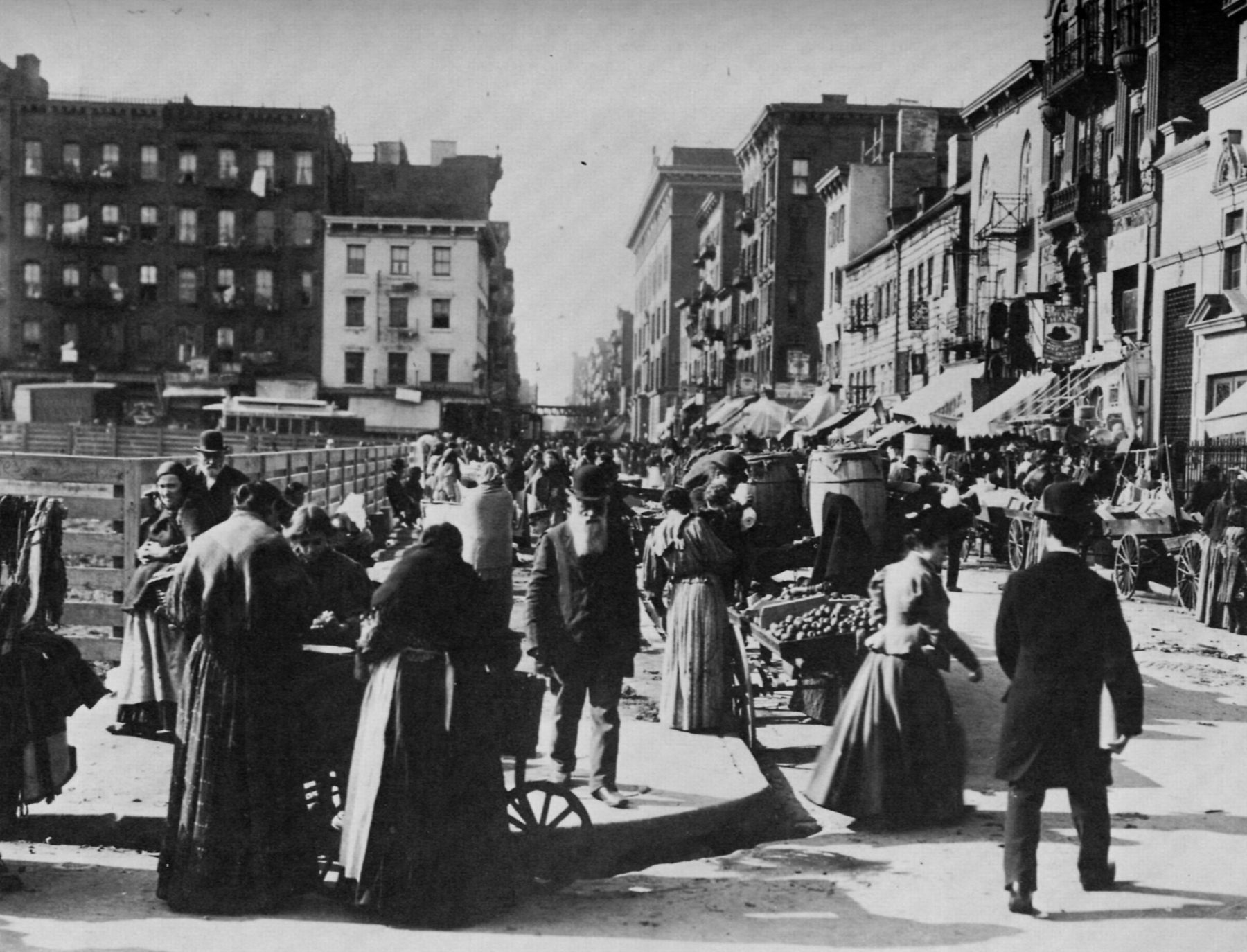
These facts belong in the account. They are not, however, the account's point. The pogroms were a push factor in the great emigration, and the emigration was one of the most consequential population movements of modern times. Between 1881 and 1914, roughly two million Jews left the Russian Empire. The majority went to the United States; the Lower East Side of Manhattan became the largest Yiddish city in the world. Others went to Argentina, to South Africa, to Britain, to Canada, to Ottoman Palestine. They took with them the presses and the politics, the yeshiva traditions and the theatre companies, the Bundist organisers and the Zionist pioneers, the Musar habits of mind and the Sholem Aleichem stories. The Pale didn't die. It dispersed.
The Pale of Settlement was abolished by the Provisional Government in March 1917, a month after the February Revolution ended the Romanov dynasty. Jews were given full civil equality. The legal cage was dismantled after 126 years. What it had contained - the arguments, the books, the movements, the people - was already, by that point, spread across the planet. Confined for a century and a quarter, the civilisation of the Pale turned out to be the most exportable thing the Jews had made since the Talmud itself.
Further reading