The acronym works like a key. Shin for Shpira - Speyer. Vav for Warmaisa - Worms. Mem for Magenza - Mainz. Put them together and you have ShUM (שו"ם), the Hebrew word for garlic, the name the communities gave to their alliance, and the shorthand for three generations of scholarship that determined how Ashkenazi Jews pray, marry, and settle disputes to this day. These were not simply prosperous medieval communities. They were, for roughly three centuries, the legislative heart of the Jewish world west of the Vistula - the place where the ordinances were written, the yeshivot that trained the masters, the cities from which the customs spread.
The story begins with a journey. By around the turn of the 10th century, the Kalonymos family - carrying with them a tradition of Talmudic learning and liturgical poetry rooted in Lucca, in northern Italy - had settled along the Rhine, principally in Mainz. They brought the infrastructure of serious scholarship to a region that was ready for it. What grew from that transplanting was extraordinary: a culture of legal reasoning and communal organisation so vigorous that its products still shape Jewish life today, a thousand years on, in communities that have never heard of the Rhineland except as somewhere bad things once happened to their ancestors. The bad things did happen. But the scholarship happened first, and lasted longer.
To understand the ShUM cities is to understand that Ashkenazi Judaism was not a dilution of something older and richer. It was a creation - confident, original, and built to last.
The Light of the Exile
The first and greatest of the ShUM legislators was Rabbenu Gershom ben Yehuda of Mainz, known to posterity as Me'or HaGolah - the Light of the Exile. Born around 960 and active in Mainz until his death in the first half of the 11th century, often dated 1028 or 1040, Rabbenu Gershom presided over what was, in effect, a constitutional moment for Ashkenazi Jewry. Around the year 1000 he convened - or was the animating authority behind - a set of enactments that would bind Ashkenazi communities for generations. Two stand out. The first banned polygamy. The second established that a husband could not divorce his wife without her consent. These were not gentle suggestions. They were binding ordinances, backed by the authority of the most respected legal mind in northern Europe, and the communities took them seriously.
The ban on polygamy was not, in a practical sense, a radical change - most Ashkenazi Jews were already monogamous. But codifying it as law was a statement. It said: we are a community that makes decisions, that sets norms, that governs itself. The protection of the wife's right to consent to divorce was more immediately consequential - a rule with genuine teeth, protecting women from abandonment in a world where the legal alternative left them agunot, chained, unable to remarry. Rabbenu Gershom's Mainz produced these protections. That fact is not incidental to the story of Ashkenaz. It is the story.
His yeshiva in Mainz trained a generation of scholars who spread through the Rhine valley and beyond. The learning was generative: Mainz produced masters, and those masters produced more. When a young man named Shlomo Yitzhaki - later known to the world as Rashi - left Troyes in the late 1050s to study Talmud, he came to the ShUM cities. He studied in Mainz under Yaakov ben Yakar, who died in 1064, and then in Worms under Isaac ben Eleazar ha-Levi, before returning to Troyes around 1065. The skills he developed there he took back to France, where he wrote the commentaries that would sit alongside every printed page of the Talmud and the Torah for the next nine centuries, and will sit there tomorrow.
The ordinances that still govern
The ShUM communities did not legislate only once. Through the 12th and 13th centuries, representatives of Speyer, Worms and Mainz met in synods - gatherings of communal leaders and rabbinic authorities - and produced a corpus of binding ordinances known as the Takkanot ShUM. The most significant synods took place in 1196, 1220, and 1223. The documents they produced addressed the full range of communal life: inheritance, the dowry, the laws of chalitzah (the ceremony releasing a widow from levirate marriage), the conduct of litigation, the obligations of community members to one another. It was, in aggregate, the most comprehensive body of communal law produced in medieval Ashkenaz.
Two of those enactments - on the dowry and on chalitzah - have not merely survived as historical curiosities. They are still cited in discussions of Ashkenazi practice, even though most ShUM decrees belong to the medieval communal world that produced them. The line runs from a meeting room in Mainz or Worms or Speyer in the early 13th century to the offices of contemporary rabbinical courts. This is what it means to say that the ShUM cities wrote the rulebook of Ashkenaz. They literally wrote it, in formal legal Hebrew, with named signatories and explicit penalties for violations, and parts of it still echo in use.
The line runs from a meeting room in 13th-century Worms to the offices of contemporary rabbinical courts. They wrote the rulebook. Parts of it still echo.
1096, and after
In the spring of 1096, armies of the First Crusade moved through the Rhineland. The communities of Speyer, Worms and Mainz were attacked. The losses were severe. In Worms, some Jews took shelter with the bishop; many were killed nonetheless. The violence was catastrophic and was not forgotten - the communities memorialised their dead in liturgical poetry, the kinot of the Rhineland, chanted in synagogues for centuries. The grief was real, the losses were real, and the record preserves them.
Then the communities rebuilt. This is the fact that matters most. Within a generation, the yeshivot were functioning again. The scholarship continued. The ordinances continued. The Kalonymos tradition of liturgical poetry absorbed the tragedy and kept producing. The communities of Speyer, Worms and Mainz were not ended in 1096. They were tested, and they returned to their work. The story of the ShUM cities is not a story about 1096. It is a story about everything that came before and everything that came after: the foundation that persecutors could damage but could not excavate.

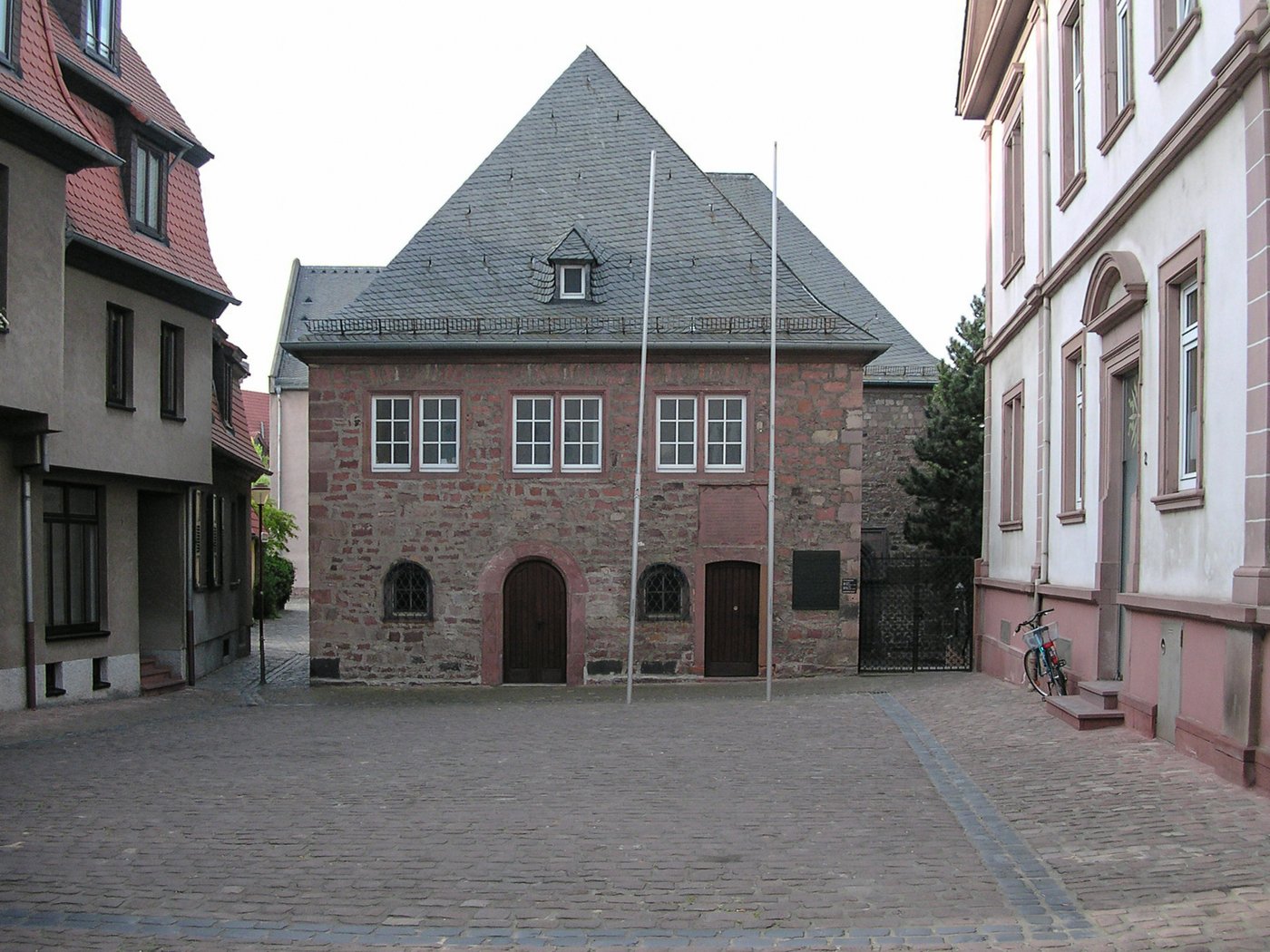
The Worms Synagogue (Rashi Synagogue)
The Worms synagogue was first built in 1034, making it one of Germany's oldest synagogue sites and the oldest known synagogue foundation in Germany. It was destroyed during the violence of 1096 and rebuilt in 1175 - the fabric of that 12th-century building survived into the 20th century. A women's annexe was added in 1213. The synagogue was destroyed again on Kristallnacht in November 1938. Rebuilt in 1961, the standing building is a reconstruction that used salvaged original stones wherever possible: medieval fabric is literally present in the walls. The synagogue is part of the UNESCO World Heritage Site inscription of 2021. It stands in the Judengasse in Worms and is open to visitors.
Worms Synagogue (Rashi Synagogue), Judengasse, Worms · First built 1034 · Rebuilt 1175 · Rebuilt again 1961 · UNESCO World Heritage Site (List 1636, inscribed 2021)The stones that stayed
The ShUM cities are not merely a story of documents and scholars. They are a story of buildings and objects - some of the oldest Jewish material remains in northern Europe, several of which are still standing, still accessible, still carrying the marks of the hands that built them.
In Worms, underground, lies a mikveh - a ritual bath - dated to 1185/86. It was cut into the earth beneath the synagogue courtyard, lined with stone, fed by groundwater. It survived because it was underground. You can visit it today. Beside the synagogue, the Heiliger Sand - the Holy Sand cemetery - holds the oldest Jewish cemetery in Europe preserved in its original location. Its oldest legible stone dates to around 1058/59. Jewish burials in the Roman catacombs elsewhere are older, but few Jewish cemeteries in Europe have such early stones preserved in situ. The grave of Meir of Rothenburg, one of the great 13th-century Talmudists, is here. Imprisoned by King Rudolf I, who demanded a ransom for his release, Meir forbade his community to pay it - reasoning that paying would simply make a business of jailing rabbis - and died in captivity in 1293. His body was ransomed and brought to Worms for burial fourteen years later, in 1307. The cemetery received him then. It holds him still.
In Speyer, below street level, the mikveh survives largely intact: built around 1120, it is the oldest mikveh of its kind north of the Alps. The carved stonework is 12th century. The structure is sound. In Mainz, the Judensand cemetery preserves burials from around 1012 onwards - the medieval community there was one of the most active of the three cities, and the grave markers span centuries. The above-ground buildings of medieval Jewish Mainz have not survived as well as those in Worms and Speyer, but the cemetery endures.
These sites were inscribed as a UNESCO World Heritage Site on 27 July 2021: "ShUM Sites of Speyer, Worms and Mainz," List 1636. The designation uses the communities' own name for themselves. The acronym that once marked alliance documents and synod resolutions is now inscribed in the international record of humanity's shared inheritance.
The Speyer Mikveh
Built around 1120, the underground mikveh in Speyer is the oldest ritual bath of its kind surviving north of the Alps. The chamber is reached by a stone staircase descending well below street level - a design that allowed the bath to be fed by groundwater, as Jewish law required. The carved stonework is Romanesque in character and largely intact. The mikveh survived the later destruction of the Jewish quarter of Speyer because it was below ground and built to last. It was excavated and restored in the 20th century and is now included within the UNESCO World Heritage Site inscription of the ShUM Sites (2021).
Speyer Mikveh, Judenbadgasse, Speyer · Built c. 1120 · UNESCO World Heritage Site (List 1636, inscribed 2021) · Open to visitorsThe foundation that remains
What the ShUM cities founded was not a building or a dynasty. It was a way of being Jewish in northern Europe - a legal culture, a liturgical tradition, a set of communal expectations that spread from the Rhine east and north until they had shaped every Ashkenazi community from Alsace to Ukraine. The customs of Rashi's France, the ordinances of the synods, the piyyutim of the Kalonymos school, the protections Rabbenu Gershom built into the structure of Jewish marriage: all of it radiated outward from these three cities on the Rhine, and all of it outlived the cities' medieval heyday by centuries.
The Worms synagogue's walls are partly original stone, preserved and reset in 1961 by people who understood what they were doing. The cemetery in the holy sand has been there for nearly a thousand years and is there now. The Speyer mikveh is below street level, cool and intact, waiting for whoever comes down the stairs. The Machzor is in Jerusalem. The ordinances are still cited. Rabbenu Gershom's enactments are still part of the legal memory of Ashkenaz.
The ShUM cities are not a memory. They're a foundation - and the building on top of it is still occupied.
Further reading