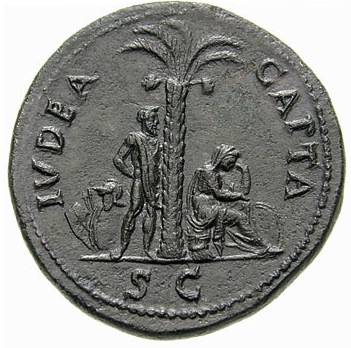
Coins are small, which is why rulers like them. A monument waits for you to come to it. A coin comes to you. It buys bread, pays wages, crosses checkpoints, drops into a purse, and repeats the same political sentence every time someone turns it over. Rome knew this. After 70 CE, it minted Judaea Capta to say that Judaea had been captured and the matter was closed.
Sixty years later, the answer came in the same medium. The Bar Kokhba administration did not simply mint new coins from blank metal. It commonly overstruck Roman imperial and provincial coins, pressing Jewish legends and symbols over the old imperial surfaces. Sometimes the Roman portrait still ghosts through beneath the new strike. That is the whole argument in one object: Rome underneath, Hebrew on top.
This was not decorative antiquarianism. It was government speech from a short-lived rebel state, dated by revolt year and crowded with claims: redemption of Israel, freedom of Israel, freedom of Jerusalem. The coins are evidence that the rebels did not think of themselves as a mob. They thought like an authority.

What an overstrike says
An overstrike is not subtle. The mint takes an existing coin, uses it as the blank, and hammers a new design onto it. The old coin is not melted, refined, and forgotten. It remains underneath as host metal. In Bar Kokhba coinage the host could be a Roman denarius, a provincial tetradrachm, or a bronze coin already carrying someone else's face and authority.
The British Museum holds one sharp example: a silver quarter-shekel or zuz from 133-135 CE, struck over a denarius of Hadrian. The museum record notes a palm branch and an undertype showing Hadrian's laureate head. That is the politics of the object. The Roman emperor is still there, but demoted into background. The new face of the coin belongs to the revolt.
The technique also tells us something practical. Rebel administrations use what they can get. The Bar Kokhba mint was not operating from the calm centre of a settled kingdom. It was working inside a war, with captured or circulating coins available as raw material. The message had to be made quickly enough to move through markets and military stores while the revolt still had a chance.
British Museum 1888,0512.36
A silver coin of the Second Jewish Revolt, described by the British Museum as a quarter-shekel or zuz, struck over a denarius of Hadrian. The visible type includes an inscription within a wreath and a palm branch; the undertype preserves Hadrian's laureate head. The record names the issuer as the Second Revolt and associates the inscription with Simon Bar Kochba. A Roman coin did not disappear. It was overwritten.
British Museum, Money and Medals · Museum number 1888,0512.36The words on the metal
The legends are the point. Dated issues speak of "Year One of the Redemption of Israel" and "Year Two of the Freedom of Israel". Undated third-year silver can carry "For the Freedom of Jerusalem". These are not private hopes. They are public slogans stamped into value. A farmer, a soldier, a tax collector, a supplier, anyone using the coin had to handle the claim.
The images do the same work. The Temple facade appears on major silver issues, even though the Temple had been destroyed for six decades. Lulav and etrog appear together, pulling Sukkot's four species into public symbolism. Grapes, palms, trumpets and lyres fill the smaller issues. The result is a compact visual grammar: Temple, festival, land, song, harvest, freedom.
This is why the coins belong beside the Bar Kokhba letters. The letters show administration in ink: orders, supplies, discipline, festival logistics. The coins show the same administration in metal. Together they make the revolt legible as a government that wrote, taxed, commanded, supplied, dated its documents, and minted its own claims.
The coin did not erase Rome. It made Rome the undertype. That was the insult and the declaration.
Types and Legends
Bar Kokhba issues include silver sela coins overstruck on provincial tetradrachms, silver zuz coins often overstruck on Roman denarii, and bronze coins in several sizes. Common images include a Temple facade, lulav and etrog, grape cluster, palm branch, palm tree, jug, lyres and trumpets. The Hebrew legends include formulas translated as "Year One of the Redemption of Israel", "Year Two of the Freedom of Israel", and "For the Freedom of Jerusalem".
Israel Museum examples; NGC Ancients overview; British Museum object recordsJerusalem on coins, not necessarily in hand
The great temptation is to let the coins settle the question we want settled. They say Jerusalem, so perhaps Jerusalem was theirs. The evidence is not that simple. The slogans show a goal and a claim. Findspots, military history, and the thin presence of Bar Kokhba coins inside ancient Jerusalem make the picture much harder.
That does not weaken the coins. It makes them more interesting. A coin can be a map of actual control, but it can also be a map of purpose. "For the Freedom of Jerusalem" is not an inventory label. It is a war aim, a rallying cry, and an argument about what the revolt meant. The rebels may not have held Jerusalem. They still minted Jerusalem as the centre of the cause.
Modern Israeli coinage later returned to these older designs in quieter form, as told in The Coin Mints Again. That later reuse is not the Bar Kokhba revolt reborn. It is a different state, in a different world, borrowing from an older archive of Jewish public symbols. The borrowings work because the ancient coins had already made the symbols political.
A Rare Jerusalem Find
In 2024 the Israel Antiquities Authority and City of David announced a Bar Kokhba bronze coin from excavations in the William Davidson Archaeological Park. The coin bears "Year Two of the Freedom of Israel" with grapes on one side and a palm tree with "Jerusalem" on the other. The report states that only four Bar Kokhba coins were known from Old City excavation contexts in that review, and that this was the only one from the area bearing the word Jerusalem.
Israel Antiquities Authority / City of David report, 21 March 2024The statement that survived defeat
The Bar Kokhba revolt ended in disaster. Roman victory was severe, the losses were immense, and Judaea was remade under Roman power. The coins did not save the revolt. They did something narrower and more durable: they preserved what the rebels said about themselves while the outcome was still undecided.
That is why these coins matter. They are not later memory smoothing a catastrophe into legend. They are contemporary objects, struck in the present tense of the revolt. They say Israel. They say freedom. They say Jerusalem. They put the Temple back into image and the festival back into public metal. They take the empire's coinage and make it carry a different sentence.
Rome won the war. The undertype is still visible. So is the overstrike.
Further reading