A coin is a state speaking in the shortest possible sentence. No speech, no manifesto, no committee minutes - just metal, image, legend, circulation. We exist. We rule here. This is our language for weight, value, memory. That is why the Judaea Capta coin mattered so much when Rome struck it after 70 CE. It wasn't merely commemorative. It was Rome's way of saying that Judaea had been brought to heel and that the matter was closed.
And that is why the answer mattered when Jewish authorities minted coins of their own in antiquity, and when a modern Jewish state later put ancient Jewish designs back into daily use. Coins are small, but they're not modest. They go where proclamations can't. They enter markets, pockets, tills, kitchens. They make sovereignty ordinary.
Rome announced an ending. The ending didn't take.
Rome's sentence
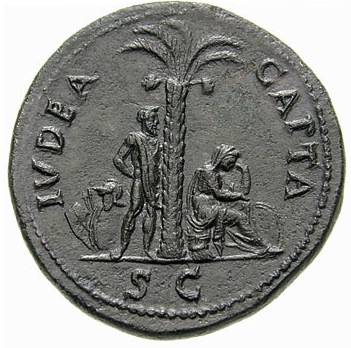
Under Vespasian and then his sons Titus and Domitian, Rome struck the Judaea Capta series for roughly twenty-five years. The types varied, but the message did not. On one familiar reverse appears a palm tree, a seated woman in mourning, and the legend IVDAEA CAPTA - Judaea captured. The province is shown as grief itself: bowed, seated, done.
It was, as propaganda goes, extremely efficient. The destruction of Jerusalem and the Temple in 70 CE was not left to rumour. Rome carved it on the Arch of Titus, wrote it into Josephus, and spent it in bronze, silver, and gold. Victory was to be read in stone and handled in change.
But this wasn't the first Jewish coinage, and it wasn't the last. Even before Rome announced capture, Jewish rebels in the Great Revolt had already minted silver shekels of their own. And after Rome's announcement, the Bar Kokhba revolt would overstrike Roman coins with Jewish symbols and Hebrew legends. The empire said finished. The mint kept objecting.
The Judaea Capta Series
Roman imperial coins struck under Vespasian, Titus, and Domitian after the suppression of the First Jewish Revolt. Surviving examples exist in bronze, silver, and gold, and the series ran for about twenty-five years. One common reverse type shows a palm tree and a mourning female figure personifying Judaea, with the legend IVDAEA CAPTA. Rome did not leave the point subtle.
British Museum and other numismatic collectionsThe first answer
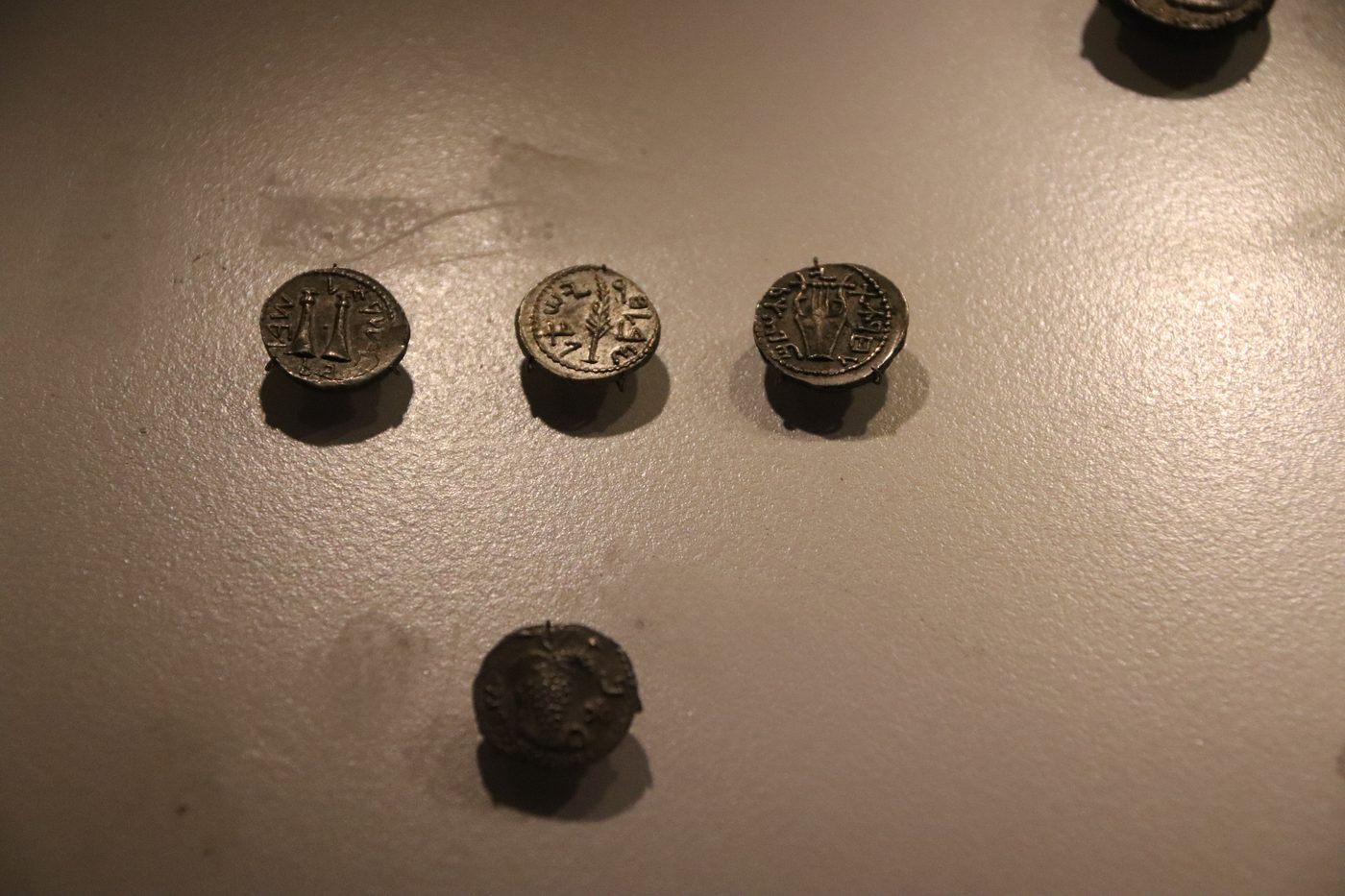
The Great Revolt coinage is what a people mints when it intends to be more than a province. The silver shekels of 66-70 CE do not ask Rome's permission for their imagery or their language. They say "Shekel of Israel". They say "Jerusalem the Holy". They date themselves by the years of the revolt, as if a new political clock has started.
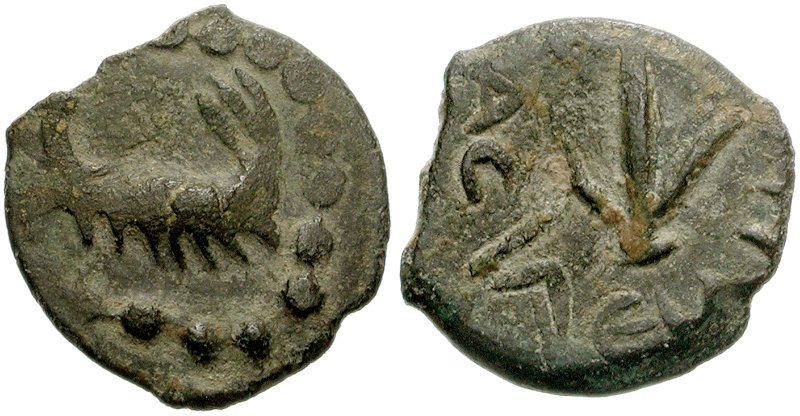
Then, sixty years after the Temple's destruction, the Bar Kokhba administration went further still. Its silver and bronze coins were commonly overstruck on existing Roman currency. The old imperial types were not always completely erased - sometimes the under-image still ghosts through - but that only sharpens the point. Roman metal, Jewish message. Among the legends are "Year One of the Redemption of Israel", "Year Two of the Freedom of Israel", and "For the Freedom of Jerusalem".
That is what makes the later modern reuse of ancient motifs more than decoration. The archive was already there. Palm trees, lulavs, etrogim, lilies, lyres, menorot, the very word shekel - all of it had once been minted in moments when Jewish political existence was being asserted out loud.
Rome struck the past tense into its coins. The Jewish answer was to mint the future anyway.
Silver Shekel of the Great Revolt
Jewish rebel silver coinage from the First Jewish Revolt, dated by year and inscribed in Paleo-Hebrew. The principal type bears a chalice with the legend "Shekel of Israel" and, on the reverse, three pomegranates with "Jerusalem the Holy". These coins were struck in the revolt's first year in silver denominations of shekel, half-shekel, and quarter-shekel. The state, such as it was, had already found its voice.
Israel Museum and other numismatic collectionsBar Kokhba Revolt Coinage
Silver and bronze coins issued by the Bar Kokhba administration, commonly overstruck on Roman coins and inscribed in Hebrew using archaic script. First-year silver tetradrachms pair Temple imagery with lulav and etrog and the legend "Year One of the Redemption of Israel". Later issues carry "Year Two of the Freedom of Israel" and, on undated coins, "For the Freedom of Jerusalem". The overstrike is the point: Rome's coin underneath, Jewish sovereignty on top.
Israel Museum, Jerusalem; Israel Antiquities Authority findsThe second answer
When the modern Israeli shekel replaced the Israeli pound on 24 February 1980, an old word came back into official use. When the new sheqel series entered circulation on 4 September 1985, ancient Jewish motifs came with it. This was not an accidental fondness for antiquities. The Bank of Israel's own catalogue is explicit about the borrowings.
The 5 agorot coin used a replica of a fourth-year revolt coin showing a lulav between two etrogim. The 10 agorot used a replica of a coin of Mattathias Antigonus with a seven-branched candelabrum. The 1 new sheqel used the lily and the ancient Hebrew word Yehud. Then, on 7 February 1995, the 10 new sheqalim coin added a palm tree with two baskets of dates and the words "for the redemption of Zion" in ancient and modern Hebrew.
That last one is almost indecently neat. Rome had once used the palm to frame Judaea as conquered. The modern coin uses a palm again, but now on a sovereign coin issued by the Bank of Israel. Same region of symbols. Entirely different grammar.

10 New Sheqalim
A circulating Bank of Israel coin whose obverse shows a palm tree with seven leaves and two baskets of dates, together with the words "for the redemption of Zion" in ancient and modern Hebrew. Its reverse carries the denomination. The design sits within a modern central-bank issue; the imagery does not. It comes straight out of the old Jewish coin chest.
Bank of Israel, Coins CatalogueThe ending that didn't hold
None of this undoes the destruction of 70 CE. The Temple was burned. Jerusalem was wrecked. The Judaea Capta coin was not bluffing about the scale of the catastrophe. But it was bluffing about finality. That is the important distinction.
Rome minted capture. Jewish rebels minted Israel and Jerusalem. Later Jewish rebels minted redemption and freedom over Roman silver. Then, after a gap of many centuries, a modern Jewish state minted shekels again and chose ancient Jewish designs for its everyday coinage. The argument is right there in the metal. Rome's sentence was grammatically complete. Historically, it failed.
The coin mints again. That is the answer.
Further reading