Most cities are scenery. Things happen in front of them, against them, around them, and the city holds still and lets the history pass through. Jerusalem does not hold still. In the Jewish story it behaves like a person: chosen, crowned, loved, betrayed, mourned, sung to, dreamed about, walked toward across continents and centuries. It is not the stage on which the drama happens. It is in the cast. You cannot tell the story of the tribe with Jerusalem in the background, because Jerusalem keeps stepping forward and taking lines.
That is the unusual thing this article is about, and it is worth saying plainly before the dates begin. The tribe did not merely live in this city. It built an entire grammar of returning to it. Three times a day the prayers turn toward it. Every wedding breaks a glass for it. Every Seder ends with next year in it. A people scattered across the whole earth agreed, without a head office to enforce it, to face one set of coordinates and keep facing them for two thousand years. No other city has been loved quite like that, for quite that long, by quite so many people who were not allowed to live in it.
So Jerusalem is at once the most concrete place imaginable - a real city of limestone and dust, with gates you can walk through and a wall you can touch - and the most portable. It travelled in the prayer book to every place the diaspora reached, and it stayed exactly where it was the whole time. Both of those are true at once, and the friction between them is most of what makes the city what it is.

The chosen city
The city enters Israelite history as a capital taken, not founded. The Bible has David capture the Jebusite stronghold and make it his royal seat - a shrewd choice, a city belonging to none of the twelve tribes and so able to belong to all of them. His son Solomon built the First Temple there, and in that act Jerusalem became something no purely political capital ever is: the single place on earth where the cult was meant to happen, the address of the divine presence, the centre toward which everything else was oriented. A capital can be moved. This could not. The whole later geography of Jewish longing is downstream of that decision.
Then came the first great wound, and with it the strange discovery that would define everything after. In 586 BCE the Babylonians destroyed the Temple and carried much of the population into exile. By every normal rule of the ancient world, that should have been the end - gods who lost their cities and their temples were understood to have lost, and their peoples dissolved into the victors. Jerusalem's exiles did the opposite. By the rivers of Babylon they sat and wept and swore not to forget, and the city that had been lost on the ground became unlosable in memory. Exile did not erase Jerusalem. It promoted it.
The First and Second Temples
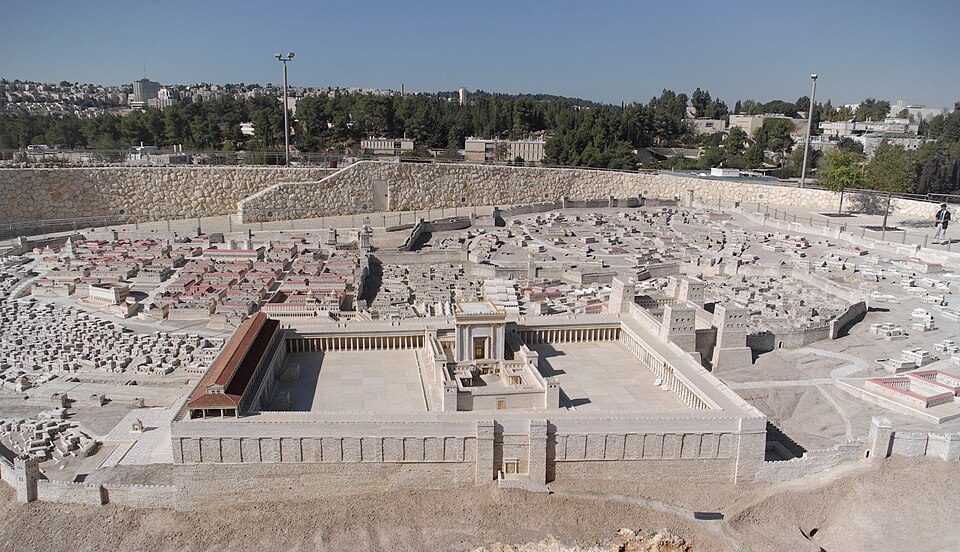
Tradition places Solomon's First Temple in the tenth century BCE; it was destroyed by the Babylonians in 586 BCE. The Second Temple was built by returning exiles under Persian rule, dedicated around 516 BCE, vastly expanded by Herod the Great, and destroyed by the Romans in 70 CE. The retaining wall of Herod's Temple Mount survives as the Western Wall, the holiest accessible site in Judaism and a place of Jewish prayer ever since.
Temple Mount, JerusalemThe city you carry
After the Romans destroyed the Second Temple in 70 CE and crushed the Bar Kokhba revolt sixty years later, Jews were largely barred from the city, which the emperor Hadrian rebuilt as a pagan colony and renamed Aelia Capitolina. Here the trick the exiles had learned in Babylon became permanent policy. If you cannot stand in the city, you build it into everything you do. The synagogue is oriented toward it. The liturgy mentions it constantly. The wedding glass shatters in its memory. Mourners sit on the floor for it once a year on the ninth of Av. A whole civilisation taught itself to keep an address warm by sheer force of attention.
This is the deepest thing about Jerusalem in the Jewish story, and it is the opposite of helplessness. A people deprived of a place does not have to lose it. It can carry the place. For nearly two millennia the tribe carried Jerusalem in the prayer book the way you might carry a photograph of a house you intend to come back to, and the intention never lapsed into metaphor. Three times daily, somewhere on earth, someone was facing it and meaning it.
Aelia Capitolina
After suppressing the Bar Kokhba revolt, the emperor Hadrian refounded Jerusalem as a Roman colony named Aelia Capitolina and barred Jews from entering it on pain of death. The renaming is recorded by the Roman historians and confirmed by coins and inscriptions bearing the colony's name. The city was taken from its people in stone and in law. It was not taken from their prayers, which is the only place that ultimately mattered.
Roman histories, coins and inscriptionsThe remembered place made lived again
And yet it was never only remembered. Through every century of exile there were Jews who actually lived in the city, prayed at the Wall, taught in its study houses and were buried on the Mount of Olives facing the Temple Mount, where tradition says the resurrection will begin. The medieval and early modern community - the Old Yishuv - kept the prayed-toward place a lived-in place as well, poor and stubborn and present. By the mid-nineteenth century Jews were the largest community in the city. The longing had never been purely abstract. Somebody was always there, keeping the address occupied.
In 1948 the city was divided, and for nineteen years Jews were barred from the Old City and the Western Wall by the Jordanian armies that held it. In 1967 that access was restored, and the strangest scene in the whole long story played out: soldiers reaching the Wall and weeping against stones their people had faced in prayer, from continents away, for two thousand years without a break. Whatever one makes of the politics that followed, the human fact underneath it is hard to match anywhere. A city loved at that distance, for that long, finally touched.
That is why Jerusalem cannot be filed under capital, shrine or battlefield, though it has been all three. It is the address through which law, memory, kingship, exile and prayer keep recognising one another - the fixed point a scattered people agreed to orient by, and never once removed from the map of longing. A protagonist, in the end, is simply the character the story cannot proceed without. By that test, Jerusalem qualifies.
Other peoples remember the cities they have lost. The tribe never agreed that Jerusalem was lost in the first place.
Further reading