People call it the last wall of the Temple, which is understandable and not, strictly speaking, true. The Temple stood above. The Wall stood around. What survives at the Kotel is part of the western retaining wall of the vast platform Herod built when he remade the Temple Mount on a scale large enough to impress Jerusalem, Rome, and very likely himself. It is magnificent work. It is also a piece of engineering with a devotional afterlife no engineer could have drawn up in advance.
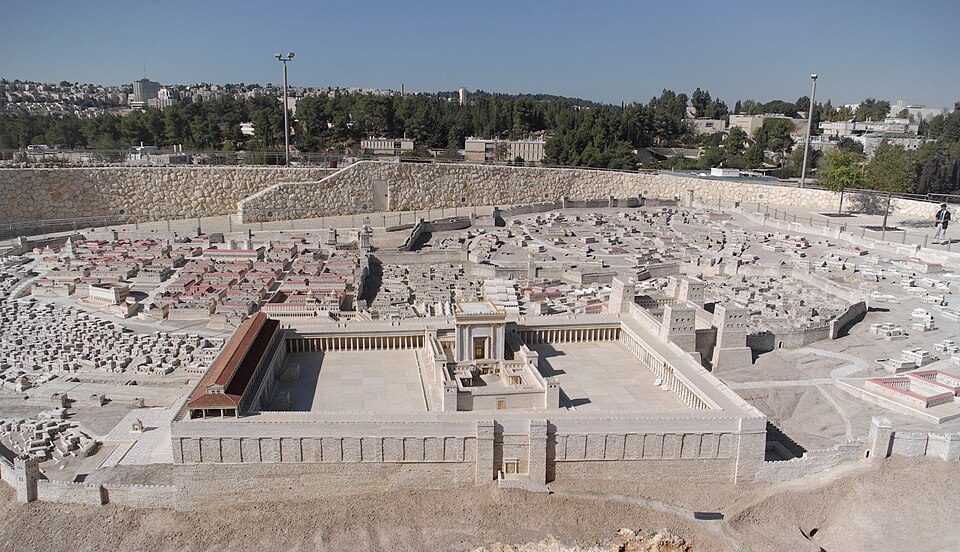
Herod began the expansion around 19 BCE. The old hilltop was not broad enough for the monument he wanted, so he squared and enlarged it with immense retaining walls, then filled the space behind them to create a great artificial platform. The Temple, rebuilt and enlarged, sat on that raised expanse. The Wall below was not sanctuary furniture. It was the thing that made the sanctuary's stage possible.
That distinction matters because it sharpens, rather than diminishes, the Wall's force. It is not holy by confusion. It is holy because it is what endured. When the Romans destroyed the Temple in 70 CE, the building and its courts were broken, burned, and plundered. The supporting perimeter remained in part because it was harder to erase and because a retaining wall has the stubborn habit of doing its job even after history has changed employers.

The Herodian Ashlars
The great lower courses of the Wall are built from meleke limestone blocks cut in the Herodian manner, with neat drafted margins framing a slightly projecting face. They belong to the retaining system of the expanded Temple Mount, not to the Temple building itself. Along the western side, the surviving wall once held back the fill behind Herod's enlarged platform. The stones do not need a sermon. They are already giving one.
Western Wall Heritage Foundation; Israel Antiquities AuthorityWhat the Wall actually is
Seen close up, the point becomes plain enough. The Wall is built of enormous structural blocks laid in long, disciplined courses. It does not read like an interior wall, or even like the wall of a single building. It reads like the side of a mountain that has been taught good manners. Herod's project was less a renovation than a remaking of terrain.
That is why the Wall could outlive the Temple it served. The sanctuary on the mountaintop was the visible glory. The retaining walls were the buried confidence underneath. In Roman victory processions the spoils mattered more than the substructure, and Josephus makes plain what was carried off after the city's fall - sacred vessels, gold, the things that could be displayed. The platform's edge did not march to Rome. It stayed where it was put.
Over time that endurance altered Jewish geography. Since the mount above was either inaccessible, forbidden, or both, the Wall became the nearest open place of approach to the site long identified with the Holy of Holies. Not the innermost room itself, of course. The closest surviving point one could actually come to, stand by, weep at, and address heaven from. A retaining wall became a threshold.
Prayer before the stones
By the medieval and early modern periods, Jewish devotion was directed toward the Temple Mount's surviving walls. Benjamin of Tudela, writing around 1170 CE, records Jews praying before a wall at the Temple precinct, but the exact wall he meant is disputed; clear sources for prayer at the present Western Wall location become firm from the 16th century onward. Later travellers and residents are less ambiguous. By the Ottoman centuries, Jews were regularly gathering there on Sabbaths, festivals, fast days, and Fridays, pressing up against the stone in a narrow lane, not yet in the broad plaza a modern visitor expects.
The devotion was not architectural pedantry. No one came because the retaining wall solved a difficult topographical problem. They came because this was what remained nearest to absence. The Temple had gone. The longing had not. So the prayer moved to the edge that endured, and the edge took on a life of its own.
That is the Wall's particular dignity. It does not pretend to be the sanctuary. It is the survivor standing nearest the place where the sanctuary was. Jewish practice has always been good at recognising that distinction and praying through it anyway.
The Wall is not the Temple's last room. It is the structure that kept the mountain in place.
Benjamin of Tudela's Jerusalem Notice
In his itinerary, Benjamin of Tudela describes Jews coming to pray before the Wall at Jerusalem. The exact topographical referent is debated, but the passage matters because it preserves a medieval Jewish witness to prayer directed toward the surviving edge of the Temple precinct. By later centuries, other Jewish accounts describe regular worship at the Wall with much less uncertainty. Pilgrimage has a habit of settling its own map.
The Itinerary of Benjamin of TudelaNotes in the cracks
The slips of paper came later. The custom of placing notes in the Wall is traditionally traced to the early 18th century. The earliest commonly cited account, preserved in a later retelling, says Rabbi Chaim ibn Attar instructed a petitioner to place an amulet or written petition between the stones. Since then the custom has become one of the site's small, unmistakable liturgies - folded paper, narrow crack, hand withdrawing a fraction more slowly than it arrived.
It is an intimate habit for such public stone. The Wall carries the grand weight of Herodian ambition and Roman destruction, but the notes are tiny. That feels right. Jewish history often does. A retaining wall built for a king now holds private petitions in dozens of languages, most of them too small to read and none of them asking the stone to become something it is not.
So the Wall remains itself: not the Temple, not a substitute for the Temple, not a misunderstanding waiting to be corrected by better labelling. It is the surviving western edge of Herod's enlarged mount, the closest accessible place of prayer to the lost heart of the sanctuary, and the stone before which generations have stood because endurance is also a form of holiness. The building above it fell. The Wall kept faith with gravity and, in time, with us.
Further reading