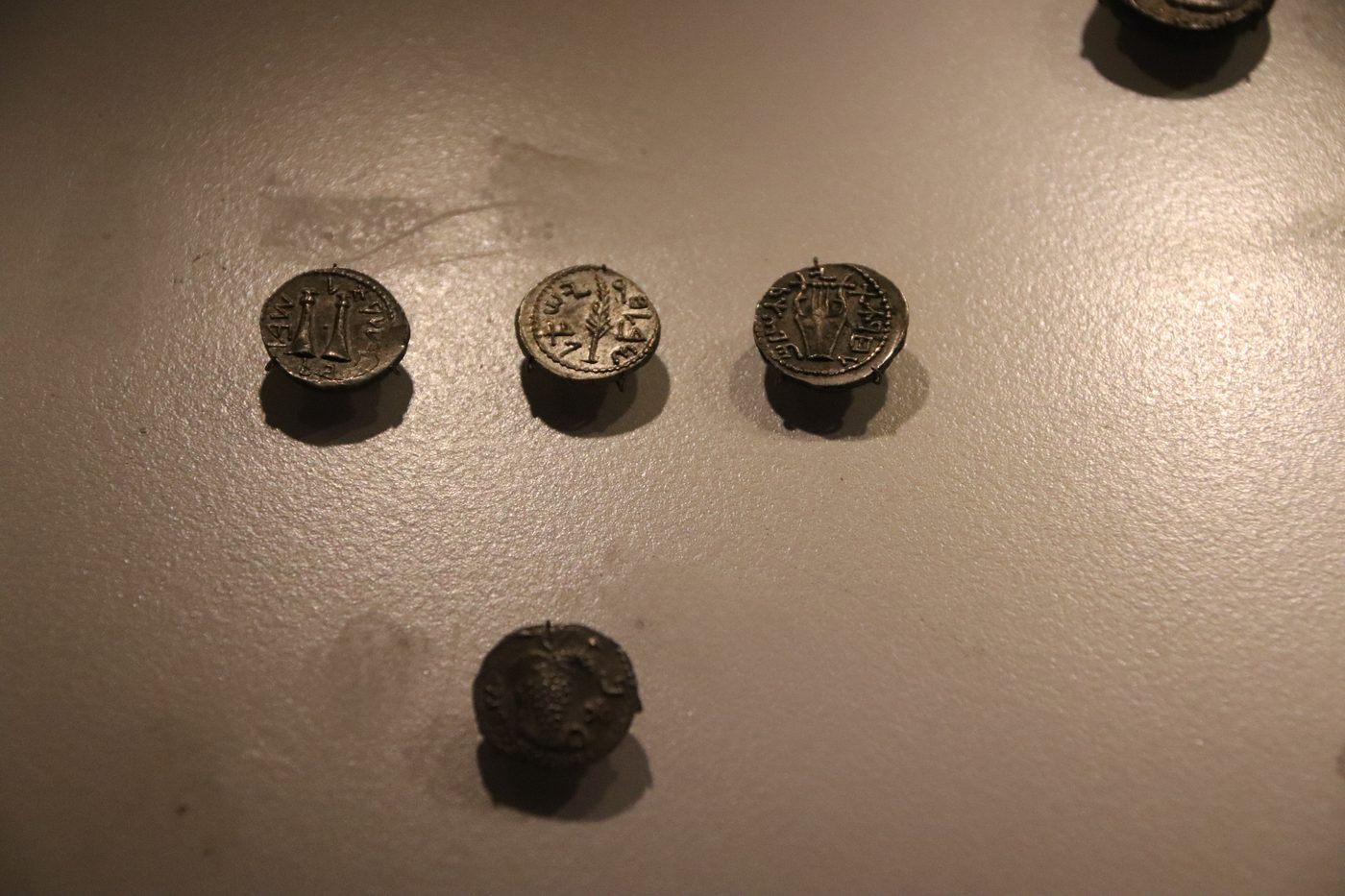
Hold a Judaea Capta coin and you are holding one of the most considered pieces of propaganda the ancient world ever produced - a small bronze or silver disc that Rome pressed into service as a message, struck on a very large scale and sent to circulate across an empire that stretched from northern Britain to Mesopotamia. On one side, the emperor's portrait and his titles. On the other, a woman seated under a palm tree, her head bowed, her posture the posture of defeat. Beneath her, two words: IVDAEA CAPTA. Judaea captured.
The coins bearing the IVDAEA CAPTA legend were struck from 71 CE onwards, under the emperor Vespasian and his son Titus, to commemorate the suppression of the Jewish revolt and the destruction of the Temple in Jerusalem in 70 CE. They are among the most widely distributed Roman imperial propaganda issues ever minted - appearing in hoards and collections from Britain to Egypt, from the Rhine frontier to the Euphrates. Every market, every barracks, every tax office in the empire was a potential venue for Rome's announcement. The announcement was: it is done. The Jewish resistance is over. Judaea is captured. There is nothing more to say.
And then the extraordinary thing happened, which is that there turned out to be quite a lot more to say, over the following two thousand years, by the people the coin had been designed to write out of history. The coin meant to announce a permanent end announced nothing of the sort. But that is getting ahead of the object. Start with what is on it.

What the coin shows
The iconography of the Judaea Capta series is consistent enough to be a programme. The reverse - the face opposite the emperor - typically shows a palm tree at the centre. The palm was Rome's shorthand for Judaea, a geographical emblem that appeared on Jewish coins of the period and was well enough understood across the Mediterranean that no label was strictly needed. Rome kept the label anyway.
To one side of the palm tree sits a female figure. She is dressed, but her pose is unmistakable: head bowed or resting on one hand, shoulders slumped, the seated posture of someone who has given up. This is Judaea personified - the province rendered as a woman in mourning. To the other side of the tree stands a Roman soldier, armed and upright, sometimes with one foot resting on a helmet, sometimes holding a spear. The contrast is architectural. One figure is vertical, dominant, active. The other is horizontal, collapsed, passive. Between them, the palm tree stands as a kind of full stop.
This feminisation of a defeated province was not accidental and not unusual in Roman iconographic practice - conquered territories were regularly figured as women in Roman art, rendering them available for the kind of gendered language of submission that Roman audiences understood immediately. What made the Judaea Capta series unusual was the scale of its production and the specificity of its target. This was not a generic image of conquest. The palm tree identified the province; the legend named it; the coins went to every corner of the empire. It was a messaging operation of a kind that Rome had not previously mounted with quite this intensity for any single conquest.
The Judaea Capta Series
A series of Roman imperial coins struck under the Flavian emperors Vespasian (69-79 CE) and Titus (79-81 CE) and, in smaller numbers, Domitian (81-96 CE). Issued in gold (aureus), silver (denarius), and bronze (sestertius and smaller denominations). The reverse consistently features a palm tree flanked by a mourning female figure (Judaea personified) and a Roman soldier or trophy, with the legend IVDAEA CAPTA or DE IVDAEIS. Surviving examples appear in collections worldwide, including the British Museum, the Israel Museum Jerusalem, the American Numismatic Society, and numerous European institutions. The series is among the most extensively documented Roman imperial propaganda issues.
British Museum (Department of Coins and Medals); Israel Museum, Jerusalem; American Numismatic Society, New YorkWhy Vespasian needed this war
The Judaea Capta coins were not merely celebrating a military success. They were performing a political necessity. To understand what is at stake on the coin, you need to understand the year 69 CE, which Rome called the Year of the Four Emperors - Galba, Otho, Vitellius, and finally Vespasian, each ascending by coup or by the violence of their armies, each dying by the same means except the last. When Vespasian finally secured the throne, he was a general from an undistinguished Italian family with no Julian blood, no hereditary claim, and no divine ancestry to invoke. He needed to explain why he was emperor.
The Jewish War was the explanation. Vespasian had been given command of the suppression of the revolt in Judaea by Nero in 67 CE. When the civil wars began and Nero died, Vespasian's legions proclaimed him emperor - his legitimacy was, in the first instance, the legitimacy of military success and the loyalty of eastern armies. The conclusion of the war, achieved by his son Titus, who captured and destroyed Jerusalem in 70 CE, was therefore not incidental to Flavian dynastic claims. It was their foundation. The Jewish War was the argument for why this family deserved to rule Rome.
Titus returned to Rome in 71 CE and the city celebrated with a triumph - the formal procession of a victorious general through the streets of Rome, displaying captives and spoils before a cheering public. The spoils of the Jerusalem Temple were carried through the streets: the great menorah, the Table of the Showbread, the silver trumpets. All of this is recorded in the Arch of Titus, which still stands at the entrance to the Roman Forum, and it is recorded on the coins. The three sources - the arch, the coins, and the account of the historian Josephus, who witnessed the war and described the triumph - form a triangle of independent corroboration remarkable in the ancient world. The events of 70 CE are among the most multiply-attested in Roman history.
The Jewish War was not the backdrop to Flavian power. It was the argument for why this family deserved to rule Rome at all.
Humiliation as fiscal policy
The coins were only one instrument of what Rome deployed after 70 CE. The other was money - specifically, a fiscal mechanism of considerable ingenuity and considerable cruelty. Before the war, adult Jewish men throughout the empire had been accustomed to paying a half-shekel annually to the Temple in Jerusalem: a religious tax that supported the Temple's upkeep, its priesthood, its sacrificial programme. It was paid by Jews in Rome, in Alexandria, in Antioch, in Babylon - wherever Jews lived, the half-shekel went to Jerusalem. It was a practice that connected the diaspora to the Temple and the Temple to the diaspora, the annual thread that made a scattered people into a single community of obligation.
After the Temple's destruction, Vespasian did not simply abolish this tax. He redirected it. Every Jew in the empire - men, women, and children, according to the historian Josephus and later Roman sources - was now required to pay the equivalent of two drachmas annually to the temple of Jupiter Capitolinus in Rome. The fiscus Judaicus, the Jewish treasury, was a new institution administered by the Roman state: a mechanism for collecting a Jewish religious tax and routing it to the chief temple of the Roman pantheon. You will pay what you used to pay to your God, and you will pay it to ours. The humiliation was not incidental. It was the point.
The fiscus Judaicus was enforced with varying intensity. Under Domitian it became notably harsh, with enforcement agents reportedly investigating whether individuals had Jewish ancestry to ensure no one escaped liability. Under Nerva, who succeeded Domitian in 96 CE, enforcement was relaxed and a coin was struck - with the legend FISCI IVDAICI CALVMNIA SVBLATA, "the malicious accusation of the Jewish treasury removed" - suggesting the tax had become a mechanism for personal harassment beyond its original scope. The tax itself continued for decades, perhaps into the second century.
The Fiscus Judaicus
Following the destruction of the Temple in 70 CE, Vespasian converted the half-shekel Temple tax previously paid by Jews throughout the empire into a tax payable to the temple of Jupiter Capitolinus in Rome. The tax was levied at two drachmas (equivalent to the original half-shekel) per person, applying to Jewish men, women, and children across the empire. Ancient sources for the fiscus Judaicus include Josephus (Jewish War 7.218), Suetonius (Domitian 12), Cassius Dio (Roman History 66.7.2), and an Egyptian papyrus (CPJ 160) recording a payment. Enforcement was tightened under Domitian and relaxed under Nerva, who struck coins referencing the reform.
Sources: Josephus, Suetonius, Cassius Dio; papyrological evidence from Roman EgyptEvery market stall in the empire
The Judaea Capta coins were not commemorative objects kept in a cabinet. They were money - actual currency, struck in denominations from the gold aureus used in large transactions to the small bronze sestertius and its fractions that passed through ordinary hands daily. They circulated. Merchants took them in payment; soldiers received them as wages; provincial tax collectors accepted them from farmers. In the decades after 70 CE, across an empire that stretched from Hadrian's Wall to the Euphrates, IVDAEA CAPTA was standard change.
This means that Jews throughout the empire - in the diaspora communities of Rome, Alexandria, Antioch, and a hundred smaller cities - would have handled these coins in the ordinary course of daily life. A Jewish bread seller in Rome accepting payment; a Jewish tax collector in Alexandria making change; a Jewish trader in Antioch counting his receipts. The coin was inescapable. It was not possible to participate in the Roman economy and avoid it. Rome had ensured that the message of conquest was embedded in the medium of exchange itself.
Scholars estimate the Judaea Capta series was minted on a very large scale, though precise figures are impossible to establish from surviving evidence. The coins appear in archaeological finds across a vast geographic range - Britain, the Rhine and Danube provinces, Egypt, Syria, and beyond - suggesting a distribution that matched the empire's own reach. Surviving examples in museum collections number in the thousands; the original production was presumably many times that. Whatever Rome spent on advertising its victory over Judaea, it spent it on coins.
The coin's long argument with itself
What is extraordinary about the Judaea Capta series is not what it said but what it failed to achieve. The coins were a declaration of termination. The imagery, the legend, the fiscal apparatus of the fiscus Judaicus - all of it was organised around the premise that the Jewish people, as a people with a homeland, a Temple, and a national existence, were finished. The seated woman under the palm tree is not a temporary setback. She is an announcement. Judaea is captured. It is in the past tense. Move on.
And yet: the coins themselves are the evidence. Not evidence of the conquest - that is the intended reading - but evidence of the people who handled them and kept going. The same coins that circulated through Jewish communities across the empire are the record of those communities' existence. Jewish merchants were buying and selling with them. Jewish households were paying taxes with them. The diaspora that Rome's victory was supposed to have eliminated from significance was, coin by coin, transaction by transaction, still there.
The seated Judaea on the reverse of the coin did not stand up for a long time. The military, political, and demographic catastrophe of 70 CE was real, and its consequences echoed through centuries. The fiscus Judaicus was a real humiliation, paid by real people who had no choice. None of this should be minimised. But the coin's claim - that the account was closed, the verdict delivered, the story over - was wrong. The people minted onto their conqueror's coinage as a defeated province kept hold of their identity, their texts, their calendar, their obligations. They took the coin and they went on.
The coin meant to announce a permanent end announced nothing of the sort.
The Arch of Titus, Rome
A triumphal arch dedicated by the emperor Domitian after the death of his brother Titus in 81 CE, commemorating Titus's capture of Jerusalem in 70 CE and the subsequent triumph of 71 CE. Located at the summit of the Via Sacra at the entrance to the Roman Forum. The inner relief panels depict the triumphal procession in detail, including Roman soldiers carrying the Temple menorah, the Table of the Showbread, and silver trumpets. The menorah is shown seven-branched, set on an elaborate stepped base decorated with mythological creatures; Josephus, who saw the object carried in the triumph, notes that its construction had been changed from the Temple original, and the relief's ornate base does not match the form he describes. The arch's imagery is otherwise consistent with the reverse iconography of the Judaea Capta coinage series, providing independent corroboration of the events of 70-71 CE. The arch stands in situ and remains accessible today.
Via Sacra, Roman Forum, Rome - in situFurther reading