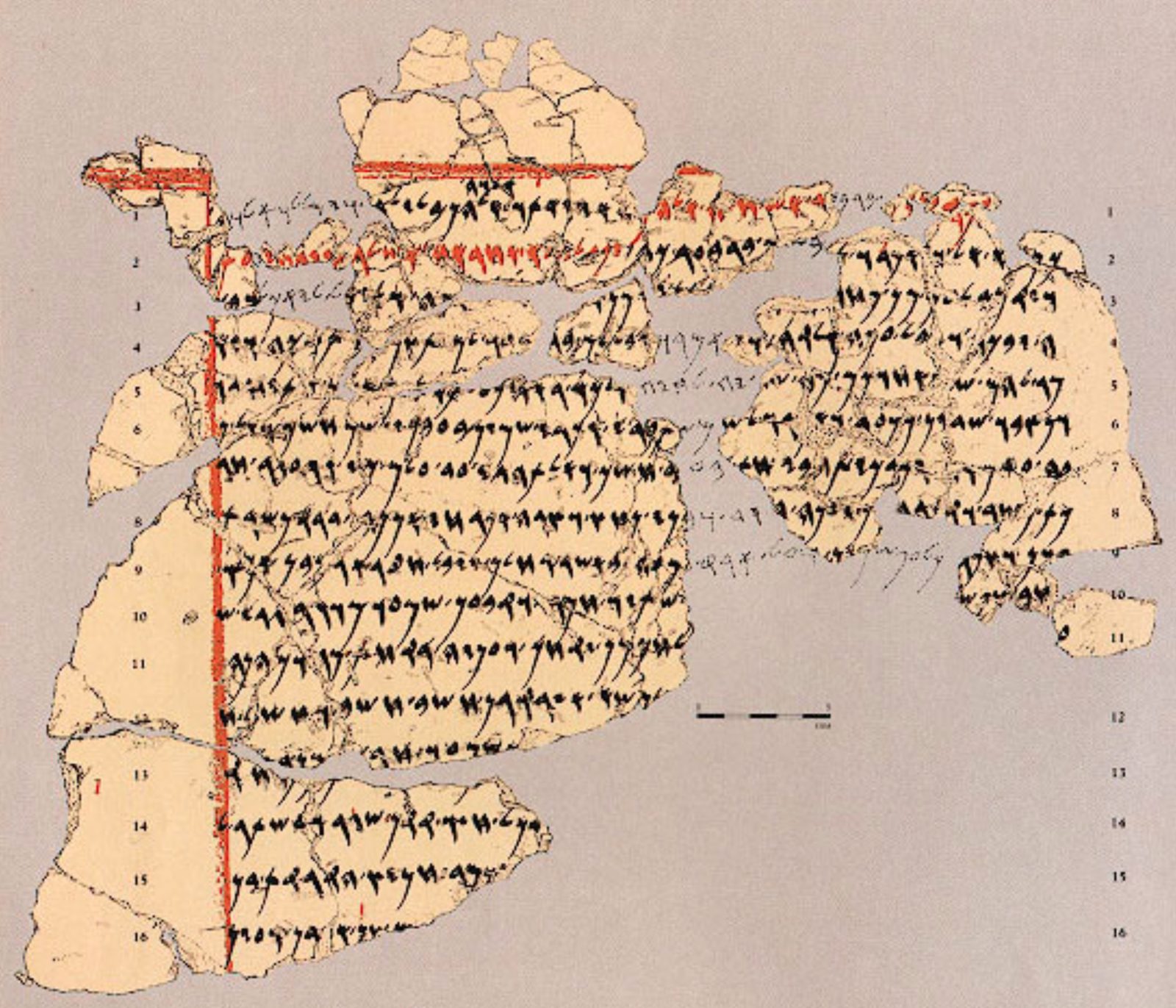
It is not much to look at. A broken piece of pottery, written on in ink, found in 2008 on a fortified hill above the Elah Valley. But that is exactly the point. Ancient history does not live by monumental inscriptions alone. It also lives by scraps, lists, exercises, instructions, the sort of writing done on whatever was to hand. The Khirbet Qeiyafa ostracon is precious because it lets that smaller world flicker into view - not a king on a triumph stele, but a fortified site where someone expected ink to matter.
Khirbet Qeiyafa sits on a borderland route between the Judean hills and the Philistine plain, near the valley where the David and Goliath story later locates its duel. Excavators uncovered a strongly fortified site there, occupied for a relatively short period in the late 11th or early 10th century BCE. Among the finds was this ostracon: a potsherd bearing five lines of inked text in a very early Northwest Semitic script. That dating is what gives the object its voltage. By the standards of alphabetic writing in the southern Levant, this is old enough for every confident label to become a scholarly knife-fight.
The temptation is to ask one prosecutorial question and nothing else: is it Hebrew? Some scholars have argued yes, seeing early Hebrew vocabulary or grammar and treating the sherd as evidence for literacy in the formative Judahite world. Others push back, reading it instead as Canaanite, as a list of names, as a scribal exercise, or as an undifferentiated early Northwest Semitic text from a period before our neat language boxes can bear much weight. Fair enough. The ostracon remains important either way. A fortified site does not become less interesting because its letters arrived before the philologists finished arguing about their accent.

Five lines, many arguments
The inscription survives in five lines, but survival is not the same as legibility. The sherd is broken, the ink faded, and some letterforms are difficult enough that scholars do not even begin from the same alphabetic certainty. That means disagreements stack on top of one another. First, which letters are actually there. Then where the word breaks fall. Then what language those words belong to. Then whether the text is legal, ethical, administrative, literary, or some mixture of the lot. By the time a translation reaches the page, it has already crossed several unstable bridges.
One influential reading hears social language in the text - injunctions concerning widows, orphans, strangers and the poor - and therefore a moral vocabulary familiar from later biblical Hebrew. Another treats that confidence as premature, arguing that the text is too fragmentary for such a polished translation and that the language could just as plausibly belong to a broader Canaanite continuum. This is not a minor academic spat. It is the difference between seeing a very early Hebrew composition and seeing a regional alphabetic text from a world whose dialect boundaries had not yet settled into the names we prefer to give them.
The object can carry that uncertainty. In fact, it is more useful when it does. Evidence from the early Iron Age is often like this: a shard, a handful of letters, a site with just enough architecture to sharpen the stakes. The honest claim is not that the debate has been resolved. The honest claim is that writing of this kind was happening here, in this fortified place, at this early date. That alone tells us that communication, practice or instruction had already reached the level of ink on clay in the border zone.
The Khirbet Qeiyafa ostracon
An ink inscription written across five lines on a pottery sherd found in 2008 at Khirbet Qeiyafa in the Elah Valley. Its script belongs to the early alphabetic world of the southern Levant, and the object is widely treated as one of the earliest substantial inscriptions from a site some excavators link to Judah, though that identification is disputed. The reading, language classification and translation remain disputed. The sherd has not asked anyone's permission to be difficult.
Khirbet Qeiyafa excavation; early Northwest Semitic inscriptionWhy the argument does not cancel the object
There is a bad habit in public history of treating disputed evidence as if it were therefore useless. It is a habit born of courtroom television. The Khirbet Qeiyafa ostracon is a good corrective. Even if no consensus ever emerges on a full translation, the object still matters for three solid reasons. First, it anchors writing at a fortified site in the Elah Valley at a very early date. Second, it shows written practice in a place where daily organisation mattered, without proving exactly what task the sherd performed. Third, it shows just how compressed and unfinished the political and linguistic map of the region still was in this period.
If the text is early Hebrew, that matters because it would push written Hebrew activity or ethical instruction firmly into the southern highland horizon. If it is instead a broader Canaanite or otherwise early Northwest Semitic text, that matters too, because it still documents writing, scribal practice and cultural traffic in the very zone where later Judahite statehood took shape. Either reading leaves us with a border fortress that was not merely piling stones but also moving words around.
That is the real force of the sherd. It belongs to the part of history where institutions are still making themselves visible in scraps. Not yet libraries. Not yet archives by the roomful. Just a piece of pottery and five lines of ink, enough to show that someone here expected language to do work beyond speech. Once you have that, a society is no longer only a story told backwards from its later texts. It begins to acquire written habits.
Khirbet Qeiyafa as context
The inscription was not found in isolation but within a short-lived fortified settlement overlooking the Elah Valley. Excavators have argued for a late 11th or early 10th century BCE date based on ceramics, stratigraphy and radiocarbon samples. That context matters as much as the text itself. A difficult inscription from a secure horizon is still a secure horizon.
Elah Valley border fortress; radiocarbon and stratigraphyThere is also something fitting about the material modesty of the thing. Royal inscriptions are built to survive because they know they are important. Ostraca survive almost by accident, which makes them better at startling us. This one does not tell us everything we want to know about language, kingship or early Judah. It tells us something smaller and therefore, in its way, more intimate: somebody at this hilltop fortress had reason to write on a potsherd, and someone else thought the result was worth keeping long enough for it to end up in the archaeological record.
For a site standing on a frontier, that feels exactly right. Borders are where communities learn to count, store, command and warn. They are where speech begins to harden into document. The Khirbet Qeiyafa ostracon is not the whole story of an emerging polity. It is only a shard. But shards are how old worlds usually introduce themselves.
Further reading