There is a moment in the ninth century that most history books pass over in a paragraph, yet it contains the seed of half the Jewish world as it would exist for the next thousand years. The Carolingian dynasty, heirs of Charlemagne, needed merchants - people who could move goods and coin across the vast, half-organised space of the Frankish empire, who had contacts in the Mediterranean world and in the Islamic east, who could be trusted to operate under contract rather than clan loyalty. They found them, in no small part, among Jewish traders who had been edging northwards from Italy and the Rhone valley for a generation or more. And so the emperors did something unusual: they wrote it down. They issued formal charters - privilegia - granting Jewish merchants named protections under the crown, the right to trade freely, to employ Christian workers, to maintain their own courts for internal disputes, and to practise their religion without interference from local clergy who might otherwise make things difficult.
Louis the Pious, son of Charlemagne, was the principal architect of this policy. He was a devout man - the epithet is not ironic - who genuinely believed that Jews should be protected precisely so that they might eventually be persuaded, by good example and patient argument, to convert. The motive was theological. The effect was something else entirely. By writing commercial and legal protections for Jewish communities into Frankish imperial law, Louis created the first durable framework in which a Jewish population could establish itself north of the Alps with something approaching security. The Rhine valley communities that would eventually produce the greatest rabbinical scholars of the mediaeval world - Mainz, Worms, Speyer, the constellation known to later Jews as ShUM - began to crystallise in precisely this administrative window.
The record
Several imperial charters (privilegia) issued under Louis the Pious between 814 and 840 CE survive in Carolingian administrative records, granting named Jewish merchants freedom of movement, the right to trade at fairs, protection of their property and persons, permission to observe the Sabbath and Jewish festivals, and access to imperial justice. The most studied of these, issued in the 820s, granted the merchant Abraham and his associates rights to travel, employ staff, and trade throughout the empire. The charters were counter-signed by imperial missi (royal agents) and were intended to override local episcopal interference. They are edited and analysed in Bernhard Blumenkranz, Juifs et Chrétiens dans le monde occidental, 430-1096 (Mouton, 1960), and in Michael Toch, The Economic History of European Jews: Late Antiquity and Early Middle Ages (Brill, 2013), pp. 91-97, which situates them in the wider pattern of Jewish involvement in Carolingian long-distance trade.
The community that grew from these invitations was not simply a transplant of Mediterranean Jewry. It became something new. The Jews who settled along the Rhine and Moselle in the ninth and tenth centuries brought with them a Babylonian Talmudic tradition, absorbed it into the rhythms of northern European life, argued with it in a German-inflected Aramaic-Hebrew that would eventually become Yiddish, and produced within two centuries the towering figure of Rashi of Troyes - whose commentary on the Torah and the Talmud remains the standard entry point for students of Jewish text to this day. None of that was inevitable. It required the particular combination of Carolingian pragmatism and Jewish tenacity: the crown needed merchants, the merchants needed legal cover, and both parties found it briefly useful to cooperate. That the result was one of the most intellectually creative communities in Jewish history was not in anyone's plan. It rarely is.
The record
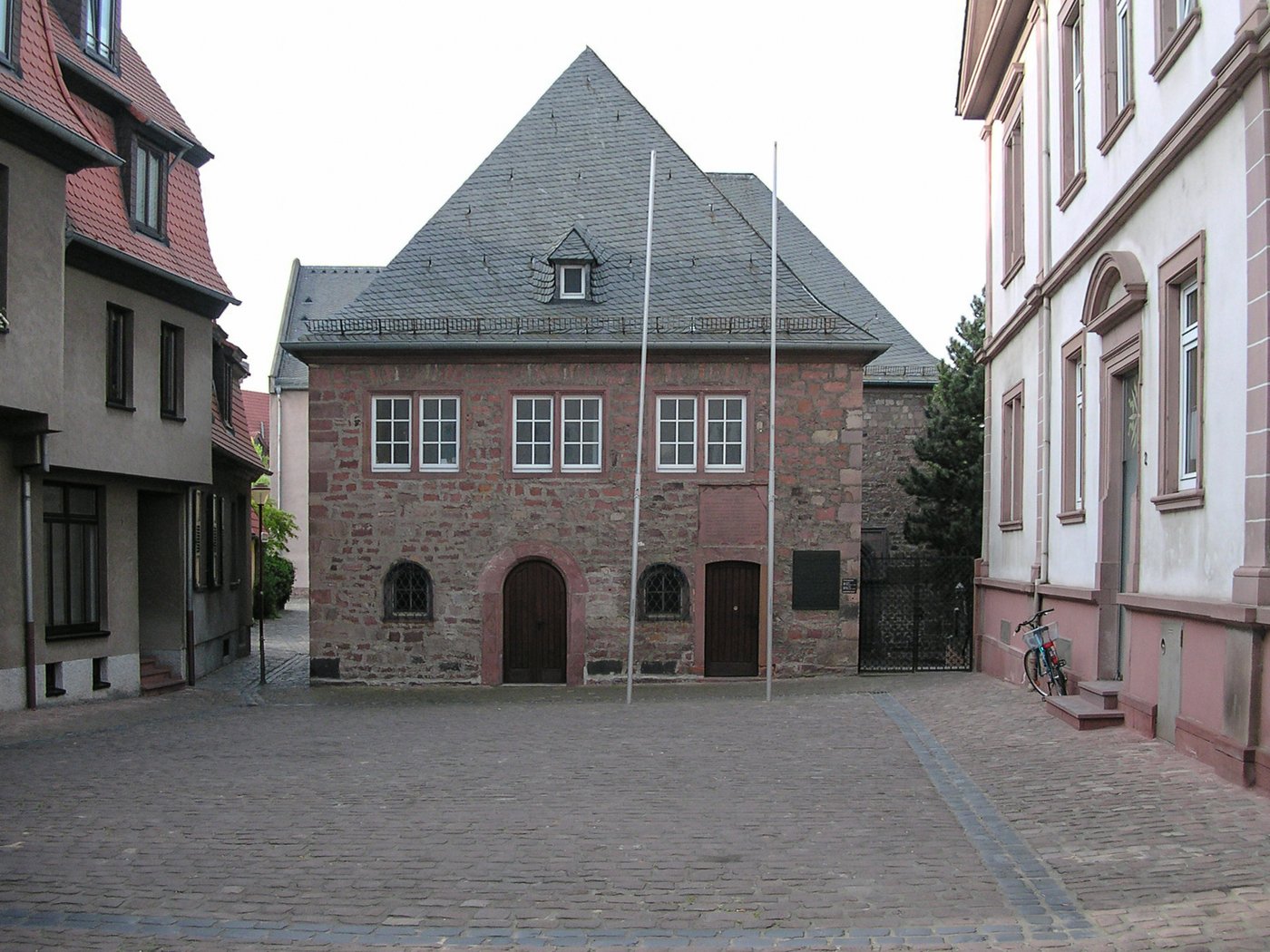
The ShUM communities - Speyer, Worms, and Mainz - whose Hebrew acronym (Shin, Vav, Mem) became their collective name, emerged as the intellectual centre of Ashkenazic Judaism by the eleventh century. The oldest surviving dated Jewish gravestone in Germany, found in the Worms Jewish cemetery (established c. 900 CE), is inscribed with the Hebrew year and the name of the deceased, attesting to a settled community with its own burial ground within two generations of the Carolingian charters. The Worms cemetery, known as the Heiliger Sand, is now listed as a UNESCO World Heritage Site (inscribed 2021, as part of the ShUM Sites ensemble). The Speyer Jewish community received its own episcopal charter from Bishop Rüdiger Huzmann in 1084, explicitly citing the model of earlier Carolingian protections - a direct administrative line from the ninth-century privilegia to the mediaeval Jewish quarter.
It would be easy, looking back from the catastrophes of the Crusades and the expulsions, to read this entire episode as a brief respite before the storm - a false dawn. That is the grievance register talking, and it misses something. The three centuries between Louis the Pious and the First Crusade were not merely tolerated existence. They were a founding. The communities that grew in this window produced legal responsa that are still cited, liturgical poetry (piyyutim) still sung on the High Holy Days, and the intellectual infrastructure that Ashkenazic Judaism would carry with it wherever it was subsequently forced to go. The invitation north, issued for pragmatic Carolingian reasons and accepted for equally pragmatic Jewish ones, turned out to be one of the most consequential acts in the long history of the tribe - not because it was kind, but because it was real, and because the people who answered it built something that lasted.
The record
The earliest rabbinic authorities of the Rhine communities - the Rishonim of Ashkenaz - began producing responsa and legal decisions by the mid-tenth century. Rabbi Gershom ben Judah of Mainz (c. 960-1028 CE), known as Meor HaGolah ("Light of the Exile"), issued the influential takkanot (rabbinic ordinances) that defined Ashkenazic practice for centuries, including the prohibition on polygamy and the ban on reading another person's private correspondence. These ordinances were accepted as binding by Jewish communities across northern Europe and are still cited in halachic literature. Rabbi Gershom's yeshiva in Mainz was the direct forerunner of the school that trained Rashi (1040-1105 CE), whose commentaries on the Talmud, written in Troyes, shaped Jewish learning worldwide. The biographical and legal record is surveyed in Avraham Grossman, The Early Sages of Ashkenaz (Magnes Press, Hebrew University of Jerusalem, 1981; Hebrew, with extensive primary citations).
Louis the Pious wanted compliant merchants and hoped for eventual converts. He got neither in quite the way he imagined. What he got instead, by accident of policy and the tenacity of the people who took up the offer, was the founding generation of Ashkenazic Jewry - a civilisation that would, within two centuries, produce the most influential body of Jewish commentary since the close of the Talmud itself. The crown issued the charters. The tribe did the rest.