There is a moment, somewhere around the middle of the ninth century, that the Ashkenazi world begins. Not with a decree, not with a battle, not with the turning of some great dynastic wheel - but with a family. The Kalonymides, as scholars call them, were already distinguished. They had built a name in Lucca, in northern Italy, as scholars, poets and communal leaders. They carried with them a tradition of liturgical poetry - the piyyut - that connected them to the academies of the East, to Babylon and the Land of Israel, through chains of learning that were already centuries old. Then, at what the medieval chronicle tradition calls the invitation of a Carolingian ruler - some versions name Charlemagne himself, others his successors - the family made the crossing. They went north over the Alps and settled in the Rhineland, most likely in Mainz. When they arrived, they did not find nothing. There were Jews in the Frankish lands already. But what the Kalonymides brought was different in kind: a dense, portable library of legal knowledge, liturgical creativity and scholarly habit that would change what Jewish life in northern Europe could become.
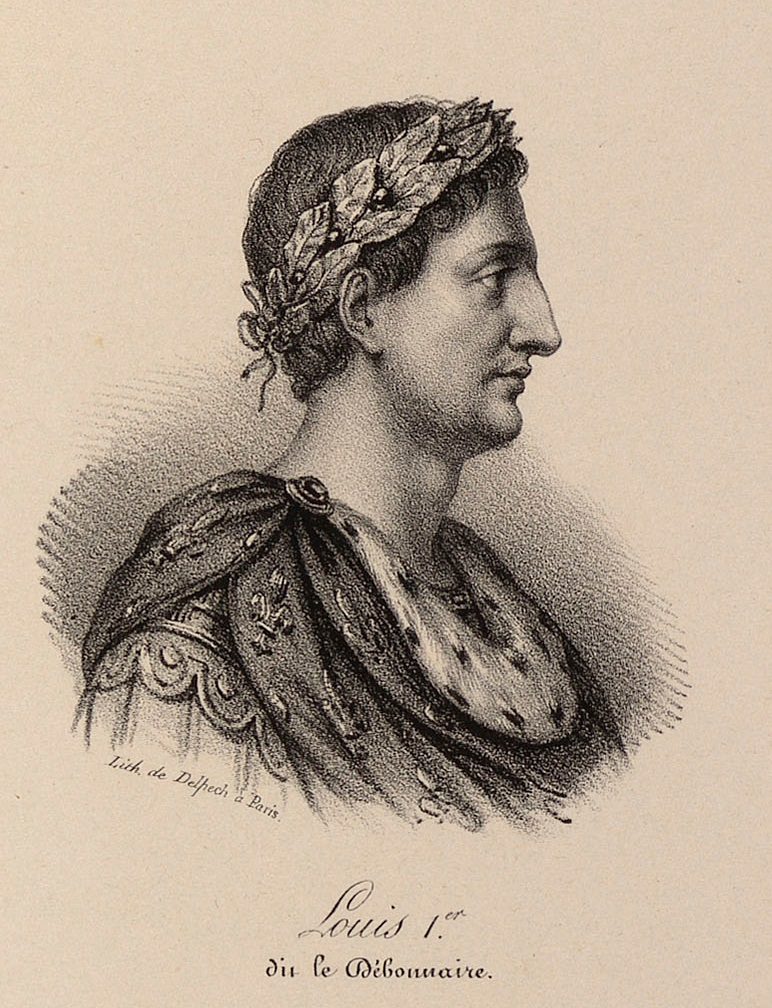
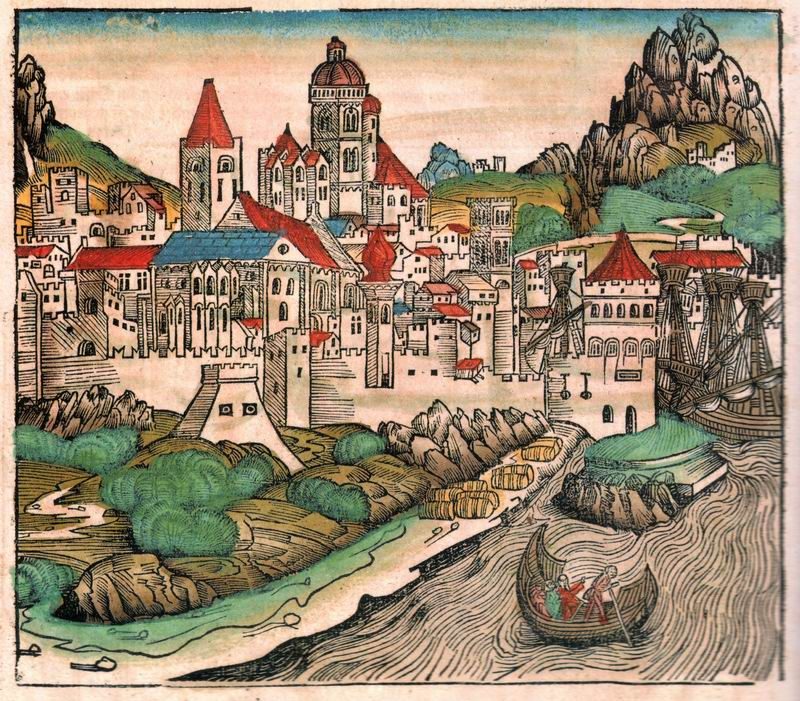
Mainz in the ninth century was a significant Carolingian city - an archiepiscopal seat, a trading hub on the Rhine, a place where the empire's administration met its merchant networks. The Jews who settled there occupied a niche that the Carolingians found genuinely useful: long-distance trade, especially in goods - spices, silk, wine, slaves in the early period - that crossed the empire's eastern and southern borders. The protections granted to Jewish merchants by Louis the Pious (814-840 CE) are documented in imperial charters that survive to this day. Into this world, with its particular mixture of tolerance and precariousness, the Kalonymos family brought something the local community did not yet have in abundance: the equipment to build a proper Jewish civilisation.
The record
The earliest solid textual evidence for the Kalonymos family's presence in Mainz comes from the genealogical and chronicle tradition preserved in two medieval Hebrew texts: the Megillat Ahimaaz (Chronicle of Ahimaaz), composed in southern Italy in 1054 CE by Ahimaaz ben Paltiel, and references in the responsa literature of the Rhineland academies themselves. The Megillat Ahimaaz records the lineage of an Italian-Jewish scholarly family with connections to Oria in Apulia and to Lucca, tracing their intellectual descent through the generation that crossed into the Frankish north. Separately, the Kalonymos name appears in the tenth and eleventh century responsa of the Mainz academies - in the work of Rabbi Gershom ben Judah (c. 960-1040 CE), known as "the Light of the Exile," who was himself deeply rooted in the traditions that the Kalonymides had transplanted. The genealogical evidence is discussed in detail by Ivan G. Marcus in Piety and Society: The Jewish Pietists of Medieval Germany (Brill, 1981), and by Israel Ta-Shma in studies of early Ashkenazi halakhic literature published in Tarbiz (Hebrew University, Jerusalem).
What the Kalonymides carried north was not just knowledge in the abstract. They carried a specific relationship to the piyyut - the elaborate liturgical poetry that embellishes the synagogue service on holy days. The piyyut tradition was Italian-Jewish in its immediate source but ultimately Palestinian in its roots, drawing on the school of Eleazar Kallir and the great liturgical poets of Byzantine-era Israel. When this tradition took root in Mainz and then spread along the Rhine to Worms and Speyer - the three cities that would become the heart of what medieval Jews called "Ashkenaz" - it created something with a distinct voice. Ashkenazi prayer did not sound like Sephardi prayer. It did not sound like Yemenite prayer. It had a particular flavour - dense, allusive, steeped in biblical wordplay - that traces a direct line back to the manuscripts the Kalonymides packed for the journey north. The family's names recur generation after generation in Rhineland Jewish life: Meshullam, Kalonymos, Samuel, Moses. They were teachers, they were judges, and at least two of them in the eleventh and twelfth centuries became the leaders of the Hasidei Ashkenaz - the Jewish pietist movement of the Rhineland, whose Sefer Hasidim (Book of the Pious) remains one of the most remarkable documents of medieval Jewish ethics.
The record
The Carolingian legal framework that made Rhineland Jewish settlement viable is documented in three imperial charters issued by Louis the Pious between 814 and 825 CE, granting named Jewish merchants specific protections: the right to travel freely within the empire, to engage servants, to trade at fairs, and to be judged by their own law in internal disputes. These charters, preserved in the Formulae Imperiales compiled for the imperial chancellery, are edited and translated in Amnon Linder's The Jews in the Legal Sources of the Early Middle Ages (Wayne State University Press / Israel Academy of Sciences and Humanities, 1997). The same volume includes the subsequent charter of Louis II (c. 845-850 CE) extending similar protections, a document contemporary with the probable date of the Kalonymos migration. The physical remains of the early Mainz Jewish community - most notably the eleventh-century Jewish quarter and the site of the old synagogue beneath the present city centre - are documented by the Landesarchiv Rheinland-Pfalz and discussed in the permanent collection of the Jüdisches Museum Mainz.
There is something worth sitting with in the shape of this story. A family picks up its books and crosses the mountains, drawn by the invitation of a foreign ruler who wants their skills and finds them useful. They settle, they teach, they pray, they argue, they produce children who become scholars. Within two hundred years the community they helped to found is producing Rabbi Gershom ben Judah, whose rulings will govern Ashkenazi Jewish life for centuries - monogamy made universal, the privacy of correspondence protected, the convert who reverts not to be shamed. Within four hundred years the Rhine valley is producing Rashi, the commentator whose words frame every page of Talmud study to this day, and then Rashi's grandsons, the Tosafists, who argue back and add their own voices in the margins. None of that begins without the crossing. None of it begins without the family that arrived in Mainz with their library, their lineage, and their liturgical poems about the God who had brought them, again, to a new place.
The Kalonymos migration is not a dramatic story by the standards of what came before and after. No sea split for them. No exile was announced by a prophet. They simply crossed a mountain range and unpacked their books in a Frankish river city, and Jewish Europe - Ashkenaz, the world of Rashi and the Vilna Gaon and the shtetl and the yeshiva - begins to exist. That is the size of a quiet crossing, taken at the right moment, by the right people, with the right things in their bags.