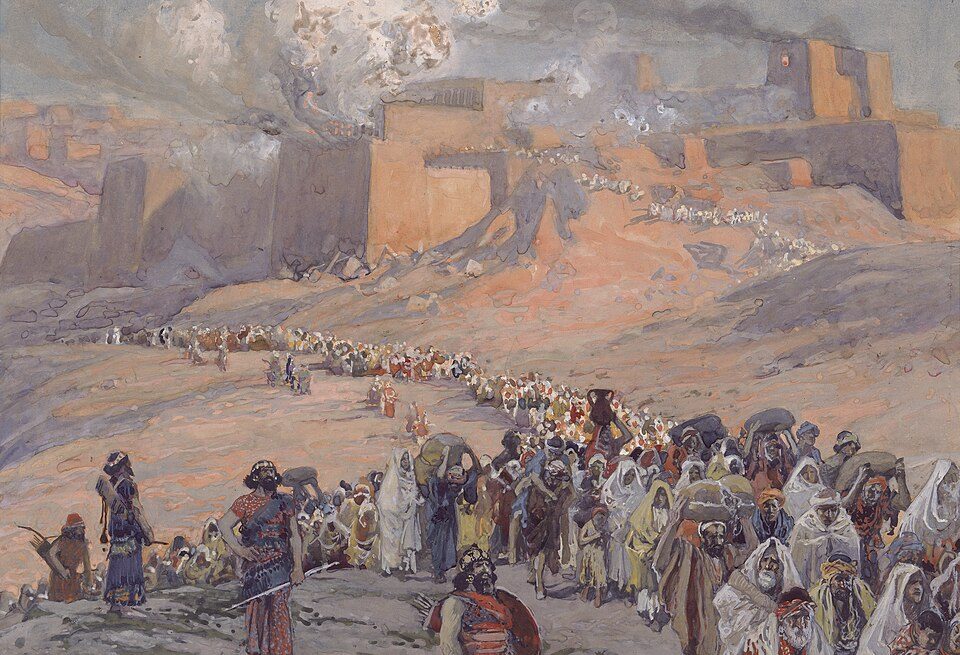
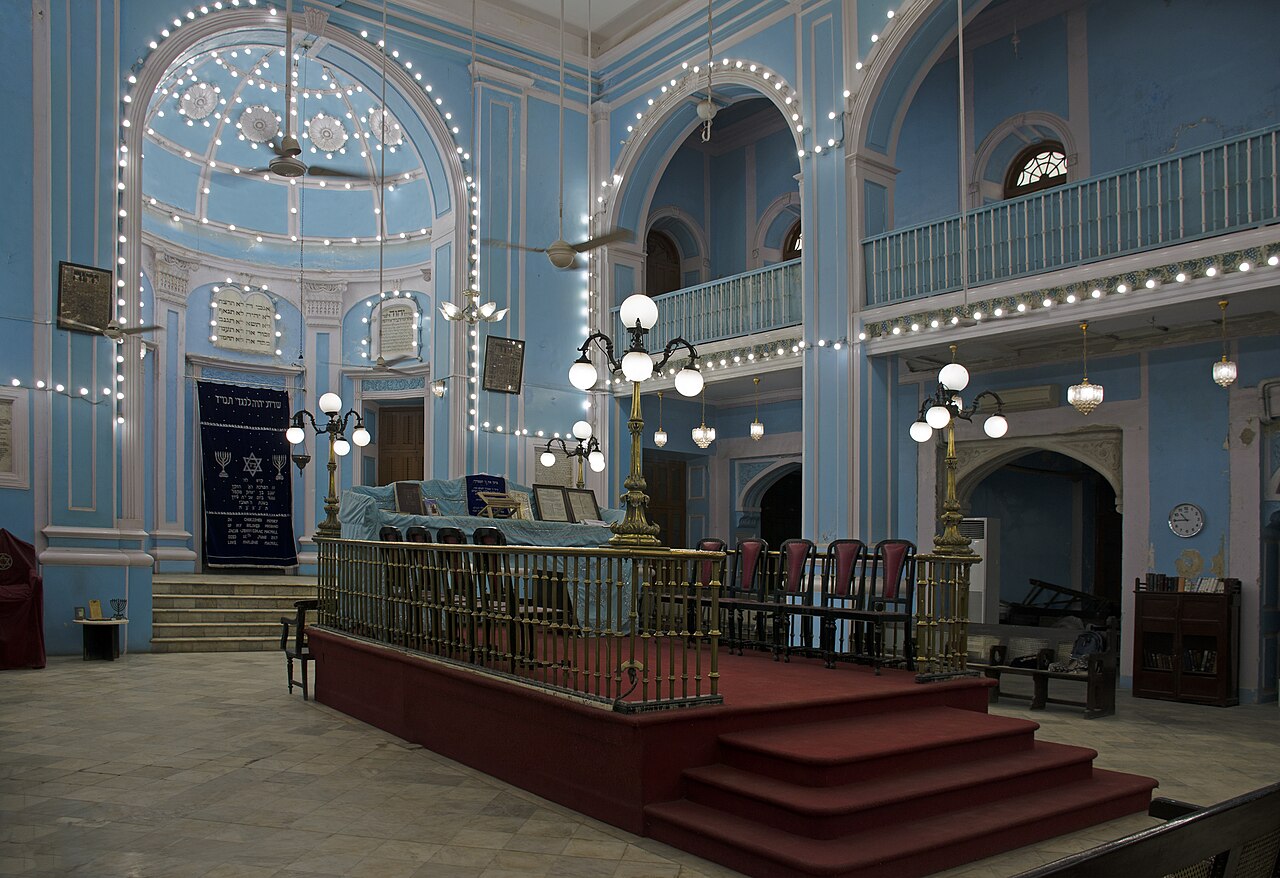
There is a synagogue on the island of Djerba, in the village the community calls Hara Sghira, that is said to be the strangest building in North Africa. Not strange in its outward form - from outside it is low and white and square, set among date palms and flat-roofed houses, unremarkable as the landscape that holds it. Strange in what it contains. The interior opens like a held breath releasing: blue and white tiles running floor to wall, painted wooden ceilings hung in panels of deep colour, stained glass letting in the particular amber light of the Tunisian afternoon. In the innermost room, behind the heikhal where the Torah scrolls are kept, there is a stone. Community tradition holds that this stone - or perhaps a door, the accounts differ - was brought from Jerusalem after the destruction of the First Temple in 586 BCE, when the exiles scattered and some, the tradition says, kept travelling west until they reached the Mediterranean and could go no further. They stopped here. They built. The synagogue that grew around the stone takes its name from the Arabic: El-Ghriba. The strange one. The miraculous one.
This is tradition, not established history, and it deserves to be handled as such - as a community's account of its own origins, shaped over centuries to say something true about identity even if the chronology resists verification. What the documentary record does establish is a Jewish community on Djerba that reaches back at least to the Roman period, with continuous presence through the Byzantine, Arab, and medieval eras. Whether the community is 2,600 years old, as tradition holds, or somewhat younger, as the earliest firm evidence suggests, it is one of the oldest continuously inhabited Jewish communities in the world. The difference between those two claims is interesting to historians and largely beside the point to the community itself, which has never needed outside confirmation of what it already knows.
What it knows is this: the island has been home since before memory. And it is still home now.

The island and its logic
Djerba sits in the Gulf of Gabes, joined to the Tunisian mainland by a Roman causeway that has been repaired and rebuilt across two millennia and is still in use. It is flat, sun-bleached, and productive - date palms, olive groves, a fishing industry, and for centuries a trading economy that made it a node in the Mediterranean commercial network rather than a remote backwater. Its geography created conditions that were, on balance, favourable to a minority community: enough distance from the mainland to develop its own social grammar, enough trade to make the Jewish community's economic role legible and valued, and enough insularity to make assimilation a slower and more negotiated process than it was in the great urban centres of North Africa.
The community organised itself into two quarters. Hara Kebira - the large quarter - was the main settlement, and it is where most of the community's synagogues, its Jewish school, and its domestic life were concentrated. Hara Sghira - the small quarter, now officially called Er-Riadh - held the El-Ghriba. The two settlements are separated by a few kilometres of Djerbanese road, and the road between them has been walked by generations of people who understood exactly what it connected: daily life and sacred life, the practical and the permanent.
The community that developed across these two quarters was, by the standards of the broader Jewish world, notably self-contained. Djerba's Jews were known within North African Jewish culture for a certain insularity - not hostility, but distinctness. They maintained their own liturgical traditions, their own approach to Jewish law, and a reputation for scholarship that gave them standing in the wider Sephardic world without requiring them to defer to it. The yeshivot on the island - the houses of Torah study - were serious institutions. The scribes of Djerba were considered among the most skilled in the region; Djerban Torah scrolls were prized possessions, sought by communities across North Africa and beyond.
The craft of the scroll
The economic life of the Djerban Jewish community ran along two main channels: jewellery and textiles. The island's Jewish silversmiths were skilled and prolific - their work, characteristically fine and intricate, circulated throughout Tunisia and across the Saharan trade routes, reaching markets as far as sub-Saharan Africa. Jewish goldsmiths and silversmiths occupied a specific and recognised role in the island's economy, one that provided both material security and a degree of social legibility. You could know where to find a Jewish jeweller on Djerba; the community was not invisible.
Alongside the silverwork ran the Torah scrolls. Djerba's scribes worked in a tradition that was, by reputation, exceptionally careful. A Torah scroll is not a book - it is a sacred object, written by hand on specially prepared parchment, subject to elaborate rules of accuracy and intention, and requiring a scribe of sufficient learning and piety to execute it correctly. A defective scroll cannot be used for public reading. Djerban scribes were trusted to get it right, and the scrolls they produced travelled across the Jewish world as the silverwork travelled across the trade routes - as evidence of what the island could make and what it stood for.
These are not separate facts. The same community that practised the precise physical craft of silversmithing also practised the precise spiritual craft of Torah writing. The hands that worked the silver also turned the pages of the Talmud. The island's reputation - for scholarship, for craftsmanship, for a certain seriousness about the obligations of Jewish life - was a single reputation, not several.
El-Ghriba Synagogue
The El-Ghriba synagogue stands in the village of Er-Riadh (formerly Hara Sghira) on the island of Djerba, Tunisia. The current building was reconstructed at the end of the 19th century, though a synagogue has stood on or near the site for considerably longer - community tradition holds that the site has been sacred to the Jewish community since antiquity. The interior is distinguished by blue and white Andalusian tiles covering the lower walls, painted wooden ceiling panels in deep blues, greens, and reds, and coloured glass lanterns. It is widely regarded as one of the most beautiful synagogues in North Africa and one of the most significant Jewish heritage sites in the Arab world. Djerba was inscribed as a UNESCO World Heritage Site in 2023. Each year at Lag BaOmer, the El-Ghriba hosts the Hillula pilgrimage, drawing tens of thousands of Jewish visitors from Tunisia, Israel, France, and elsewhere - one of the largest annual Jewish pilgrimage gatherings in the world.
Er-Riadh (Hara Sghira), Djerba, Tunisia · UNESCO World Heritage Site (inscribed 2023) · Annual Lag BaOmer HillulaThe pilgrimage
Every year, in the weeks after Passover, the road from Houmt Souk to Er-Riadh fills with coaches and cars and people on foot, and the population of the small quarter swells by tens of thousands. They come for the Hillula de-Rabbi Shimon bar Yochai - the Lag BaOmer festival centred on the El-Ghriba synagogue, one of the largest Jewish pilgrimage gatherings anywhere in the world and one of the most vivid expressions of Jewish communal continuity in North Africa.
The Hillula is an act of joyful assertion. Pilgrims come from Israel, from France, from North America, from communities across the Jewish diaspora that trace their origins to Tunisia. Many of them are Tunisian Jews or descendants of Tunisian Jews who left in the decades after independence, returning now not to live but to remember, to pray, and to reconnect with the specific texture of the Jewish life their families carried away from the island. The candles they light at the El-Ghriba are lit in a space that their great-grandparents knew, that generations before those great-grandparents knew, that stretches back past the edge of documented history into the territory where tradition begins.
The pilgrimage has faced adversity. In April 2002, a truck bomb exploded outside the El-Ghriba, killing 21 people and damaging the synagogue. The community repaired the building. The pilgrimage resumed. The persistence here is not metaphorical - it is logistical, physical, and deliberate. Every year that the pilgrims return is a year in which the community answers, in the clearest possible register, a question nobody should have had to ask.
The Bombing and the Return
On 11 April 2002, a truck bomb exploded outside the El-Ghriba synagogue during the Lag BaOmer pilgrimage. Twenty-one people were killed: 14 German tourists, 5 Tunisian nationals, and 2 French nationals. The attack was later claimed by Al-Qaeda, and is widely described as the network's first major operation after the attacks of 11 September 2001. The synagogue was damaged and the pilgrimage was suspended for a period. The building was repaired and the annual Hillula resumed. The community did not leave. The pilgrimage did not stop.
Er-Riadh, Djerba, Tunisia · 11 April 2002 · Pilgrimage resumed subsequent yearsThe long attrition
The story of the Djerban Jewish community in the twentieth century is, in one sense, a story of departure. In the early decades of the century, several thousand Jews lived on the island - a small but coherent community with its synagogues, its yeshivot, its scribal tradition, its silversmiths, its two quarters. The French protectorate period, whatever its other effects, did not dislodge the community from its particular place in Djerbanese life. The community was known, was present, was part of the island's social fabric in ways that the fabric itself had shaped over centuries.
Then, in the years after Tunisian independence in 1956, and especially after 1967, most of the community left. The emigration was not a single event but a series of decisions, family by family, responding to a changing political climate, to the pull of Israel and France where relatives had already gone, to the ordinary calculus of a minority community assessing its prospects in a newly nationalised state. The mathematics of those departures is familiar - it is the same mathematics that played out, in different configurations, across the Jewish communities of Egypt, Libya, Iraq, Syria, and Morocco in the same decades. Most went. Most did not come back to live.
But some stayed. That is the remarkable fact, the one that earns the community its place in this series. The Jewish community of Djerba today is small - a few hundred people, concentrated in Hara Kebira - but it is not extinct. It has synagogues. It has a Jewish school. It has an active religious life. It tends the El-Ghriba. In a region where Jewish communal life has largely contracted to memory and memorialisation, Djerba has something that Kaifeng and the ruins of Bukhara do not: a living present tense.
The same story the tribe carries everywhere - Torah, Shabbat, the covenant. On Djerba, it has been spoken in the same place for at least two thousand years.
What the island kept
There is a particular quality to the Jewish life of Djerba that scholars of North African Jewry have noted across many centuries of description: a conservatism that is not rigidity but rootedness. The community maintained practices and liturgical customs that the broader Sephardic world had revised or abandoned; it kept a relationship to Jewish law that was at once deeply traditional and specifically its own. This was possible because the island was close enough to the wider Jewish world to know what that world was doing, and self-possessed enough to take its time deciding what to adopt.
The Torah scrolls the Djerban scribes produced were not copies of someone else's tradition - they were expressions of a tradition that the community had been tending on its own terms, in its own place, for as long as anyone could trace. The pilgrims who come each year for the Hillula are not visiting a museum. They are visiting a community that has been present continuously, that has maintained the obligations of Jewish life without the need for anyone else's permission, and that has done so on a Mediterranean island in the Arab world - a fact that requires no romanticising to be genuinely extraordinary.
On Shabbat in Hara Kebira, candles are lit. The prayers are chanted in the community's own accent, in the rhythms that have been passed down through generations on the island. The El-Ghriba stands in Er-Riadh, its blue and white tiles as particular as ever, its stone in the innermost room. Whether that stone came from Jerusalem in 586 BCE is a question for historians. That it has been the centre of a living Jewish community for centuries, on this specific island, in this specific sea - that is not a question at all. That is what you can see, if you go.
Further reading