If you want to know what continuity looks like, don't start with ruins. Start with a page. A page of Talmud argued over in Sura, sharpened in Pumbedita, carried forward by the geonim, copied in Baghdad, studied in Basra, packed into a trunk, then unpacked again in Ramat Gan or Golders Green or Great Neck. The page is the thing. Empires come through with banners and horses and tax systems and high opinions of themselves; the page remains where it was, on a table, with somebody leaning over it and objecting in the proper tone. For the Jews of Iraq, that tone lasted a very long time indeed.
The story begins where Jewish memory says it begins: with the Babylonian conquest of Judah in 586 BCE and the exile that followed. The Hebrew Bible itself remembers Babylonia not as a passing stop but as a world - a place of rivers, canals, imperial power, grief and adaptation. Some exiles returned under Persian rule. Many did not. Over the centuries a Jewish civilisation grew in Mesopotamia that was not a mere outpost of Jerusalem but one of the main engines of Jewish life anywhere. By late antiquity, the great academies of Sura and Pumbedita had become the beating intellectual centres of the Jewish world. From that Iraqi soil came the Babylonian Talmud, which is to rabbinic Judaism what a foundation stone is to a house - not the whole structure, but the thing the rest depends on.
That matters because Baghdad came later. The city the Abbasid caliphs founded in the eighth century rose in the shadow - and then in the company - of an already ancient Jewish world. The academies were older than Baghdad. The exilarchate was older than Baghdad. The habits of study, law, liturgy, commerce and communal self-government were older than Baghdad. So when Jews became one of the city's formative populations, they were not improvising a foothold. They were moving within their own long Mesopotamian chapter, from one address to another.

The house by the river
Under the Abbasids, Baghdad became one of the great cities on earth, and its Jews flourished within it. This wasn't always serene. No old city is. But the broad fact is plain: Jewish life there was confident, productive and public. The geonim - the heads of the academies of Sura and Pumbedita from the sixth to the eleventh centuries - answered legal questions from across the diaspora. Baghdad itself became a centre of communal authority, scholarship and trade. Judeo-Arabic joined Hebrew and Aramaic as a language of serious Jewish thought. Poets, merchants, rabbis and financiers all found room in the same city, which is another way of saying it was a real civilisation and not a museum label.
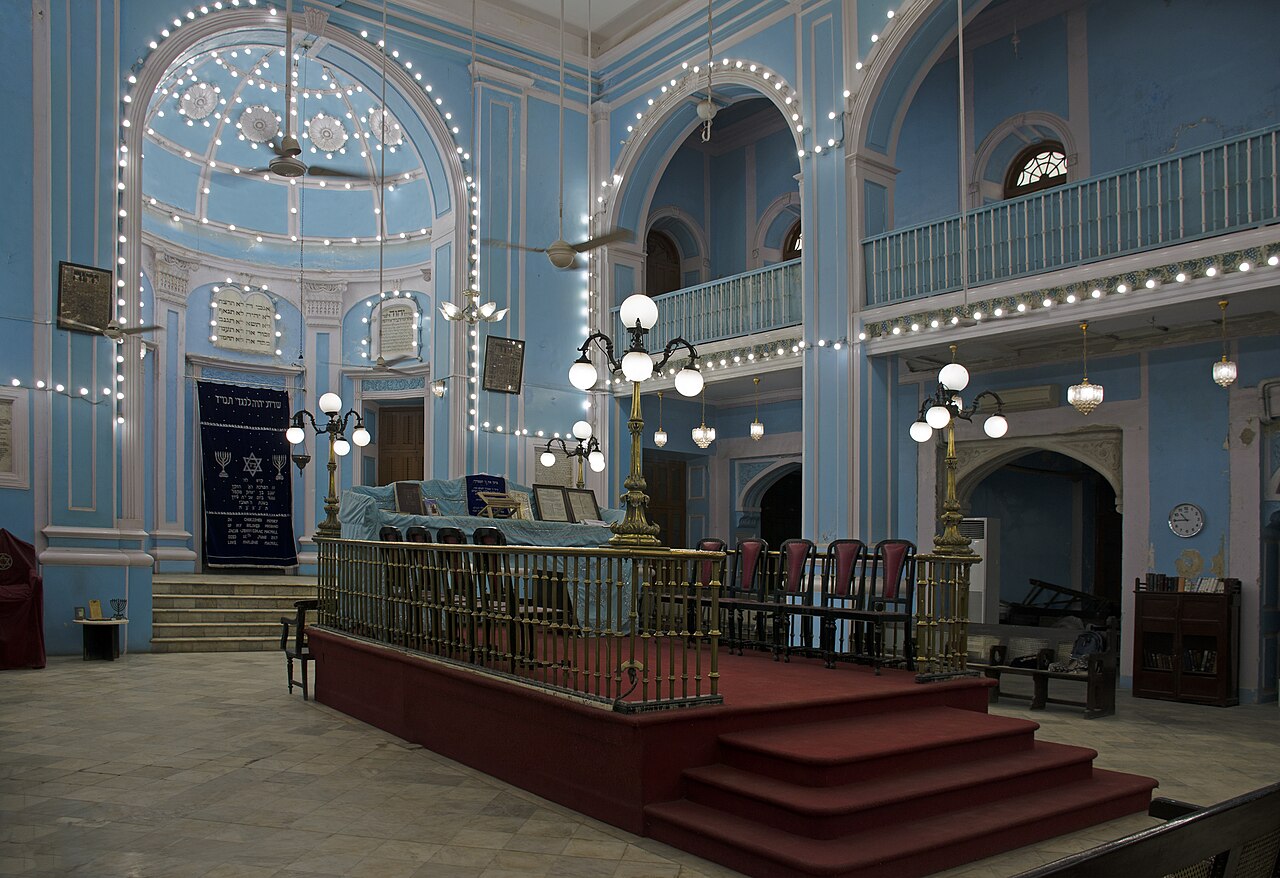
There is a tendency, especially among people who think Jewish history consists mainly of exits, to rush past the fact of home. Baghdad was home. Not temporary shelter, not tolerated lodging, not antechamber to somewhere else. Home, for centuries. The Jewish quarter had its rhythm, its synagogues, its schools, its kitchens, its business houses, its pronunciation, its melodies. The city's Arabic culture entered Jewish speech and song; Jewish learning entered the city's commerce and manners. None of this made the Jews less Jewish. It made them Baghdadi as well.
By the eighteenth and nineteenth centuries, Baghdad's Jewish merchants stood at the hinge between Iraq, India and the wider trading world. Families such as the Sassoons rose from the city's Jewish elite and then carried Baghdadi habits eastward - to Bombay, Calcutta, Hong Kong and Shanghai. They became so rich that later writers called them the Rothschilds of the East, which is flattering in the wrong direction. The more interesting fact is that they remained recognisably Baghdadi even as their networks spanned Asia. They took Baghdad with them in prayer books, family law, accents, cuisine and charitable obligation. Diaspora, in other words, can itself generate further diaspora. Jews are nothing if not recursively talented.
Sura, Pumbedita and the Talmudic world
The academy of Sura was founded in the third century, and Pumbedita soon after. Together they became the two great academies of Jewish Babylonia, dominating Jewish learning through the Amoraic and Geonic periods. The Babylonian Talmud was compiled in that scholarly world, and the geonim of Sura and Pumbedita later issued responsa to Jewish communities across the diaspora. Baghdad did not create this civilisation from scratch. It inherited it at close range, and then housed it.
Talmudic academies in BabyloniaThe city that was partly Jewish
By the turn of the twentieth century, Baghdad's Jews were not an ornament on the city's edge. They were one of its major populations. An 1890 count recorded 52,500 Jews in Baghdad, and the Ottoman yearbook for 1917 recorded 80,000 Jews in a sanjak population of just over 202,000. That makes the 1917 figure about two-fifths of the Baghdad sanjak, if you want the shorthand, but the point is simpler than the arithmetic. This was a city in which Jewish life was not marginal. It was everywhere that ordinary life was: in markets, in schools, in music, in medicine, in civil service, in finance and in the daily argument by which cities remain alive.
There is real pleasure in that fact, and it ought to be said plainly. Jewish history is too often narrated as a series of alarms. Baghdad allows a different emphasis. Here was a Jewish community that had not merely survived but ripened. It had produced commentators and merchants, printers and ministers, benefactors and sharp-tongued scholars, women who kept households running with formidable competence, and men who could argue a legal point for an hour before breakfast. It had scale. It had style. It had enough self-possession to be both deeply Jewish and entirely local.
Even the modernising Iraqi state bore Jewish fingerprints. Sassoon Eskell, Baghdadi Jew and one of the founders of modern Iraqi finance, served as the kingdom's first finance minister. Jewish schools were strong. Jewish musicians mattered. Jewish traders linked Baghdad outward. The longer one looks, the less plausible it becomes to treat Jews in Iraq as an appendix. They were among the authors.
Counting the community
Vital Cuinet's figures for 1890 gave Baghdad 52,500 Jews. The Ottoman yearbook for 1917 gave the Baghdad sanjak 80,000 Jews out of 202,200 people. The exact denominator changes with administrative boundary and method, as it always does when states begin counting the human race with seriousness. What does not change is the scale. Baghdad was one of the great Jewish cities of the modern Middle East.
Vital Cuinet and the Ottoman yearbookThe Sassoons make a useful emblem here, provided one does not let them eclipse everyone else. David Sassoon fled Baghdad in the 1830s after persecution under Dawud Pasha and built the family empire from Bombay. His descendants scattered through British Asia and Britain itself, yet they remained attached to the Baghdadi Jewish world that had formed them. David Solomon Sassoon, bibliophile and collector, assembled one of the great private collections of Hebrew manuscripts in modern history, including codices and liturgical works from across the Jewish world. The family fortune travelled by ship. The family memory travelled by book.
One of the oldest continuous Jewish diaspora communities was not a camp beside history. It was a civilisation in its own right, and Baghdad was one of its capitals.
The Sassoon library
David Solomon Sassoon catalogued a manuscript library that grew from roughly 500 manuscripts in 1914 to more than 1,100 described items by 1932 in his two-volume Ohel David. Among the treasures associated with his collection were the manuscript later known as Codex Sassoon and the Damascus Pentateuch, now in the National Library of Israel. A Baghdadi mercantile dynasty turned part of its wealth into an ark. Civilisations do sometimes know what to do with money.
Ohel David · National Library of IsraelThe longest chapter closes
Then, in historical terms, very quickly, it ended. The violence of the Farhud in 1941 shattered old assumptions. The years after 1948 tightened the vice further. In 1950 and 1951, Iraqi laws denaturalised Jews who chose to leave and froze much of their property. Operation Ezra and Nehemiah carried around 120,000 to 130,000 Iraqi Jews to Israel between 1951 and 1952. That sentence contains a tragedy, but it also contains an act of endurance. A community of more than two and a half millennia did not vanish. It moved.
That is why Baghdad should not be written only as loss. The departure matters. It would be indecent to pretend otherwise. But the proper scale of the story is longer than the departure. What lasted in Iraq for twenty-six centuries cannot be reduced to its final airport queue. The last chapter was abrupt; the book before it was enormous.
And so Baghdad remains in the Jewish world not only as memory of what was broken, but as proof of what was built - a house of study, a mercantile network, a liturgical accent, a kitchen, a public confidence, an old civilisation carried east of Zion and faithful to it all the same. The chapter closed with restraint. The page, predictably, survived.
Further reading