Every religion has its surface and its depths. The surface of Judaism is well known: a covenant sealed at Sinai, a law elaborated across millennia, a calendar that turns the year into argument and remembrance. The depths are less often told. Beneath the plain meaning of every word - what the rabbis called peshat - there runs a hidden current. The mystics called it sod, secret. They held that the Torah was not only a legal code or a history but a map of the divine itself, every letter trembling with significance that ordinary reading couldn't reach. The tradition that explored those depths is Kabbalah - "reception," what has been handed down. And its greatest text appeared, shimmering and strange, in the hill towns of 13th-century Castile.
The word Kabbalah covers several centuries and several schools of thought, but its centrepiece - the text every subsequent kabbalist argued with, built upon, or felt compelled to refute - is the Zohar, the Book of Radiance. It arrived in circulation in the 1280s, in Castile, distributed by a scholar named Moses de Leon. What it claimed to be was something far older: the recorded teachings of Rabbi Shimon bar Yochai, a 2nd-century sage who had fled Roman persecution and hidden in a cave for thirteen years, emerging with a knowledge of Torah's hidden layers that no one before him had put into words. Whether that claim was true is the question the tradition has been arguing about ever since.
The map of God
Before the Zohar itself, there is the idea that makes it possible. Kabbalah builds on the understanding that God, in the divine essence, is utterly beyond human comprehension - Ein Sof, Without End, the infinite that no name can touch. But the world exists, and the world has form, and something bridges the infinite and the finite. Kabbalistic thinking developed a map of that bridge: ten sefirot, ten divine emanations or channels through which the Ein Sof pours into creation.
The sefirot aren't ten gods; they're more like ten facets of a single light, or ten modes through which divinity is knowable. At the top, Keter - the Crown, pure will, the first stirring of creation before it has taken any shape. Then Chokhmah and Binah, Wisdom and Understanding, the creative flash and its elaboration into thought. Then a middle triad of Chesed, Gevurah, and Tiferet - Lovingkindness, Strength, and Beauty, the qualities of God's action in the world brought into balance. Then Netzach and Hod, Yesod, and finally Malkhut - Sovereignty, the divine presence as it manifests in the created world, the point where the infinite touches the ground beneath our feet.
Kabbalists traditionally arranged these ten on a diagram called the Tree of Life, the sefirot linked by twenty-two paths corresponding to the letters of the Hebrew alphabet. The whole structure was understood as the skeleton of reality: the body of Adam Kadmon, the primordial human; the architecture of the cosmos; the inner structure of the Torah itself. Once you had this map, every verse of scripture could be read as a document about the divine life. A word that seemed to be describing a well or a garment was, at the level of sod, describing the relationship between two sefirot. The depth beneath the surface became inexhaustible.
The book that arrived from the past
Into this tradition of sefirot and hidden meanings, the Zohar arrived like a manuscript dropped from the sky. Moses de Leon - an itinerant Castilian scholar who had been writing his own Hebrew kabbalistic works since the late 1270s - began circulating Aramaic texts in the 1280s that he presented as ancient. The language was an artificial literary Aramaic, modelled on the Babylonian Talmud and Targum Onkelos. The setting was the Galilee of the 2nd century. The teacher at the centre was Shimon bar Yochai, the sage of the cave, gathering his disciples in the hills above Tiberias to discuss Torah in terms of dazzling mystical depth.
The Zohar is not a single book in the way a novel is a single book. It's a vast anthology: biblical commentary, homily, narrative, theosophical speculation, and mystical poetry, all threaded through with the conversations of Shimon and his circle. Its Aramaic is unusual - fluent, even beautiful, but scholars noted early that it contains vocabulary and grammatical forms that don't appear in genuine ancient Aramaic texts, and that its knowledge of medieval Spanish geography sometimes surfaces through the Palestinian setting. The text knows about Maimonides. It gestures toward ideas that only crystallised in the medieval period. It is a 2nd-century text that somehow knew what the 12th and 13th centuries had been thinking.
The question of what the Zohar actually is has generated its own library. A contemporary of Moses de Leon, a scholar named Isaac ben Samuel of Acre, investigated the provenance directly. He met Moses de Leon at Valladolid, where de Leon swore an oath that he possessed the ancient manuscript in his home at Avila. Before Isaac could verify this, de Leon died - in 1305 - and de Leon's widow reportedly told a different story: her husband had written it himself, she said, and had used the pseudepigraphic frame to give it authority that his own name wouldn't have commanded. The widow's account is itself disputed, mediated through Isaac of Acre's notes, and the tradition records that Isaac of Acre may have eventually accepted the ancient attribution anyway. The trail winds and doubles back.

The First Printed Zohar: Mantua and Cremona
The Zohar went into print for the first time in two competing Italian editions, appearing almost simultaneously. The Mantua edition was printed in three volumes by Tommaso Ruffinelli: the first volume in 1558, the second in 1559, the third in 1560. The Cremona edition, printed by the Christian press of Vincenzo Conti, received its censor's imprimatur in August 1558 and appeared the same year. The two editions circulated and argued with each other for generations - the Cremona text served as the basis for subsequent printings in Lublin (1623) and Sulzbach (1684), while religious authorities in the Land of Israel eventually declared the Mantua text canonical. Print did not settle the Zohar's controversies; it multiplied them, and made them available to everyone.
National Library of Israel; Kedem Auction House records; Beit HaZohar research archiveSafed, and the second flowering
The Zohar circulated for two and a half centuries before the event that detonated its full influence. In 1492, the Jews of Spain were expelled - a hundred thousand people, the creative heart of the medieval Jewish world, turned out of the country that had produced the Zohar itself. The trauma was vast, and it demanded a theological response on the same scale. Where was God in an expulsion this total? What was the meaning of such rupture? Kabbalah, with its map of the divine and its language of catastrophe, offered a framework that straight legal reasoning could not.
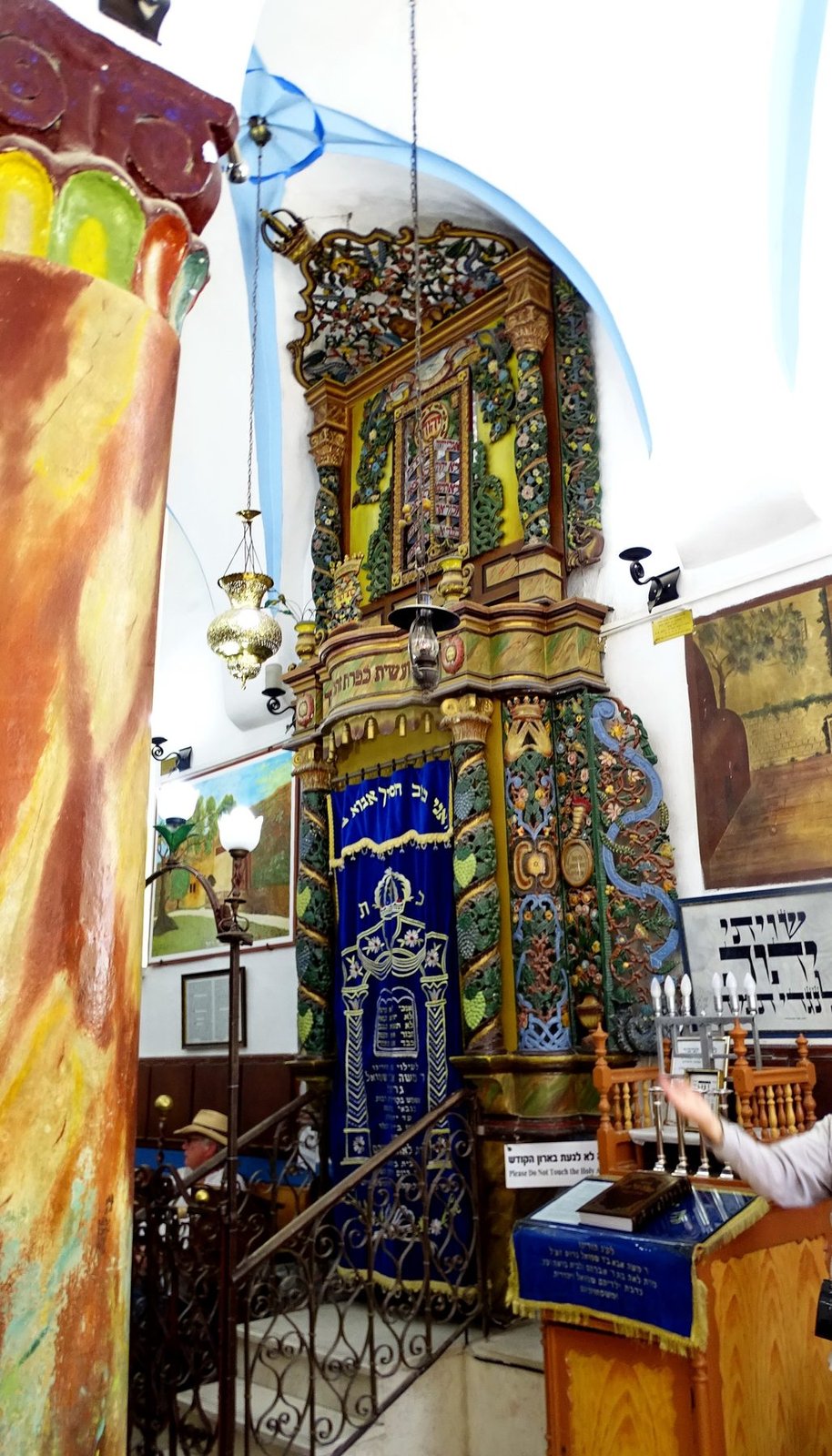
The response came from an unlikely location: Safed, a hilltop town in the Galilee, high above the Sea of Tiberias, in what was then Ottoman Syria. By the mid-16th century, Safed had become the most concentrated gathering of Jewish mystical thinkers in history. Many were Sephardic refugees and their descendants, carrying the Zohar and the traditions of Castile and Aragon northward and eastward. By 1548, Turkish census records show some 716 Jewish households in the town. By the 1560s, Safed had thirty-two synagogues. The Galilee had become, briefly and brilliantly, the centre of the Jewish world.
The first great systematiser of the Safed revival was Moses Cordovero, known as the Ramak (1522-1570). In 1548, at the age of twenty-six, he completed Pardes Rimonim - the Orchard of Pomegranates - a comprehensive map of all kabbalistic thought to date, weaving together the traditions of the sefirot into a single coherent system. Cordovero had been drawn into Kabbalah by his teacher and brother-in-law Shlomo Alkabetz, and went on to run a yeshiva in Safed that trained the next generation, among them Isaac Luria. He was, in the old-fashioned phrase, a complete scholar: a man who had read everything and found a way to hold it together.
Then Luria arrived, and everything Cordovero had systematised broke open in the most productive possible way.
The kabbalists of Safed didn't ask why God had allowed catastrophe. They asked what the catastrophe revealed about the structure of creation itself - and concluded that repair was written into the fabric of the cosmos from the very beginning.
The Ari and the breaking of the vessels
Isaac Luria - the Ari, a contraction of HaElohi Rabbi Yitzhak, the divine Rabbi Isaac - offered a creation myth that matched the scale of Jewish suffering. His starting point was the problem that had shadowed all mystical thinking: if God is infinite and fills all existence, how does anything else exist? The answer, in Lurianic Kabbalah, is tzimtzum - divine contraction. God withdrew, contracted inward, to make space for creation. In the resulting void, God sent a ray of light to begin the work of forming a world. Vessels were prepared to receive and shape that light, channelling the infinite into finite form.
Then something went wrong. The vessels couldn't hold the light. They shattered - shevirat ha-kelim, the breaking of the vessels. Shards of the broken vessels fell through the cosmos, and with them fell sparks of divine light, trapped in the husks of the broken world. This is the Lurianic explanation for evil, for exile, for suffering: not a failure of divine will but a structural catastrophe at the very moment of creation, a rupture that precedes human history and gives it its meaning.
Because the task that follows from this cosmology is breathtaking in its scope: tikkun, repair. Every human act of piety, every mitzvah performed with proper intention, lifts a trapped spark back toward its source. The world is a salvage operation. Every individual carries a piece of the work. The kabbalist's meditation, the craftsman's honest labour, the widow's charity - all of it is participation in the cosmic repair that the broken vessels made necessary. The Spanish expulsion had shattered something, yes. But shattering, in Lurianic thought, is not the last word. Tikkun is.
Lecha Dodi and the Kabbalat Shabbat Service
The Safed kabbalists didn't keep their mysticism inside books. They poured it into liturgy and the rhythms of the week. Rabbi Shlomo Alkabetz (c.1505-1584) composed Lecha Dodi - "Come, my beloved" - a nine-stanza poem threaded with kabbalistic imagery, the first eight stanzas' opening letters spelling out his own name, Shlomo Halevi, as a hidden signature. The practice of dressing in white garments and walking out into the fields beyond Safed to welcome the Sabbath as a bride and queen became associated especially with Isaac Luria's circle in the generation that followed. Alkabetz's poem became the centrepiece of the Kabbalat Shabbat service that the Safed circle developed and which spread, within decades, across the Jewish world. It appears in a Sephardic prayer book printed in Venice in 1584. It's in every siddur today.
National Library of Israel, Piyut collection; Lekha Dodi, Venice 1584 (Sephardic siddur)The hidden that became commonplace
What the Safed kabbalists achieved, over the course of roughly a century, was the transformation of mystical speculation into lived practice. This is the part of the story that tends to get lost when Kabbalah is discussed only as esoteric theology. The Zohar and the Lurianic system were, obviously, elaborate and demanding. But their downstream effects on ordinary Jewish observance were enormous, and they were deliberate.
Kabbalat Shabbat - the Friday night service that welcomes the Sabbath - is a Safed invention. Before the 16th century, there was no such ceremony; the Sabbath evening prayer began with the evening service proper. The Safed kabbalists added a prologue: the six psalms corresponding to the six days of creation, then Lecha Dodi, then another psalm welcoming the day. This structure, rooted in the kabbalistic understanding of the Sabbath as the Shekhinah, the divine presence, became the universal Jewish practice within a generation. It's still done every Friday night in synagogues from Reykjavik to Tel Aviv.
The sefirot, the tzimtzum, the breaking of the vessels, the notion of tikkun olam as cosmic repair - these ideas didn't stay in manuscripts or in the yeshivot of Safed. They percolated into prayer, into song, into the way the Sabbath candles are lit and the way the Havdalah ceremony ends the holy day. Kabbalah is sometimes presented as a secret tradition, preserved by adepts and hidden from the masses. The truth is nearly the opposite. The mystics of Safed wanted their ideas in every home, and very largely they achieved it.
The Zohar itself remains one of the stranger literary objects in existence: a medieval Spanish text dressed in ancient Aramaic, presenting itself as a window onto the 2nd-century Galilee, and containing within it a theology of such depth and strangeness that it generated a tradition capable of outlasting the civilisation that produced it. Whatever Moses de Leon was doing in those hill towns of Castile - composing, compiling, channelling, transmitting - he released something that the Jewish world wasn't finished with. It's still not finished with it now.
Further reading
- Sefaria: Kabbalistic texts in full, including Zohar passages
- Wikipedia: Zohar - history, authorship debate, and influence
- My Jewish Learning: Isaac Luria and Lurianic Kabbalah
- Jewish Theological Seminary: Exploring Kabbalah - the Zohar's origins
- Shalom Hartman Institute: Lecha Dodi and the kabbalist background to Kabbalat Shabbat
- National Library of Israel: The history of the Zohar - the Italian connection