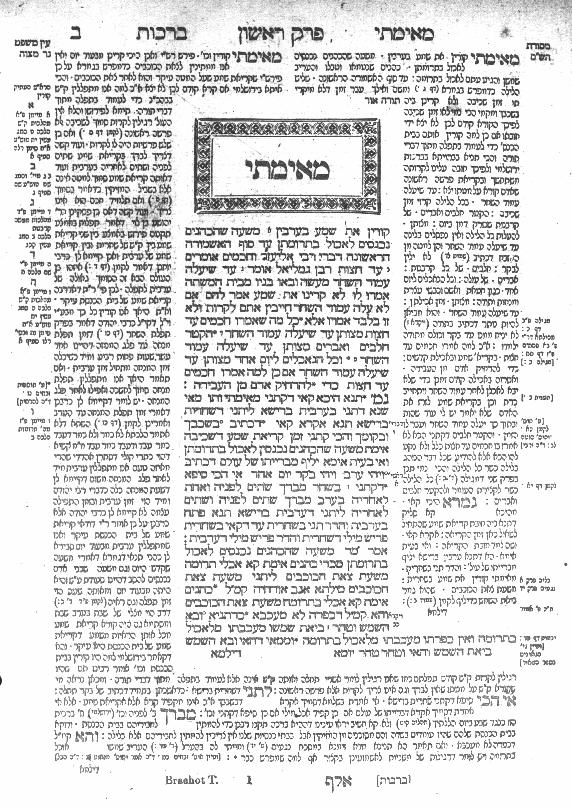
There are grander Jewish survivals than a page design, but not many more useful ones. Open a standard Talmud in Jerusalem, Manchester, Melbourne or Monsey and the coordinates are broadly the same. The Mishnah and Gemara sit at the centre. Rashi runs along the inner margin, close to the binding, patient and indispensable. Tosafot argue on the outer edge, as is only proper. Bomberg's pagination became the standard for later printings, with some tractate-level exceptions. A teacher can say, "We're on Berakhot 2a," and half a world answers by arriving at exactly the same place.
That sameness is not ancient in the obvious sense. The Babylonian Talmud itself was formed in late antiquity, but the page most Jews recognise is a work of the age of print. Its permanent shape emerged in two acts. The Soncino family printers pioneered the layout for individual tractates from 1483 onward. Daniel Bomberg, a Christian printer working in Venice, adopted that layout and then standardised the pagination across the first complete printed Babylonian Talmud, issued between about 1519 or 1520 and 1523. Since then, the page has behaved like a treaty. Jews may argue about what the daf means. They are still on the same daf.

Before Bomberg
The first thing to say, because precision matters, is that Bomberg did not invent the famous Talmud page from nothing. The Soncino family had got there first. In 1483, at Soncino in Lombardy, Joshua Solomon Soncino printed tractate Berakhot, the first printed tractate of the Babylonian Talmud. There the basic arrangement was already visible: the Talmudic text held in the middle, commentary wrapped round it. That mattered because the Talmud had long lived in manuscripts with no universal printed page to obey. The words existed. The look was still negotiable.
The Soncino printers were among the great Jewish craftsmen of the early Hebrew press, and they understood something important. Talmud is not merely text. It is text plus argument plus the long companionship of commentators. Put the Gemara in one volume and Rashi somewhere else and you have preserved the words but damaged the habit of study. Put them on the same page and the page begins to think the way Jews think - centre and margin, statement and gloss, law and challenge, the thing itself and the centuries leaning over it.
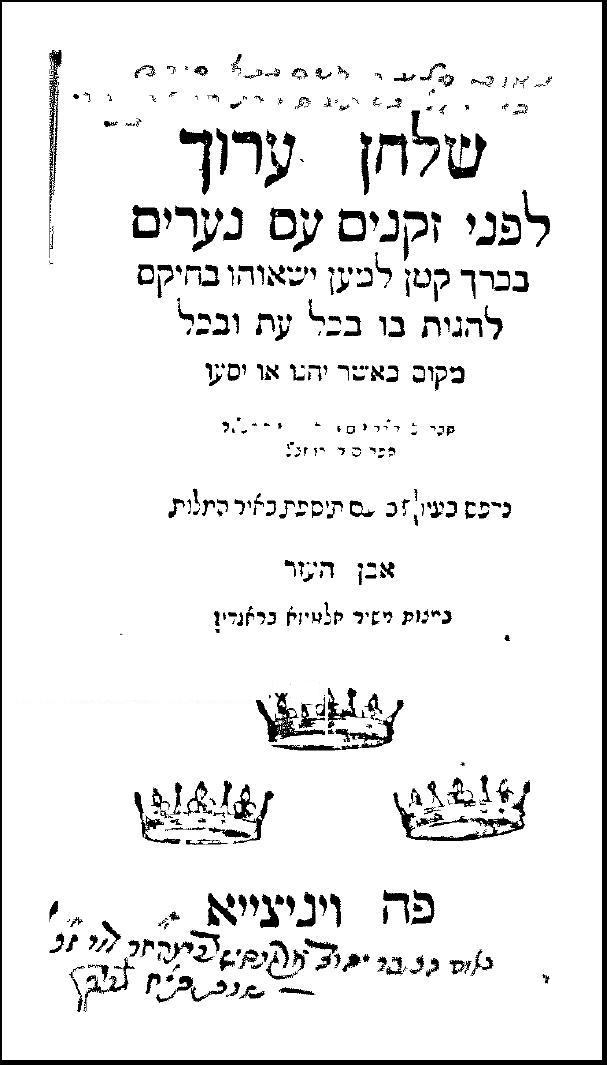
Soncino's printed tractate Berakhot
The Soncino press published tractate Berakhot in 1483, the first printed tractate of the Babylonian Talmud. Bibliographical tradition credits the Soncino family with pioneering the page arrangement later made universal: Talmud text at the centre, commentary around it. Bomberg's later achievement begins here, which is the polite way of saying that even printers have ancestors.
Library of Congress - Judaic TreasuresWhat Bomberg actually changed
Then Venice enters the story, which is a very Venetian place for a Jewish page to become permanent. Daniel Bomberg was not Jewish. He was a Christian from Antwerp who established a Hebrew press in Venice and employed Jewish scholars and editors. With papal approval under Leo X, he undertook the first complete printed edition of the Babylonian Talmud. Complete is the operative word. Not one tractate, not a useful cluster, not a scholar's sampler. The whole sea.
Bomberg's press kept the Soncino page architecture because it was already right. The novelty was scale and discipline. A complete Shas needed a uniform internal geography. Once the foliation was fixed tractate by tractate, the Talmud stopped being only a vast work and became a navigable one. Citation could harden into custom. Teachers and students who never met could still meet on the page. Later editions - above all the Vilna Shas that became the common household form - inherited Bomberg's map rather than drawing a new one.
This is the lovely irony at the centre of the thing. Rabbinic Judaism, whose life is argument wrapped round inherited text, received the lasting shape of its great argument-book from a Christian workshop. No embarrassment is required. History is allowed its jokes. Bomberg did not change what the Talmud said. He gave it a stable body.
That durability altered Jewish learning in a practical way that is easy to underestimate. A standard page is not decorative. It is an infrastructure. It allows reference, memory and communal rhythm. Much later, when Daf Yomi made the daily study cycle itself into a global habit, the old Bomberg foliation was waiting there like a road already laid. The learner in Casablanca and the learner in Cleveland could be late for the same appointment.
A Jew in one country could cite a folio, and a Jew in another could arrive there exactly. That is what it means to be on the same daf.
Bomberg's first complete printed Babylonian Talmud
Daniel Bomberg's first complete printed Babylonian Talmud was issued in Venice between about 1519 or 1520 and 1523. Surviving sets and volumes are held in major collections, including the Bayerische Staatsbibliothek, and the celebrated Valmadonna copy sold at Sotheby's in 2015 for $9.3 million. Its lasting importance is not only rarity. This edition standardised the foliation and fixed the visual form that later printings broadly follow.
Bayerische Staatsbibliothek, MunichThe Christian printer and the Jewish page
There is a temptation to tell this as an oddity, almost a parlour trick of history. Look, a Christian printer gave the Talmud its permanent form. But the deeper point is more generous than that. Jewish civilisation has always known how to take tools from the surrounding world and make them serve continuity. Alphabets, empires, ports, banking instruments, legal forms, paper, print. We did not become less ourselves by using them well. We became more difficult to erase.
Bomberg's Venice edition belongs in that tradition. Print was the new machine. The Jews did not own it first. They did what they usually do with a good machine once it appears: filled it with learning, argument and memory until it became part of the tribe's own furniture. The result was not merely efficient. It was intimate. A student opening the Talmud now encounters not only Rav and Shmuel, Abaye and Rava, Rashi and Rabbenu Tam. He encounters a 16th-century settlement between typography and tradition that turned study into something geographically shareable.
And because this is Jewish history, the page then outlasted the powers around it. Venice changed. Censors came. Editions were burned in 1553. Later printers rose in Basel, Amsterdam, Slavuta and Vilna. The languages around the Jews changed, the governments changed, the clothes changed, the trains arrived, the steamship arrived, the aeroplane arrived, the internet arrived. The page remained recognisable. Not identical in every cosmetic detail, but recognisable in the only way that counts. The centre still held. The margins still spoke.
That may be Bomberg's real monument. Not a record price at auction, though collectors do enjoy their drama. His monument is the quiet fact that a people scattered across continents can still sit down, open a book, and discover that someone half a world away has opened the same page. A tribe of learning requires many things. One of them, as it turns out, is a printer in Venice who understood when not to improve the design any further.
Further reading