Consider the scale of what one man decided to do. The accumulated body of Jewish law - the Mishnah and the two Talmuds, the Geonic responsa, the medieval legal rulings that had been accumulating since the academies of Babylon began to decline - was enormous, scattered, contested, and largely in Aramaic. To use it, you needed decades of training; you needed access to manuscripts; you needed, above all, a rabbi who could navigate the labyrinth on your behalf. Maimonides looked at this situation and decided that the answer was to read all of it himself, master all of it himself, and produce a complete, clear, systematic summary in good Mishnaic Hebrew that gave the ruling directly without the competing opinions, without the Aramaic, without the need for a learned intermediary. Then, having done that - having produced what became the most influential legal code in Jewish history - he wrote a second major work, in Arabic, addressing the question of whether Torah and Aristotelian philosophy could be reconciled. They could, he argued. He showed how. The book reached Christian scholastics in Latin translation and shaped the intellectual world of medieval Europe. He was also a practising physician the entire time.
Moses ben Maimon was born in Córdoba, Andalusia, around 1138 CE - the traditional Hebrew date most commonly cited is 14 Nisan 4895 (corresponding to 1135 CE), though scholarly convention has generally settled on c. 1138 based on alternative calculations; the exact year remains debated. His family were scholars and judges: his father Maimon ben Joseph was a dayyan, a religious judge, trained in both Talmudic law and Andalusian philosophy. The world Maimonides was born into was, by any standard, extraordinary. Córdoba and the wider Andalusian civilisation had been, for generations, a place where Jewish, Islamic, and Graeco-Arabic intellectual traditions lived in dense, productive contact. Aristotle circulated in Arabic translation. Ibn Rushd - Averroes - would be born in Córdoba in 1126, a dozen years before Maimonides. A thoughtful Jewish family in mid-12th-century Andalusia had access to the full range of philosophy, mathematics, astronomy, and medicine alongside their Talmud. The serious mind could reach for the serious question without being told that the question itself was forbidden.
In 1148, that world ended. The Almohad dynasty, which had swept across North Africa, took Córdoba and imposed a religious settlement that left no room for non-Muslim worship. The Almohads demanded conversion or exile. Maimonides was approximately ten years old. His family left. What followed was not a single decisive departure but a decade of uncertain wandering: through Andalusia, then across to Fez in Morocco - itself under Almohad rule, which required careful concealment of their religious practice that Maimonides would later write about with considerable anguish. From Fez, the family passed briefly through the Land of Israel, which was then under Crusader control and offered limited scope for a Jewish family of their background. Sometime in the 1160s they arrived in Fustat, Old Cairo, in Egypt, and there they stayed.

The road to Fustat, and what it cost
Egypt suited him in ways that no previous stopping point had. Under the Fatimid caliphate and then under Saladin, Egypt offered a Jewish scholar something the Almohad west had withdrawn: the ability to function publicly as a Jew, to lead a community, to correspond with other scholars across the Mediterranean world without concealment. Maimonides built a life in Fustat that had no equivalent anywhere else he had been. He served at various points as the leading religious authority of Egyptian Jewry, effectively the head of the community's legal and spiritual life. He was appointed physician to Qadi al-Fadil, Saladin's chief secretary and counsellor - a figure of great influence, sometimes described as Saladin's vizier, though his formal title was different - and through this appointment he gained both the security of patronage and the exhausting demands of a court medical practice. His letters describe arriving home from his rounds too tired to receive visitors, sitting down to eat with patients already waiting, working through the evening on correspondence and rulings and the books he was writing.
The years in Egypt were also the years in which he lost his brother David. David ben Maimon had been a trader in precious stones, travelling the routes between Egypt and the Indian Ocean ports, and it was his commerce that had supported the family financially through the long years of wandering and resettlement - enabling Moses to study and write without having to earn a full income from other work. Sometime in the late 1170s, David drowned in the Indian Ocean, taking with him a substantial part of the family's capital and the goods of merchants who had trusted him with their investments. Maimonides wrote about this loss in a letter preserved in the Cairo Geniza, and he wrote about it with a directness that is unusual in the literature of medieval self-presentation. The grief, he said, left him bedridden for nearly a year. A sadness he could not fully shake remained with him for the rest of his life. The physician who prescribed remedies for others carried this wound for decades.
The Mishneh Torah: the whole law, clearly stated
The ambition behind the Mishneh Torah - "repetition of the Torah," or, by deliberate wordplay, the title of the book of Deuteronomy itself - was straightforward to state and staggering to execute. The entire body of Jewish law, from every corner of the Mishnah and the two Talmuds and the accumulated Geonic tradition, was to be read, mastered, and presented in clear Mishnaic Hebrew, organised by subject, giving the ruling without the debate. Composed over roughly the decade from c. 1170 to c. 1180 CE, the work runs to fourteen books. These books proceed systematically: the first, Sefer ha-Madda - the Book of Knowledge - covers Jewish theology and philosophical foundations, not just practice; subsequent books work through the full range of halakhah in logical order, from prayer and daily observance through civil law, marriage and divorce, agriculture, the Temple service and sacrificial system, and the laws pertaining to kings. The organisation is Maimonides' own, not the Talmud's.
The radicalism of the enterprise lay not only in its scale but in its intention. Maimonides wrote in the introduction that a person would need no other work in the world alongside the Torah itself to know what Jewish law required. The Talmud and the Geonic literature would no longer be necessary for practical guidance. You could consult the Mishneh Torah directly. The implication - that an educated layperson could, in principle, navigate Jewish law without a rabbinic intermediary - was not lost on the rabbinic world, and the response was not entirely welcoming. The great Provençal authority Rabbi Abraham ben David of Posquières, known as the Rabad, wrote pointed critical glosses - the Hassagot - directly onto the Mishneh Torah, objecting to rulings he regarded as wrong and, more pointedly, to the entire method: by suppressing the Talmudic sources and the chain of argument, Maimonides had made it impossible for a reader to verify his conclusions or to compare his rulings against the tradition that produced them. These glosses have been printed alongside the Mishneh Torah in every major edition since the earliest printings. The critical apparatus became part of the canonical text.
Maimonides addressed the objection in correspondence, arguing that the work was designed for those who could not navigate the full Talmudic apparatus, not to replace it for those who could. The argument did not fully convince his critics. But the work's practical logic was its own answer: generations of Jews who would never master the Talmud could now know what was required of them. Every subsequent Jewish legal code - the Arba'ah Turim of Jacob ben Asher, the Shulchan Aruch of Joseph Karo - is explicitly in dialogue with the Mishneh Torah, agreeing with it, departing from it, filling in what it left out. The tradition that objected to the work most vigorously also absorbed it most completely.
The Mishneh Torah
Composed in Fustat, Egypt, over approximately the decade from 1170 to 1180 CE. Written in Mishnaic Hebrew - deliberately archaic and clear, not the Aramaic of the Talmud - and organised in 14 books by subject matter rather than Talmudic tractate order. Covers the entire body of halakhah, including laws pertaining to the Temple and the sacrificial system not currently applicable in exile. The work was immediately controversial for omitting citations of its Talmudic sources. Critical glosses by Rabbi Abraham ben David of Posquières (the Rabad), known as the Hassagot, have been printed alongside the text since the earliest editions. First printed in Rome c. 1480; in continuous print ever since. Available in full with English translation and commentary at Sefaria.org. The standard academic introduction is Isadore Twersky, Introduction to the Code of Maimonides (Mishneh Torah) (Yale University Press, 1980).
14 books · Mishnaic Hebrew · Sefaria.org · Twersky, Yale UP 1980The Guide for the Perplexed: reason and revelation
The Mishneh Torah organised law. The Guide for the Perplexed (Moreh Nevukhim) addressed a different problem - one that was, in some ways, more urgent for a philosophically educated reader of Maimonides' generation. The Aristotelian tradition that had shaped Andalusian thought, and that Maimonides had absorbed deeply as a young man, was unambiguous about certain things: God was not the kind of being that had a body or experienced emotions; the universe had always existed; the soul was not straightforwardly immortal in the theological sense. The Torah, read literally, appeared to say something different on most of these points. It described God as having hands, eyes, a back; as regretting his decisions; as sitting on a throne. It described a moment of creation. What was a person of philosophical education and genuine religious conviction supposed to do with this? The perplexity was real, the question was serious, and Maimonides wrote the Guide to address it.
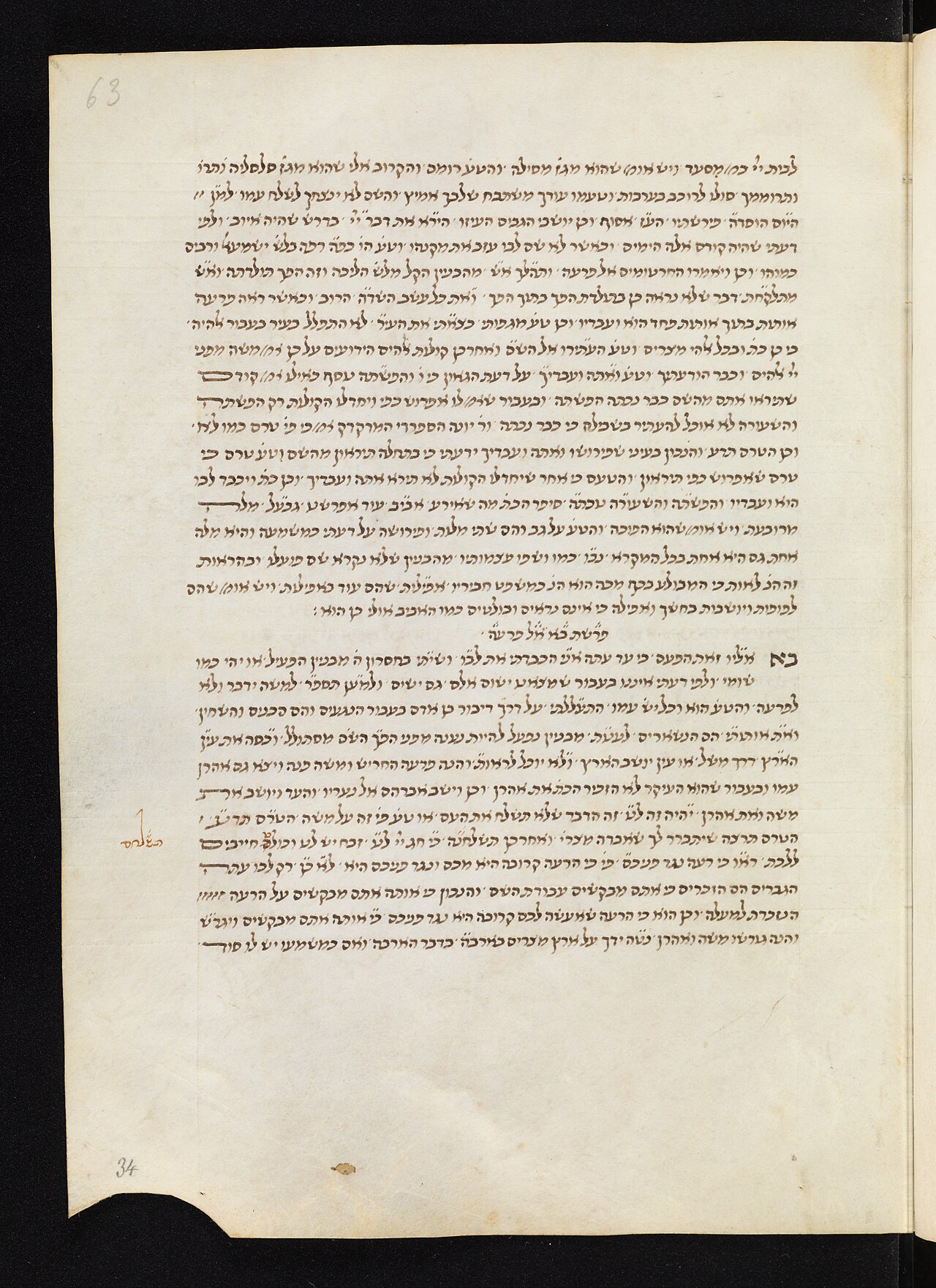
He composed it in Judaeo-Arabic - Arabic written in Hebrew characters, the everyday literary language of much of the medieval Jewish world - and addressed it to his student Joseph ben Judah, who had moved away and written with exactly these difficulties. The Guide argues that the anthropomorphic language of the Torah is not literal description but accommodation to human understanding. God has no body, no parts, no human emotions. The descriptions of divine anger or regret are figures of speech pointing at the effects of divine action in the world, not reports on God's inner states. More radically, Maimonides advances a doctrine of negative theology: because God is utterly unlike anything in our experience, the only accurate statements we can make about God are negative ones. We cannot say what God is; we can say what God is not. The tradition, properly read, had always meant this. The philosopher's discomfort with the literal reading was a sign that the philosopher was reading more carefully than the tradition's popular presentation suggested was necessary.
On the question of creation - whether the universe was made at a moment in time (the Torah's account) or had existed eternally (Aristotle's position) - Maimonides argued that Aristotle's proofs were not, in fact, logically conclusive. The question remained genuinely open. Since the Torah's account was coherent and not demonstrably false, it was the better position to hold. The engagement with Aristotle was philosophically serious throughout: Maimonides was not dismissing philosophy in favour of faith but engaging the philosopher on philosophical ground and finding his proofs insufficient. This was a very different move from simply asserting revelation over reason.
The Guide's reach beyond the Jewish world was extraordinary. Samuel ibn Tibbon translated it from Judaeo-Arabic into Hebrew in 1204 - completing the translation in direct correspondence with Maimonides, who died before he could fully review it. The Hebrew version was then translated into Latin in the 13th century under the title Dux Neutrorum or Dux Perplexorum, and the Latin translation reached the libraries of the Christian scholastics. Thomas Aquinas cited him as "Rabbi Moses" in the Summa Theologica and the Summa Contra Gentiles. The influence is traceable in Aquinas's treatment of divine attributes, in his method of reading scripture allegorically where literal reading generates philosophical difficulties, and in the overall project of demonstrating that revelation and reason are not enemies but complementary approaches to the same truth. Albert the Great, Aquinas's teacher, engaged with the Guide directly. A book written in Arabic for a single Jewish student in Egypt reshaped the intellectual foundations of medieval Christian theology.
Guide for the Perplexed (Moreh Nevukhim)
Composed in Fustat, Egypt, c. 1186-1190 CE in Judaeo-Arabic (Arabic written in Hebrew characters). Addressed to Maimonides' student Joseph ben Judah. Translated into Hebrew by Samuel ibn Tibbon in 1204 - in direct correspondence with Maimonides - and in a separate version by Judah al-Harizi. The Hebrew translation was rendered into Latin in the 13th century as Dux Neutrorum / Dux Perplexorum. Thomas Aquinas cited "Rabbi Moses" in the Summa Theologica and Summa Contra Gentiles; Albertus Magnus engaged with the work directly. The standard modern English translation is by Shlomo Pines (University of Chicago Press, 1963), with an introductory essay by Leo Strauss that remains essential reading for anyone approaching the work seriously.
University of Chicago Press · Pines translation, 1963Thirteen principles, and a prayer
The question of what Jews were required to believe had not, before Maimonides, been given a systematic answer. The tradition had commandments - 613 of them by the standard count, which Maimonides himself carefully enumerated in his Sefer ha-Mitzvot - but commandments are things you do. Belief is something else, and the tradition had not previously felt the need, or perhaps the philosophical pressure, to draw up a definitive list of required doctrines. Maimonides, working from his Aristotelian framework and from his sense that the tradition needed clear intellectual foundations if it was to survive the philosophical challenges of his age, produced thirteen.
The principles appear in his Commentary on the Mishnah, in the tractate Sanhedrin (chapter Chelek), completed around 1168 CE in Fustat - begun during the years of wandering but finished after the family had settled in Egypt. They cover the existence of God, God's unity, God's incorporeality, God's eternity, that God alone is worthy of worship, the reality of prophecy, that Moses was the greatest of the prophets, that the Torah in its present form was given at Sinai, that the Torah will not be replaced, that God knows human actions, that God rewards and punishes, the coming of the Messiah, and the resurrection of the dead. The act of listing these as thirteen necessary affirmations - the rejection of any of which constituted a departure from the community of Israel - was itself an innovation. The tradition had debated many of these propositions; assembling them into a creed was new.
The immediate response was controversy. Hasdai Crescas in the 14th century and Joseph Albo in the 15th argued that the list was mistaken - too many principles, or the wrong ones, or the wrong framing. The historian Marc Shapiro has shown, in The Limits of Orthodox Theology (Littman Library, 2004), that each of the thirteen principles was disputed by significant medieval authorities. The principles never achieved, formally, the status of an enforceable creed with institutional backing. And yet they became the basis of the Yigdal prayer - a liturgical poem whose thirteen stanzas correspond to the thirteen principles, incorporated into Shabbat and festival services across many traditions - and into the daily morning service in others - sung in synagogues across the world in traditions that otherwise have very little in common. A philosophical document produced to define the minimum intellectual requirements of Jewish belief became a congregational hymn. The tradition absorbed the argument and set it to music.
A summary written to define the minimum of Jewish belief became a congregational hymn. The tradition absorbed the argument and turned it into song.
The physician who was also everything else
A letter Maimonides wrote to his translator Samuel ibn Tibbon, who had asked to visit him in Fustat to discuss the Guide, survives in the Geniza. Maimonides described his day. He rose early and travelled to the palace of al-Fadil in Cairo, returning to Fustat - a journey of some distance - only in the afternoon, sometimes in the evening. At home, he found patients already waiting, sometimes a dozen or more, who had used his absence to gather outside his door. He saw them through. He ate - barely, he says, from exhaustion. He received them lying down, because by evening he could no longer sit upright comfortably. He asked ibn Tibbon not to make the journey: he could not give him the time the visit would require, and the journey would be wasted. The letter is written with characteristic precision and without self-pity. It is simply a report of what his days were like.
The medical practice was not a sideline. It was the source of the family's income in the years after David's death, and it was conducted with the same systematic intelligence he brought to everything else. His medical writings show the same habits of mind as his legal and philosophical work: the organisation of material by category, the willingness to criticise received authority when observation suggested it was wrong, the commitment to clarity over elaborate construction. He criticised Galen directly in his Medical Aphorisms - a move that was unusual in its directness for the period. He was a man of his age in the framework of his medical thinking, but he was unusually attentive to the empirical observation that older authorities had missed or misread. His medical treatises were read across the Islamic and Christian worlds and remained in use for centuries.
The pastoral work ran alongside the medical and the scholarly. Communities across the Jewish world wrote to him - with legal questions, with philosophical difficulties, with communal crises. The Letter to Yemen (Iggeret Teman), written c. 1172, addressed a community under severe pressure: persecution, pressure to convert to Islam, and the appearance of a local messianic claimant who was attracting followers and raising dangerous hopes. Maimonides wrote back not as a philosopher but as a pastor - in support and instruction, with historical perspective and practical counsel. He addressed the messianic claimant's claims directly and carefully. He told the community what they were facing was not unprecedented and would not be final. The letter was copied and distributed widely and became one of his most influential pastoral documents; the Yemenite Jewish community included a special blessing for Maimonides in their Kaddish for generations in gratitude for it.
What the Rambam leaves behind
Maimonides died in Fustat on 13 December 1204 CE. He was sixty-six years old. By tradition, Jews, Muslims, and Christians mourned him in Egypt - a detail, whether precisely accurate or somewhat amplified by later reverence, that captures something real about his standing in the broader intellectual world of his time. He had not been a figure only of the Jewish world. He had been a figure in the world.
His body was taken, according to tradition, to Tiberias in the Land of Israel for burial - a journey of considerable distance that speaks to the community's sense of what it was transporting. No contemporary source documents the transfer from Egypt; the burial in Tiberias rests on medieval tradition. The tomb has been venerated since at least the medieval period and is still visited by thousands of pilgrims annually. The Hebrew inscription associated with it - "From Moses to Moses there arose none like Moses," placing Maimonides alongside Moses of Sinai - is a later saying, not a self-description; it appears in various forms in the literature from around the 14th century. The tradition was not modest about him. It was not wrong.
The work left behind is vast: the Commentary on the Mishnah (including the thirteen principles and extensive philosophical introductions), the Sefer ha-Mitzvot, the Mishneh Torah, the Guide, the medical writings, the responsa - hundreds of legal decisions sent to communities across the Jewish world - and the letters. Every significant Jewish legal code written after him is in conversation with the Mishneh Torah, either following it, departing from it, or arguing with it explicitly. Every serious subsequent attempt to reconcile Torah and philosophy takes its starting point from the Guide. The Aristotelian scholastics of 13th-century Europe, Thomas Aquinas among them, built on foundations he had laid. The Yigdal is still sung.
The controversies he generated never fully resolved, which is - from the perspective of a tradition whose vitality depends on productive argument - not a failure but a signal of how much he gave the tradition to argue about. The Rambam was not afraid of the question. He was constitutionally incapable of leaving it half-answered. That combination - the refusal of the lazy answer, the commitment to rigour across the full width of what was known in his time, the persistence that carried it through exile and exhaustion and grief - is what the thread runs gold through him for.
Further reading