A question leaves Kairouan. Another leaves al-Andalus. Another comes from Egypt, or Yemen, or some smaller community whose name survives now only because somebody kept the paper. They travel east through the ordinary communications networks of the age - along trade and travel routes by land and sea. In Babylonia, in the academies of Sura and Pumbedita, they are read, argued over, answered, copied, and sent back out again. That answer is not merely a private letter. It is law in motion. For the Jewish world between roughly 589 and 1038 CE, the geonic academies did something remarkable: they turned correspondence into cohesion.
The Geonim were the heads of those two Babylonian academies, in what is now Iraq, heirs to the Talmudic world and, for centuries, its most widely recognised legal authorities. Tradition likes a clean line of command, and one can see why. A dispersed people, no state, no capital in the usual sense, yet communities thousands of miles apart still asking the same court how to keep Shabbat, write a contract, settle an inheritance, order a prayer service, or understand a difficult page of Talmud. History is a little less tidy and more interesting. The authority was immense, but it was exercised through writing - patient, interpretive, portable writing. A postal civilisation, in effect. Jewish continuity has often looked like that: not marble first, but manuscript.
That is why the responsum matters. In Hebrew, she'elah u-teshuvah - a question and an answer. The form sounds modest. Its consequences were not. Responsa allowed a village with no great scholar of its own to speak to the centre, and allowed the centre to travel back without leaving its desk. The genre knitted the diaspora into a single legal conversation. It also did something subtler. It trained communities to think of themselves as participants in one argument, even when they lived under different rulers, spoke different vernaculars, and had never seen Babylonia with their own eyes.

The academies and their reach
Sura and Pumbedita were not merely schools in the modern sense. They were academies, courts, archives, and engines of standardisation. The Babylonian Talmud had already given Babylonia enormous prestige. The Geonim inherited that prestige and operationalised it. Questions came in close at hand from Babylonia and neighbouring regions, then from farther afield as communities less able to consult the Talmud directly looked east for rulings. Early answers could be brief. Later ones often became essays, even small books. Amram Gaon's prayer order, sent to Spain in response to a question about liturgy, is one famous example. Sherira Gaon's great letter to Kairouan, written in 987, is another: a responsum so expansive that it became one of the classic sources for the history of the Mishnah and the Talmud.
There is something quietly thrilling about that. A community writes in from Tunisia asking, in effect, how the tradition itself was assembled, and a gaon in Pumbedita answers with a historical narrative. The legal reply becomes historiography. The ruling comes wrapped in memory. That is not accidental. For the Geonim, halachah was never merely a list of outcomes. It was a chain of transmission, and the answer mattered in part because it could show where it came from.
Much of this survives because of the Cairo room we now call the Geniza. Fragments from geonic correspondence, copies of their rulings, and later manuscripts preserving their words ended up in the storeroom of the Ben Ezra Synagogue in Fustat. Dry air did the rest. Without that Egyptian attic, the geonic age would look grander, flatter, and thinner - grander because only later reputation would remain, flatter because the texture of exchange would be gone, thinner because so many actual pages would have vanished. The Geniza gave the argument back its handwriting.
Geonic responsa in the Cairo Geniza
Surviving responsa of the Geonim exist in several states: some in their original form, some quoted in later books, and many in Geniza fragments. Cambridge Digital Library's Genizah collection includes manuscripts catalogued simply as responsa, alongside the larger Taylor-Schechter corpus that preserves the paper traffic of the medieval Jewish world. The significance is plain enough. These are not legends about authority. They are the paperwork of authority.
Cambridge Digital Library · Taylor-Schechter Cairo Genizah CollectionSaadia, the towering figure
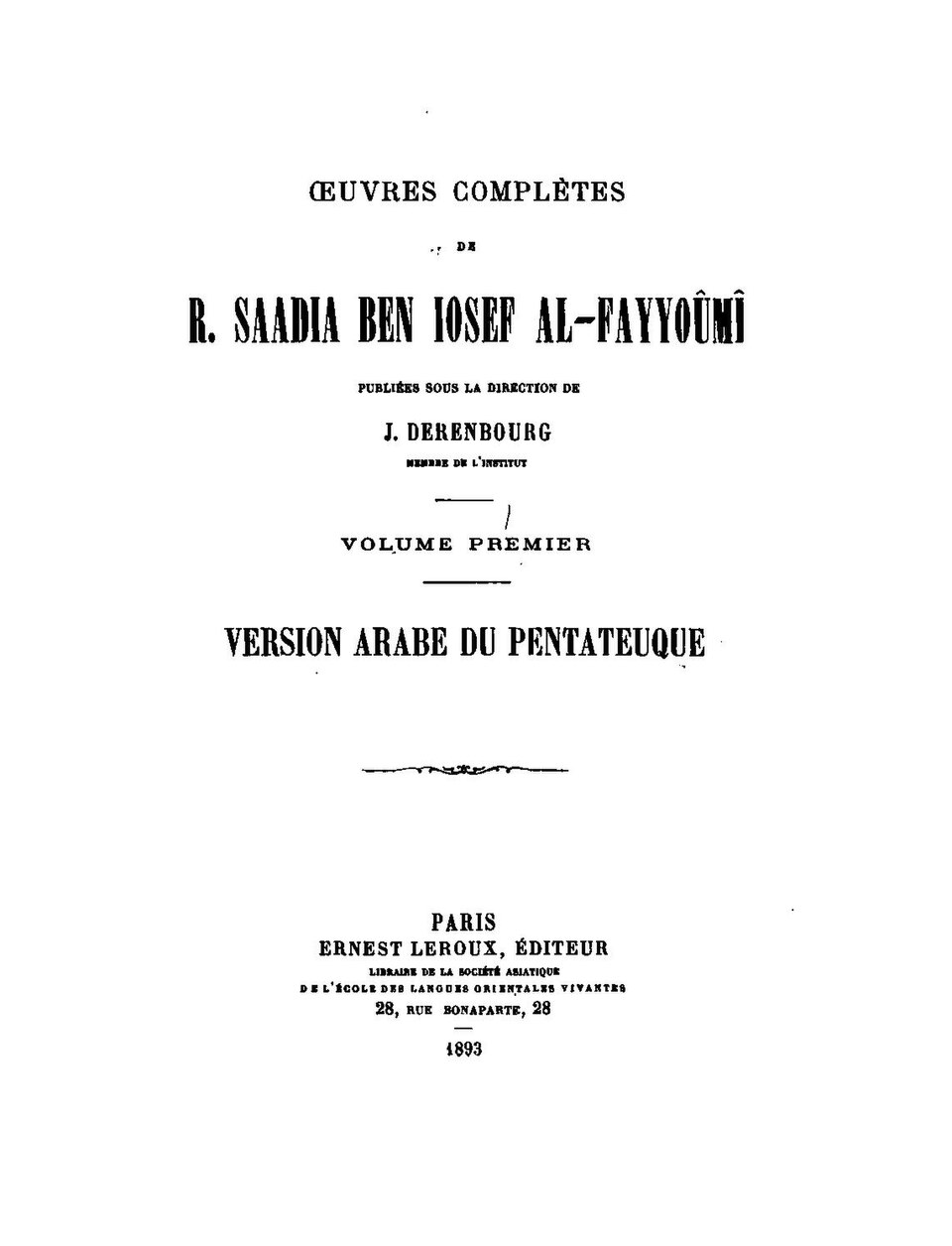
If one geonic name still stands in full architectural relief, it is Saadia Gaon. Born in Fayyum in Egypt in 882 and dead in 942, he was not Babylonian by birth and became gaon of Sura anyway - which tells you something both about his brilliance and about the seriousness of the age. Saadia wrote across genres with unnerving ease: Bible translation, grammar, liturgy, law, polemic, philosophy. The Stanford Encyclopedia of Philosophy calls him a key figure in Jewish communal life and the first major rabbinic thinker to write extensively in Judeo-Arabic. He was, in other words, not only a transmitter of tradition but an adapter of medium. He made rabbinic Judaism speak in the language the age was actually using.
That matters for the story of responsa because Saadia shows the geonic office at full stretch. He was a jurist, certainly, but also a public intellectual of the diaspora. In the calendar controversy of 921-922, he threw his pen into a dispute that threatened to split communities over the dating of festivals. He wrote for scholars, but he also wrote so communities could remain communities. Law, language, and belonging are not separate departments in Jewish history. They tend to arrive in the same envelope.
The geonic world was strongest when it could do both things at once - answer a narrow question and reinforce a shared framework. That is why the genre outlived any single gaon. Even when the query was local, the method was general. Cite the Talmud. Interpret with care. Decide. Send the answer back out into the world. A people can travel a long way on that kind of discipline. It did.
That fraying is part of the story, not its failure. A legal culture that depends on letters will eventually create more readers, better readers, and then rival answerers. Success breeds decentralisation. The Babylonians taught the diaspora how to ask; eventually the diaspora learned how to answer as well.
A scattered people kept one legal conversation going for centuries. The road was paper.
A Cairo Geniza fragment of Saadia Gaon
Halper 276, now in the University of Pennsylvania's Cairo Genizah Collection, preserves part of a bakashah by Saadia Gaon with intermittent Judeo-Arabic translation. OPenn dates the copy to the twelfth or thirteenth century and marks the images free of known copyright restrictions. The object matters beyond liturgy. A geonic text written in the tenth century was still being copied, translated, and used generations later, far from its first moment. Authority had legs.
OPenn · University of Pennsylvania Libraries, Halper 276When the centre moved west
The conventional end of the geonic period is 1038, the year of Hai Gaon's death. Dates that neat are always a little ceremonial, but this one is useful. By then the old Babylonian monopoly had plainly weakened. Study of the Talmud had deepened in North Africa and Spain. Communities that once wrote east for decisions were increasingly consulting scholars closer to home. The age of the Rishonim was beginning - not as a rebellion against the Geonim, but as their consequence. The centre of gravity shifted westward because the geonic system had succeeded too well in teaching the wider Jewish world what serious legal reasoning looked like.
That shift did not erase Babylonia. It absorbed it. Spanish and North African scholars inherited geonic rulings, geonic forms, geonic habits of argument. The responsum remained the great travelling genre of Jewish law. It simply acquired new addresses. If the Geonim built the postal civilisation, the Rishonim expanded the franchise.
There is confidence in that story, and rightly so. A dispersed minority, often prosperous, sometimes precarious, managed to maintain a shared legal culture across enormous distances without state power behind it. That is not a footnote to Jewish history. It is one of its master achievements. The academies of Sura and Pumbedita did not hold the diaspora together by sentiment alone. They did it by answering letters, one after another, until scattered communities could hear themselves as one people thinking aloud.
The image to keep is not a throne, but a desk. Paper arriving worn at the edges. A question opened in Babylonia. An answer folded for the road.
Further reading