The story goes like this. Jerusalem is besieged, the factions inside the walls are killing each other almost as efficiently as the Romans outside, and a rabbi named Yochanan ben Zakkai has decided he needs to leave. The Zealots aren't letting anyone out alive - so he arranges to be carried out dead. His students spread the word that the great teacher has died of plague. They fashion a bier, they lay him in it, and at the gates they explain that Jewish law demands the body be buried outside the city walls. The guards let them through.
This is the tradition as Gittin 56a-b tells it, and the stone register is honest: it's tradition. The Talmud was compiled some centuries after the events it describes, the details vary between tellings, and no Roman record confirms the scene. What we have is the story the rabbis chose to tell about their own origins, and it is instructive that this is the story they chose: not a miracle, not a battle, not a martyrdom. A man in a coffin, thinking three moves ahead.

Once through the gates, Yochanan was brought before the Roman commander - who would shortly become the Emperor Vespasian. The story says Yochanan greeted him as king, and that within moments a messenger arrived confirming the promotion. Whether or not it happened that way, the structural point is clear: Yochanan was a man who read the room. He knew the Temple was finished, and he wasn't there to save the building. He was there to save the thing the building contained.
His request, in the tradition's words, was: ten li Yavneh ve-chachameha - give me Yavneh and its sages. The Talmud (Gittin 56b) records two further requests: the preservation of Rabban Gamliel's dynasty, and physicians for Rabbi Tzadok. But the first petition is the one history fastened on. A small town on the coastal plain, an academy, the scholars who could fill it. Vespasian, who presumably expected a demand for hostages or treasure, agreed. He had just granted the Jews the right to survive as a civilisation, and he didn't know it.
The audacity of the pivot
What the Yavneh academy did in the years after 70 CE is one of the more breathtaking acts of institutional improvisation in history. The Temple had been the engine of Jewish life for centuries - not merely a place of worship but the literal mechanism of it. Sacrifice was the covenant in action: the burnt offering, the grain offering, the paschal lamb slaughtered and eaten on Passover eve. Without a Temple there was, by every existing logic, no way to perform the religion. The Zealots had fought because the Temple was non-negotiable. It was over.
The rabbis at Yavneh decided it wasn't over. They decided, with a boldness that still takes the breath away, that everything the Temple did could be done differently. Prayer replaced sacrifice - three daily services mapped onto the rhythm the offerings had kept. Torah study wasn't merely preparation for worship; it was worship, with the same ritual weight the altar had carried. The Passover seder - already a home ceremony, already a story told at a table - was now the complete act: the retelling and the meal, the lamb replaced by the shank bone and the memory of the lamb. A Temple religion became a text civilisation, and it did it in roughly one generation.
This was not painless and it was not unanimous. The rabbis argued ferociously - and the Talmud preserved the arguments, which is itself part of the point. The school of Shammai and the school of Hillel had been at it for generations before the destruction; afterwards, the disagreements multiplied rather than resolved. Yavneh was a place where disputes went to be recorded, not settled.
The Hammat Tiberias Synagogue Mosaic
A mosaic floor from the ancient synagogue at Hammat Tiberias, near the lake's southern shore, survives in three panels: a Torah shrine flanked by menorahs, a zodiac wheel with the sun-god Helios at its centre, and Greek donor inscriptions guarded by lions. It is a remarkable object for a religion that had just negotiated life without a Temple - the liturgical furniture of the old world rendered in new materials, on a new kind of sacred floor, in the landscape where the Mishnah was being compiled. The synagogue replaced the sanctuary. The mosaic is still there.
Hammat Tiberias National Park, Israel; excavations by the Israel Antiquities AuthorityUsha, and then the Mishnah
Yavneh didn't last. The Bar Kokhba revolt of 132-135 CE - the last great military attempt to reverse the destruction - brought Roman retaliation so severe that Jewish life in Judaea was effectively ended. The academy relocated, first to Usha in the Galilee and then across the Galilean towns, following the sages and the surviving population northward. The Galilee became the centre, and it stayed the centre for several centuries. Tiberias, Sepphoris, Beit She'arim - these are the addresses of the argument now.
It was in this Galilean world, around 200 CE, that a patriarch named Judah ha-Nasi - Judah "the Prince," head of the Jewish community under Roman tolerance - made the decision that sealed the whole project. He compiled the Mishnah: six orders, sixty-three tractates, centuries of legal debate and religious practice, set down and organised. The Oral Law, written down.
That phrase needs a pause. The law had been oral not by accident but by conviction. To write it down was to fix it, to close it, to hand it to anyone who could read rather than to students formed by years with a teacher. The rabbis before Judah had resisted the idea with something approaching horror. What changed his mind, the tradition says, was fear: persecution was scattering the sages, and if the sages scattered without leaving a text behind, everything would go with them. Better an imperfect written record than a perfect oral tradition that nobody living could remember. It was the same logic Yochanan had used at the gates of Jerusalem - read the room, save what can be saved, accept the loss the situation demands.
The Kaufmann Manuscript of the Mishnah
The oldest and most complete manuscript of all six orders of the Mishnah, MS A50 sits in Budapest at the Library of the Hungarian Academy of Sciences. Scholars date it to the 10th or 11th century CE - perhaps eight hundred years after Judah ha-Nasi compiled the text it copies. The manuscript includes vocalisations added by a later hand from a different textual tradition, which means even this earliest surviving copy already carries a palimpsest of rabbinic argument. There is no manuscript tradition that isn't also a commentary. This one just makes it visible.
Library of the Hungarian Academy of Sciences, Budapest (MS A50)Two Talmuds and a portable homeland
The Mishnah wasn't an ending; it was a prompt. Within a generation, the academies in the Land of Israel and in Babylon - where the exile community had never fully left - were producing commentary on the commentary, argument on the argument. By the 5th century CE the Jerusalem Talmud was complete, a leaner record of the Galilean debates. By the 6th or early 7th century the Babylonian Talmud was complete too: vaster, more digressive, more argumentative, and for reasons that probably have more to do with political stability than intellectual quality, the version that became authoritative everywhere. The academies at Sura and Pumbedita had built the more durable structure.
What they had built, though neither the phrase nor the full understanding of it was available to them, was a portable homeland. The Talmud was a record of a community thinking together across time - sages in the text arguing with sages long dead, editors in Babylon incorporating disputes from the Galilee, students in every subsequent century joining an argument that had no fixed conclusion. You could carry it across an ocean and the argument continued, exactly as it had in Sura, exactly as it had in Yavneh, exactly as it had in the coffin at the gates of Jerusalem.
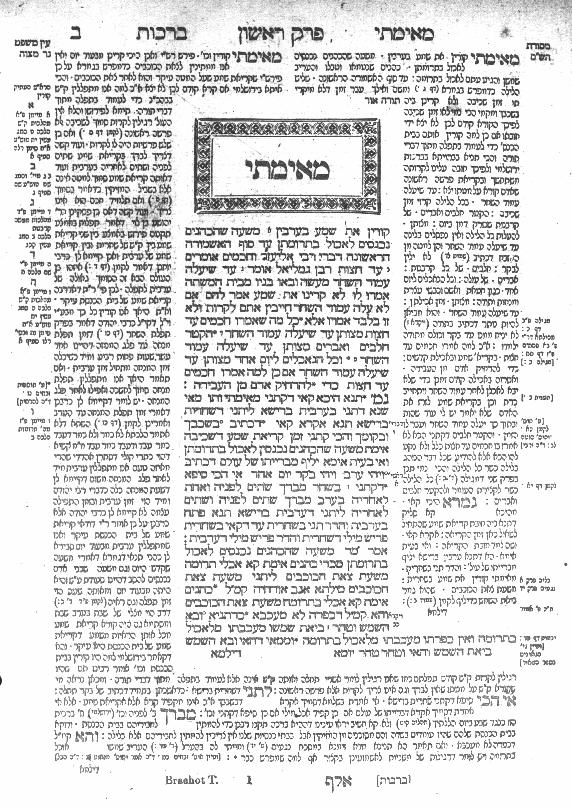
The chain from Yochanan's petition to the yeshiva student opening a daf today is unbroken. Every printed edition of the Talmud follows the pagination established in Venice in the 1520s by the printer Daniel Bomberg - a Christian printer, as it happens, which is exactly the kind of detail the stone register can't resist - and standardised definitively in the Vilna edition of 1880-1886. Open any tractate and the architecture is immediately legible: Mishnah text at the centre, Gemara around it, Rashi's commentary running inside, Tosafot running outside, additional cross-references and legal citations marshalled in the remaining margins. Centuries of response, wrapped around the text. The Talmud page didn't invent margin notes; it was margin notes, long before any digital format thought to claim the idea.
Rome minted coins saying Judaea Capta. The coins are now in museums. The argument moved into books and has not stopped since.
The thing they actually saved
The loss of the Temple was real and the grief was real - Tisha b'Av, the fast commemorating the destruction, has been observed every year since 70 CE, and is still observed today. The rabbis weren't in the business of minimising catastrophe. But they were in the business of response, and their response was extraordinary: they looked at what they had and decided it was enough to build from. Prayer, study, the table, the calendar, the argument itself - these weren't consolation prizes for the absence of the altar. They were a civilisation.
Temple religion had required a single address. You went to Jerusalem, you brought your offering, the priest performed the rite. Rabbinic Judaism requires only a minyan, a text, and someone willing to argue. It has no fixed address. It has been practised in the academies of Babylon, the courtyards of Cairo, the cellars of Worms, the attics of Warsaw, the community centres of Melbourne, and - if the tradition is to be believed - in a coffin being carried through the gates of a besieged city by two students who trusted their teacher's plan. The building ended. The argument didn't.
Further reading
Story & Stone · The Tribe of Learning Nº 3
Next on the shelf: Second Temple politics - the world Yochanan was escaping →