Some scholars leave a shelf. Nahmanides left a bridge. Moses ben Nahman - Ramban, to the Jewish world; Bonastruc ça Porta, to his Catalan neighbours - was born in Girona in 1194 and died in the Land of Israel around 1270. Between those dates he became the great rabbinic authority of Catalonia, a master of Talmud, a halakhist, a biblical commentator, and one of the earliest major figures to let Kabbalah breathe inside mainstream Torah interpretation without turning the whole page into mist.
That combination mattered because the 13th century was not gentle. Jewish communities in Christian Spain were intellectually vigorous and socially exposed at the same time. Philosophy was pressing hard from one side, ecclesiastical pressure from another, and the old labour of keeping a learned community learned never stopped just because the century had developed other hobbies. Ramban's greatness lies partly in the fact that he did not confuse drama with importance. He held the line in the ordinary places - the page, the beit midrash, the communal quarrel, the legal ruling - and so he was ready when history forced him into the royal palace.
He is often described as a commentator, which is true in the same way that calling a keel part of a ship is true. His Torah commentary became one of the classic Jewish ways of reading Scripture. His Talmudic writings carry the authority of a mind that knew both the northern French dialectic and the Sephardi legal tradition. His name is attached to Barcelona in 1263 because that was the public moment. His real achievement was larger and quieter. He made fidelity to inherited learning look confident again.

Girona and the page
Girona was not a provincial cul-de-sac. Its Jewish community was one of the important centres of Catalan Jewish life, and its scholars stood close to the early flowering of Spanish Kabbalah. Ramban studied Talmud under Judah ben Yakar and Nathan ben Meir of Trinquetaille; later tradition also links him to Azriel of Gerona in the mystical line descending from Isaac the Blind. That sounds grand, but the real point is simpler: he grew up where learning was dense, varied, and argumentative, and he learned to carry more than one register at once.
His Torah commentary shows the habit everywhere. Ramban reads closely. He cares about grammar, sequence, context, and the plain force of the verse. He argues with Rashi where he must, with Ibn Ezra where he thinks the matter requires it, and with Maimonides when rational explanation begins to flatten what Scripture is actually saying. Yet he also signals, at chosen moments, that there is more in the verse than the surface can hold. The plain sense remains the front door. The deeper chamber is not denied. It is simply entered with decorum.
That balance is why the commentary endured. Too much peshat on its own can become a cleverness that leaves the reader colder than he arrived. Too much esoteric smoke and the text disappears into performance. Ramban does neither. He keeps Scripture legible while refusing to pretend that it is merely literal. The result is a page that feels intellectually honest and spiritually inhabited at the same time. Judaism has always had room for argument. It has less patience for aridness.
Vikkuach HaRamban - Ramban's account of the Barcelona disputation
The Disputation of Barcelona took place before King James I of Aragon in July 1263, with Pablo Christiani, a Jewish convert who argued for Christian claims from rabbinic texts, facing Nahmanides as the Jewish spokesman. Ramban later wrote a Hebrew account of the exchange. Whatever one makes of every detail in that text, it preserves the shape of his method: patient definition, textual precision, and refusal to concede the frame. He did not treat the Talmud as quarry for someone else's sermon. Quite right too.
Ramban's Hebrew report of the disputationBarcelona without theatre
The Barcelona disputation is the episode people remember because it has scenery: king, friars, court, danger, consequences. It deserves to be remembered, but not as a triumphalist anecdote and not as a jeer at Christianity. It was a coercive medieval religious contest in which the terms were not set by the Jews. Pablo Christiani, backed by Dominican authority, wanted to argue from the Talmud and Midrash that rabbinic tradition itself proved Christian doctrine. King James compelled Ramban to answer, though the king also granted him unusual freedom to speak frankly.
Ramban answered as a rabbi should answer - by returning texts to their own context, by insisting that aggadah is not a sack of detached slogans, and by stating clearly that Judaism did not understand the Messiah in the terms Christiani was demanding. His dignity in the debate is the point. He neither blustered nor begged. He argued as though Jewish learning had a right to stand upright in public, because it did.
The consequences were real all the same. The Dominicans claimed victory. Ramban published his version of the proceedings. Complaints followed. In 1264 King James remitted part of a fine imposed on him, yet the atmosphere had changed, and the path back to ordinary communal leadership in Catalonia had narrowed sharply. By 1267 he was in the Land of Israel. The debate did not break him. It dislodged him.
There is a reason the episode still matters. It was not only about one rabbi's bravery. It was about whether Jewish texts could still be read by Jews on Jewish terms when power insisted otherwise. Ramban's answer was that they could, and must. The king heard a formidable mind. The Jewish world heard something even more useful: steadiness under pressure.
Ramban's gift was not to choose between clarity and depth. He kept the verse plain enough to enter and deep enough to stay in.
The Jerusalem letter
After reaching Jerusalem in 1267, Ramban wrote to his son describing the city as devastated and thinly inhabited, yet still beloved. Later tradition preserves the line that there were only two Jewish residents there, brothers who worked as dyers; other versions speak more broadly of a tiny community able to gather a minyan on Shabbat. The details are argued over. The central fact is not. Ramban reached Jerusalem, found it battered, and wrote of Jewish life there as diminished but unbroken.
Letter attributed to Ramban to his sonJerusalem, desolate and not abandoned
That last point matters because modern people like clean binaries and history rarely provides them. Jerusalem in Ramban's day was not flourishing. It had been through Crusader conquest, Muslim reconquest, and further devastation. He saw ruin. He also saw Jews still there. This is the connection to the larger thread of Jewish history in the land: not uninterrupted comfort, which would have been news to nearly everyone involved, but uninterrupted presence. Small, strained, sometimes barely there to the casual eye - and still there.
Ramban's move east was therefore more than retirement in holy scenery. In the land he found, learning needed rebuilding as much as buildings did. He settled finally in Acre, gathered pupils, and in those years completed the Torah commentary that became his most famous work. The old scholar from Girona did not arrive in the Levant to reminisce. He arrived to resume the labour.
Tradition also places him at the beginning of the Ramban Synagogue in Jerusalem. The tradition is old and cherished: that he found a ruined structure, helped organise a synagogue, and encouraged Jews to gather again in the city. Scholars are more cautious about the exact building history, and rightly so. But caution is not cancellation. Even where the masonry gets argumentative, the memory points to something solid - Ramban as a restorer of communal life in Jerusalem, not merely a visitor passing through the ruins with a good line for a letter.
The Ramban Synagogue tradition
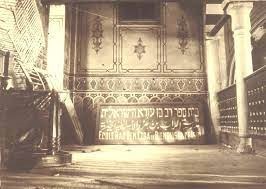
The institution later known as the Ramban Synagogue in Jerusalem is traditionally linked to Nahmanides' arrival in 1267. A 16th-century Italian pilgrimage scroll, now in the National Library of Israel and published by the Posen Library, already shows a synagogue in Jerusalem carrying his name. The congregation is traditionally linked to Nahmanides' arrival in 1267; the current site's medieval structure dates to c. 1400, and the present building is a post-1967 reconstruction over those ruins. Tradition keeps the founder close. Architectural history asks harder questions. Both belong on the page.
Posen Library / National Library of IsraelThe hinge he held
Nahmanides sits at a hinge moment because so many lines meet in him. He is traditional without being timid, mystical without becoming vague, legal without becoming dry, and public without becoming theatrical. He belongs to Girona and to Jerusalem, to the Talmudic page and to the royal court, to the argument with philosophers and to the continuity of ordinary Jewish reading. When later generations opened the Chumash with Ramban, they were not only consulting a great medieval commentator. They were inheriting a way of staying whole.
That, finally, is why his story lands with such force. Communities survive pressure when they still know how to read themselves. Ramban helped make that possible. He carried the text, the law, the inner current, and the communal nerve across a narrowing bridge, and the bridge held.
Further reading
- Biblioteca Nacional de Portugal: 1489 Lisbon edition of Ramban's Perush Ha-Torah
- English translation: The Disputation of Barcelona
- Posen Library: The Synagogue of Nahmanides in Jerusalem
- Nachmanides: biography, works, and Jerusalem years
- Ramban Synagogue: tradition, building history, and scholarly caution