The Malabar coast smells of black pepper and rain. It always has - traders from the Mediterranean knew it two thousand years ago, and they came for the spices and the welcome, which were both reliable. Among them, the story tells us, were Jews. The tradition in Cochin itself goes back further still: Solomon's ships, the account says, sailed here for the ivory and monkeys and peacocks mentioned in the Book of Kings, and some of the words the text uses for those things turn out to be derived from Sanskrit. That may be the oldest argument for Jewish-Indian contact ever made by a linguist, and it wasn't made by a linguist. It was just there in the text, waiting.
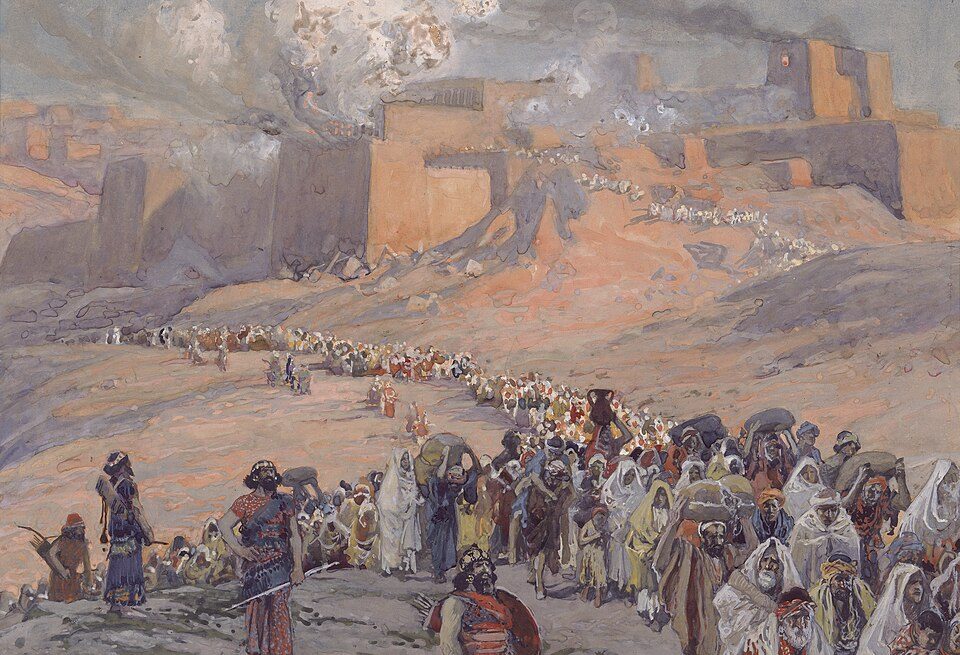
The documentary record is firmer from the period after the Second Temple's destruction in 70 CE. Jewish settlers are attested on the Malabar coast in growing numbers from the early centuries of the common era; the Cairo Geniza - that extraordinary accidental archive of Jewish life preserved in a Cairo synagogue storeroom - contains letters and trade documents from the eleventh and twelfth centuries showing Jewish merchants in active partnership with Hindu trading houses, moving pepper, indigo, and textiles between the Indian coast and the Mediterranean world. The spice trade that held the medieval world together ran partly on Jewish credit, Jewish ships, and Jewish commercial networks. Cochin was one end of that thread, and Cairo was another, and the Geniza caught the correspondence between them.
The community that formed on the Malabar coast was not a community in exile. That is what makes it unusual, and what makes it matter. These were traders who had found a good harbour and stayed - welcomed, settled, and, in time, granted privileges that would have seemed extraordinary anywhere else in the medieval world. They called themselves the Malabari Jews, or the Black Jews - a name whose racial politics later became fraught, but which in its original context simply marked them as the old community, the ones who had been there longest, as distinct from the Paradesi Jews, the "foreigners," who arrived much later as refugees from Spain and Portugal.

The copper plates
Around the year 1000 CE - the exact date is debated, but most historians now accept approximately 1000 or 1001 CE - the Chera king of Kerala, Bhaskara Ravi Varma, granted a charter of privileges to a Jewish merchant leader named Joseph Rabban. The grant was inscribed on copper plates in Old Malayalam - the number and precise dating of the original plates has been debated by scholars, as the surviving tablets have been copied and added to over the centuries. The privileges were extraordinary. Joseph Rabban received hereditary rights to land in Cranganore, exemption from taxes, the right to ride an elephant and travel under a silk umbrella - marks of semi-royal status in the caste hierarchy - and the right to transmit all of this to his descendants in perpetuity. The king was granting him, in effect, a permanent place of honour within the social fabric of Kerala. Not tolerance. Honour.
The copper plates have survived. They are kept in an iron box inside the Paradesi Synagogue in Mattancherry, Cochin, where they are occasionally displayed. They are the oldest dated documentary evidence of a Jewish community in India. They are also, if you read them slowly, a quietly remarkable document: a Hindu king and a Jewish merchant reaching a formal agreement about mutual respect and mutual benefit, inscribed in metal so it would last. It lasted.
The Copper Plates of Joseph Rabban
Copper plates bearing a royal charter in Old Malayalam, granting Joseph Rabban and his descendants hereditary privileges including land rights, tax exemptions, and ceremonial honours equivalent to those of minor royalty. Issued by Bhaskara Ravi Varma, king of Kerala. The plates are the oldest surviving documentary evidence of Jewish settlement in India, and they have been in the continuous custody of the Cochin Jewish community since they were first issued - held now, as they have been for centuries, inside the Paradesi Synagogue.
Paradesi Synagogue, Mattancherry, Kochi, KeralaChinese tiles and Belgian light
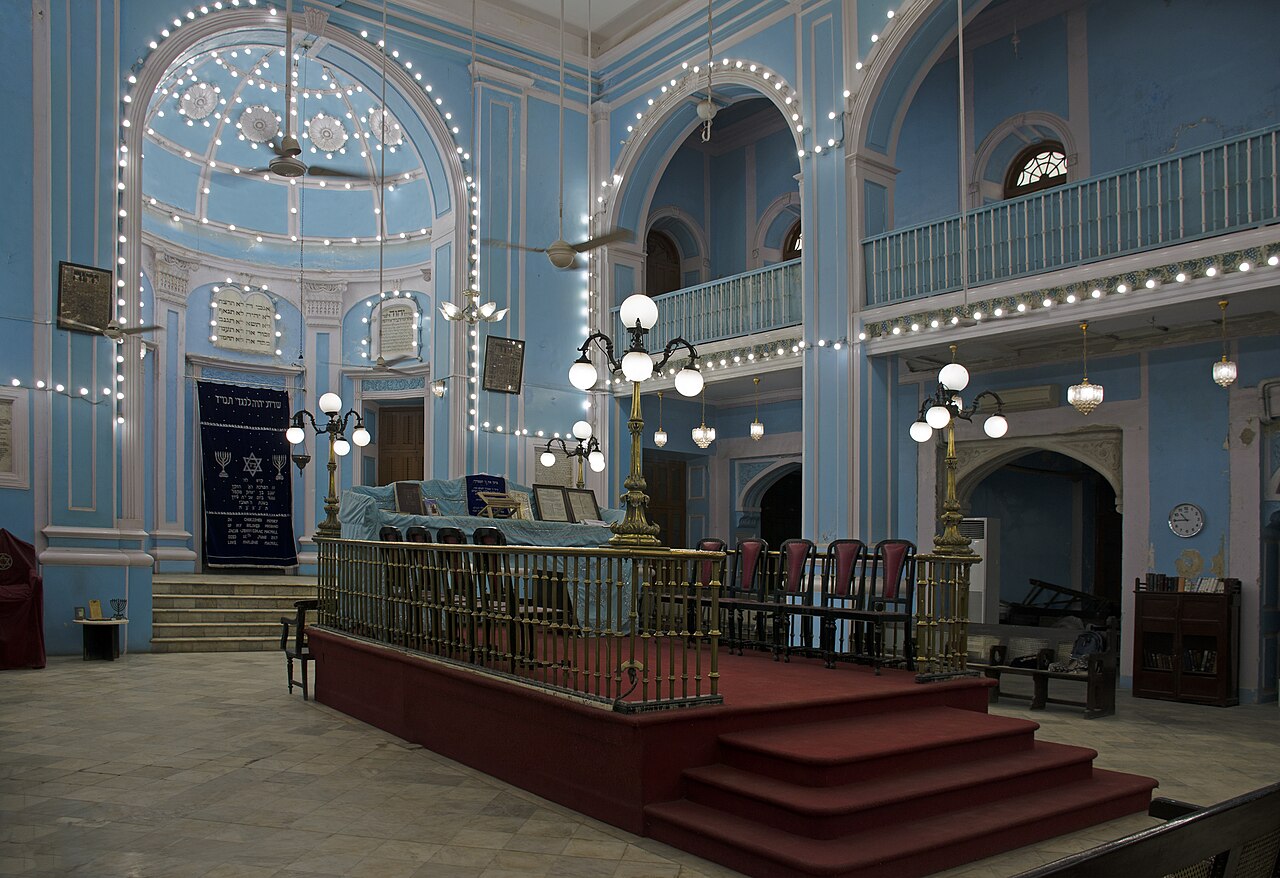
The Paradesi synagogue - built in 1568 by the community of Jewish refugees who had come to Cochin after fleeing the Portuguese expulsion from their earlier settlements - is one of the most visually improbable buildings in the world, and that's before you've noticed the floor. The floor is covered in hand-painted tiles from Canton, each one unique, each one showing a willow-pattern design in blue and white. There are 1,100 of them. They were added during a major renovation in 1762, commissioned by the merchant Ezekiel Rahabi, and the effect is of a Jewish synagogue in India tiled with Chinese porcelain - which is precisely what it is, and which is either deeply strange or perfectly logical depending on how you think about a port city on a trading coast where goods from three continents passed through constantly.
The light inside falls through Belgian chandeliers, nineteenth century, suspended above the women's gallery of carved teak. The ark that holds the Torah scrolls is carved in the same wood. On the reading desk rests a Torah crown that came from somewhere else, at some point, by some route. The synagogue is an anthology of the world the community traded with - Chinese, Belgian, local - assembled around the fixed point of the Torah and the Hebrew calendar. Cantonese tiles at Pesach. The same prayers, the same text, the same moon-counted dates. Same story. Different everything else.
The synagogue was destroyed by Portuguese forces in 1662, and rebuilt within two years after the Dutch took Cochin from them. That pattern - destruction, reconstruction, continuity of practice - is one the tribe knows well. The Dutch were more sympathetic; trade was trade, and the Jewish merchants were good for it.
Cantonese tiles and Belgian chandeliers, carved Kerala teak - assembled around the fixed point of Torah and the Hebrew calendar. Same story. Different everything else.
The Paradesi Synagogue, Mattancherry
Built in 1568 by the Paradesi Jewish community of Cochin, destroyed by Portuguese forces in 1662, and rebuilt under Dutch protection by 1664. The floor was re-tiled in 1762 with 1,100 hand-painted Canton willow-pattern tiles - each unique. Belgian chandeliers, installed in the nineteenth century, still illuminate the interior. The synagogue remains in use and is the oldest active synagogue in the Commonwealth of Nations. It contains, among its treasures, the copper plates of Joseph Rabban. There are not many buildings in the world that can be described as simultaneously Jewish, Indian, Chinese, and Belgian.
Paradesi Synagogue, Mattancherry, Kochi, Kerala (in use)The songs the women kept
Here is the thing no one tends to lead with when they describe the Cochin Jewish community, and it's the most remarkable of all: for centuries, the women sang. Not in Hebrew - or not only in Hebrew. They sang in Malayalam, the language of Kerala, setting Jewish themes and Jewish occasions to the music of their Indian home. Weddings, the festivals, Shabbat - all of it had a Malayalam song tradition, composed and carried by the women of the community across generations, passed from mothers to daughters in the same continuous chain by which the whole inheritance was kept.
More than sixty of these songs have been recorded, some in field recordings made in the late 1970s, others in studio recordings since. The sound archives of the Jewish Music Research Centre at the Hebrew University in Jerusalem hold the largest collection. In 2004 the Centre published a CD called "Oh Lovely Parrot! Jewish Women's Songs from Kerala" - forty-two songs in a language spoken by 35 million people on the southwestern coast of India, drawn from a written repertoire of more than three hundred texts, setting scenes from the Torah and the liturgy in the melodic modes of Carnatic music. The Shabbat song in Malayalam. The Pesach song in Malayalam. The same festivals, in the music of the coast where the community had lived for two thousand years.
This is what transmission looks like from the inside: not just the men learning Torah in the synagogue (which they did), but the women in the kitchen and at weddings ensuring that the tradition lived in the body, in the voice, in the music that children heard before they were old enough to learn anything deliberately. The tradition survived partly because the women sang it into people who hadn't yet decided whether to keep it.
The ships home, and the songs that went with them
After Indian independence and the establishment of the State of Israel, most of Cochin's Jews made aliyah. The mass emigration happened primarily in the early 1950s, with the greatest numbers arriving in 1954. They left a world they'd occupied for two millennia, and they brought with them the copper-plate memory, the Malayalam songs, and the particular Cochini rite - the "Shingli" liturgy, named after Cranganore, the ancient port city where the first communities had settled - that was theirs and no one else's.
They were settled on moshavim in Israel: Nevatim in the Negev, Mesillat Zion and Aviezer in the Jerusalem Corridor, Kfar Yuval in the north. Nevatim built its synagogue in the Kerala style and furnished it with the Torah ark and fittings brought from the Tekkumbagam synagogue in Ernakulam. The Cochini liturgy - the specific order of prayers, the particular melodies, the traditions that were Malabar Jewish and nothing else - is still observed there. They did not leave the tradition in India. They carried it.
In Kochi, the Paradesi Synagogue still stands. The Chinese tiles still cover the floor. Shabbat is still observed when there are enough people to make a minyan, which isn't always, but sometimes is. The handful of Jews remaining in what used to be Jew Town - the lanes around the synagogue where the community once had its bakeries and its schools and its arguments - are mostly elderly. But tourists come in enormous numbers, which is its own kind of testimony: something about those tiles, that light, that improbable combination of Kerala and Canton and Belgium all gathered around a Torah ark, insists on being seen.
And in Nevatim, a woman who grew up in the Negev but whose grandmother grew up in Kerala knows the Malayalam songs. She may sing one at a wedding this summer - Shabbat beginning as it always does, the Hebrew words, the Indian melody, the same moon overhead that rose over Cranganore two thousand years ago when the first traders arrived on the pepper coast and decided to stay.
Further reading