The wonder of the Cochin Copper Plates is not that they survived. Metal is more durable than papyrus or parchment; copper plates were the medium Kerala kings reached for precisely when they wanted a grant to outlast the reign that made it. The wonder is what the plates say - and who said it, and to whom, and in what terms. A South Indian king, inscribing a document in Tamil, in the legal conventions of medieval Kerala, conferring on a Jewish man the rights and ceremonial privileges of a nobleman. Not a letter of permission. Not a note of toleration. A charter. A formal place within the social order of the kingdom. Joseph Rabban, leader of the Jewish community of the Malabar Coast, was not being suffered to exist on the margins of somebody else's civilisation. He was being given a seat inside it.
That is the object. Not a Torah scroll, not a rabbinic ruling, not a document produced by or for the Jewish community in any internal sense. A document produced by a Hindu king, in his own language, in the genre of royal enactment - and it is among the most remarkable objects in the entire documentary record of the Jewish diaspora. It testifies not to suffering or resilience in adversity, but to something rarer in the historical record: a community that was valued enough, established enough, and trusted enough to receive a royal charter of its own.
The plates are kept today in the Paradesi Synagogue in Mattancherry, Kochi - a building that is itself one of the most extraordinary survivors in Jewish history. They have been in Jewish hands, in some form, since the day they were made. No conquering army carried them off. No forced conversion scattered their custodians before anyone thought to rescue them. They simply stayed - in the community, in the synagogue, on the Malabar Coast where the Jewish presence they document has been continuous, in one form or another, for somewhere between one and two millennia.

The grant and what it gave
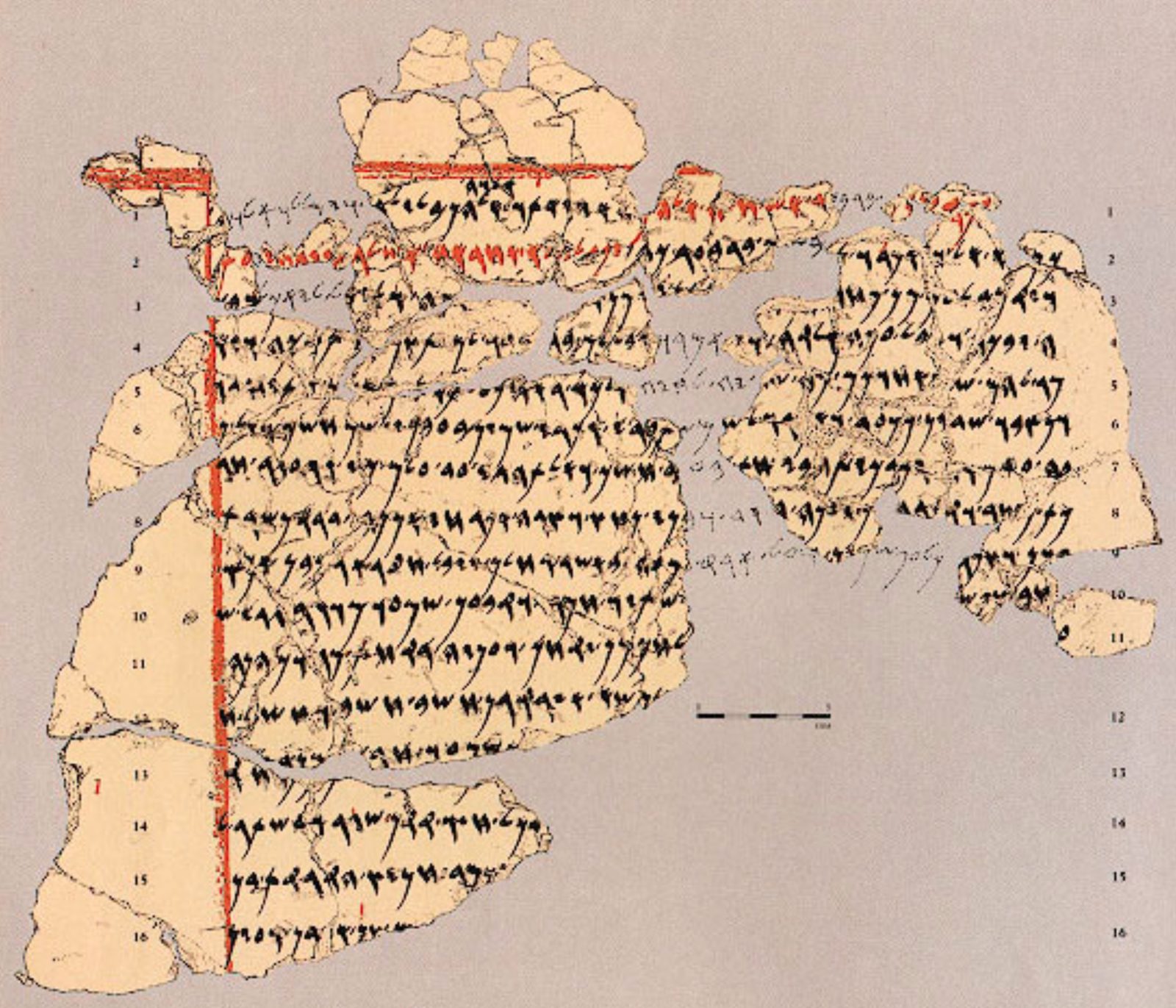
The inscription is in Old Malayalam/Middle Tamil, written in the Vatteluttu script of medieval Kerala. The king granting it is identified as Bhaskara Ravi Varman, a ruler of the Chera/Kulasekharas dynasty of Kerala. The recipient is Joseph Rabban, identified as the leader - Mudaliar - of the Jewish community of Cranganore, the ancient port called Kodungallur or Shingly, north of present-day Kochi on the Malabar Coast. What the grant confers is specific, elaborate, and deeply intelligible within the structures of medieval Kerala society.
The privileges listed on the plates are the privileges of a nobleman. The right to be carried in a palanquin. A day-lamp borne before him in procession. A drum and a double drum. A ceremonial gateway and pavilion. The right to collect specified tolls on roads. The right to use certain parasols. These are not merely useful rights in a commercial sense, though some of them have economic implications. They are markers of honour - the visible, public signs by which Kerala society recognised rank and assigned dignity. A man with a palanquin, a torch-bearer, and the right to erect a pavilion at a ceremony was not a man on the margin of society. He was a man whose status was legible to everyone who saw him, in a language that everyone who saw him would have understood.
The grant gives these rights to Joseph Rabban and to his descendants, in perpetuity. It is, in effect, a hereditary patent of communal nobility. The Jewish community of the Malabar Coast was not merely permitted to exist under the terms of this document - it was given a recognised and inheritable place within the formal structure of a Kerala kingdom. Its leader had the same standing, in the same register of symbols, as the leaders of other favoured communities in the same region. The grant is a document of encounter, and the encounter it records was one of equality in the only terms that medieval Kerala had for such a thing: the terms of rank.
The date dispute
Here the straightforward story becomes more complicated, and honesty requires sitting with the complication rather than resolving it artificially. Traditional accounts within the Cochin Jewish community date the grant to 379 CE. This is a very early date - it would place the Cochin Copper Plates among the oldest surviving communal documents in the entire diaspora, and would make the Malabar Jewish community one of the best-attested in the ancient world. The community itself has held to this date with understandable pride; it connects the charter to a time when the Roman empire still stood and before the great medieval dispersals had fully taken shape.
Modern scholarship is considerably more cautious. Palaeographic analysis of the Tamil script, combined with historical study of the Kulasekharas dynasty and the political circumstances of the Malabar Coast, has led most scholars to place the inscription between the ninth and twelfth centuries CE. A date around the tenth or eleventh century - roughly 1000 CE - is now widely accepted as the most plausible range, with some scholars preferring the ninth century and others the eleventh. The historian S.S. Koder, himself a member of the Cochin Jewish community and a serious scholar of its history, noted the difficulty of reconciling the traditional date with the available palaeographic and historical evidence. Nathan Katz and Ellen Goldberg, in their work on the Cochin Jewish community, engaged the same problem and reached similarly cautious conclusions about the traditional chronology.
What should be said plainly is this: the traditional date of 379 CE is not supported by the scholarly consensus, and responsible discussion of the plates cannot assert it as fact. The scholarly date range - ninth to twelfth century, with the tenth or eleventh century as the most commonly preferred estimate - is itself not settled with precision; the plates remain a live subject of research. What is not in dispute is that the copper-plate grant is authentic, that it records a real encounter between a real Kerala king and a real Jewish community leader, and that whether it was made in the fourth century or the eleventh, it documents a community that was already established, organised, and valued enough to receive a formal royal charter. The date is disputed. The community was real.
The dating of the plates
The traditional date given by the Cochin Jewish community for the royal grant is 379 CE. Modern scholarly analysis - palaeographic, historical, and dynastic - places the inscription between the ninth and twelfth centuries CE; many scholars prefer a date around 1000 CE, in the period of the Kulasekharas dynasty's prominence on the Malabar Coast. Key discussions: S.S. Koder, studies of Cochin Jewish history; Nathan Katz and Ellen S. Goldberg, The Last Jews of Cochin: Jewish Identity in Hindu India (University of South Carolina Press, 1993). The date remains contested in scholarship; the tenth-eleventh century range is most commonly accepted by modern researchers.
Paradesi Synagogue, Mattancherry, KochiA community on the spice routes
Whatever the precise date of the copper plates, the Jewish community they document was not a recent arrival. The Cochin Jews - known in their own tradition as the Malabar Jews, or the Black Jews - traced their presence on the Kerala coast to trade connections of immense antiquity. The traditional account speaks of Jewish merchants arriving during the First Temple period; more cautious versions of the community's own history speak of settlement following the Second Temple's destruction in 70 CE. Neither claim is directly verifiable from surviving documents. But the existence of a well-established, organised community, with a recognised leader and formal relationships with the ruling powers, by the time the copper plates were made - at whatever point in the range from the fourth to the twelfth century - implies a community that had been there long enough to acquire standing.
The Malabar Coast had good reason to have a Jewish presence. It was one of the great hinge-points of the pre-modern world's trading economy - the place where the overland routes of the Middle East and the sea lanes of the Indian Ocean met. Spices, particularly black pepper, moved through these ports in enormous quantities; so did precious stones, textiles, and metals. Jewish merchants had been participants in Indian Ocean trade at least since the period documented by the Cairo Geniza's India traders archive, which covers roughly 1000 to 1150 CE - which is to say, precisely the period when the copper plates are most likely to have been made. The community that produced Joseph Rabban was a merchant community in a trading port at the centre of the medieval world's most valuable exchange network.
This context matters for understanding the grant. Kerala kings had strong reasons to cultivate relationships with established trading communities. Granting a community's leader formal noble status, the right to collect specified tolls, and the ceremonial apparatus of rank was not purely a gesture of goodwill. It was a way of incorporating a commercially useful and well-connected community into the formal political economy of the kingdom. The copper plates are a document of mutual interest as much as one of royal generosity - which is precisely what made the relationship durable. Joseph Rabban and his heirs were granted their charter because they were worth having.
The Jewish community's leader had the same ceremonial standing as the leaders of other favoured communities. He was not tolerated on the margins. He was given a seat inside the order.
The Paradesi Synagogue
The copper plates are kept in the Paradesi Synagogue in Mattancherry, the old Jewish quarter of Kochi - a neighbourhood that is itself a remarkable survival. The Paradesi Synagogue was built in 1568 by the community known as the Paradesi Jews - "foreign Jews," the descendants of Sephardic refugees who had arrived on the Malabar Coast in the late fifteenth and sixteenth centuries, fleeing expulsion from Spain and Portugal and persecution in the Middle East. The building was badly damaged in 1662 when Portuguese forces attacked and burned parts of the area, after the Jewish community had sided with the Dutch in the contest for control of Kochi; the synagogue was repaired in 1663-1664 under the Dutch East India Company, which had by then taken the city. It has stood ever since.
The synagogue's interior is one of the most visually unusual religious spaces in the Jewish world. The floor is laid with hand-painted blue-and-white willow-pattern tiles, imported from China in the eighteenth century - no two tiles, by design or happy accident, are quite the same. The ceiling hangs with Belgian crystal chandeliers and Chinese glass lanterns. The clock tower that stands beside the synagogue has four faces: three show the time in Hebrew numerals, Malayalam, and Roman respectively; the fourth is blank. This is not eccentricity. It is the visual record of a community that traded across the world's oceans and absorbed the aesthetic wealth of every port it touched.
The Paradesi Synagogue is now officially the oldest active synagogue in the Commonwealth - though "active" requires a parenthesis. The Cochin Jewish community emigrated to Israel almost entirely in the 1950s and 1960s, following Israeli independence. From a community that numbered in the hundreds, a handful of individuals remain in Kochi today. Services are held on Saturdays and festivals when there are people enough to hold them. The building is maintained. It functions as a heritage site, a museum of its own community's history, and occasionally, still, a synagogue. The copper plates are among its most treasured holdings.
The Paradesi Synagogue, Mattancherry
Built 1568 by the Paradesi (Sephardic) Jewish community of Kochi. Damaged in 1662 when Portuguese forces attacked (the community had sided with the Dutch); repaired and restored 1663-1664 under Dutch East India Company rule. Clock tower added 1760, with four faces: three displaying time in Hebrew, Malayalam, and Roman numerals, one blank. Interior floor of hand-painted Chinese willow-pattern tiles, imported 18th century. Considered the oldest active synagogue in the Commonwealth. Listed as a heritage site. Current custodian of the Cochin Copper Plates. The surrounding Jew Town neighbourhood in Mattancherry retains its historic character, though the Jewish community that once populated it has almost entirely emigrated to Israel.
Mattancherry, Kochi, Kerala, IndiaThe framework of recognition
There is a question embedded in the Cochin Copper Plates that repays careful attention: what does it mean for a community to be recognised? The grant to Joseph Rabban recognises the Jewish community not in its own terms - not in the terms of Torah law, not in the language of Jewish communal organisation, not in any form that the community would have used to describe itself from the inside. It recognises the community in the terms of the Kerala kingdom: a leader with the rank of a nobleman, carrying a charter that lists his ceremonial entitlements the way any other charter of the period would list them. The Jewish community has been translated into a language the kingdom could read.
This is not assimilation. Joseph Rabban remained the leader of the Jewish community - his function, the document makes clear, was communal leadership among Jews. The grant did not absorb the community into the general social structure; it gave the community a formal place within that structure while leaving its distinctiveness intact. It is a document that says, in effect: you are here, you are yours, and you are also ours - in the sense that we recognise you as part of what this kingdom contains and values. The formula is not one that Western European medieval states typically applied to their Jewish populations, for whom the categories of recognition were far more ambivalent and far more precarious.
That contrast is worth noting without labouring it. The copper-plate tradition of Kerala was not invented for Jews, and it was not applied exclusively to Jews. Other trading and artisan communities received similar royal charters. The grant to Joseph Rabban was unusual in its specific content, not in its form. Jews on the Malabar Coast were one favoured trading community among several, receiving from the king the same kind of formal acknowledgement that the king extended to others. To be ordinary in that sense - to be one recognised community among others rather than a singular and suspicious exception - was not nothing. It was, in the medieval world, quite a lot.
What the plates hold now
There is a particular kind of object in Jewish history - and the copper plates belong to it - that has not been carried across continents by refugees, or buried to avoid confiscation, or transmitted in fragments through the hands of scholars. The copper plates of Cochin stayed put. They were made on the Malabar Coast, they were held on the Malabar Coast, and they are on the Malabar Coast still. They have not required rescue. The community that held them emigrated, largely, to a country that did not yet exist when the plates were made. The synagogue is nearly empty. But the plates are there.
This is not a neutral fact. Most objects in the documentary record of the diaspora come to us having travelled - in the packs of fleeing communities, in the luggage of scholars who recognised their significance, in the collections of institutions that sometimes saved and sometimes appropriated. The Cochin Copper Plates did not travel. They sit in the building that their custodians built, in the neighbourhood their custodians named, in a city that has held a Jewish community in some form since before most of Europe's Jewish communities were established. The continuity that the plates represent is not only the continuity of the document. It is the continuity of the place.
That place is now a heritage site as much as a living community. The handful of Jews who remain in Kochi carry a weight of history that is disproportionate to their number - custodians of a synagogue, a copper-plate charter, a tiled floor from China, a clock tower that tells time in three scripts. What the plates document - a Jewish community accorded formal dignity within a framework not its own - is still visible in the building that keeps them. The kingdom that made the grant is long gone. The community that received it is mostly elsewhere. The document remains.
Further reading