There is a black basalt stele in the Louvre - Sully Wing, Department of Near Eastern Antiquities, not the busiest corridor - that does something extraordinary. It names YHWH. Not in Hebrew, not in a biblical text, not in a tradition that venerates the name: in Moabite, carved by the order of a king who worshipped Chemosh, in a victory inscription designed to celebrate Moab's defeat of Israel. An enemy king, writing in a foreign language, about a military campaign against the Israelites, used the Tetragrammaton - the four-letter name of the God of Israel - as casually as he used the names of towns. YHWH was not a private theological claim. YHWH was a name that Mesha of Moab knew, and used, because it was the name Israel's neighbours used for Israel's god. The stele is 1.15 metres of polished basalt and it is one of the most remarkable objects for the external verification of the Hebrew Bible that survives in any museum in the world.
Mesha commissioned it around 840 BCE. He was king of Moab - the territory east of the Dead Sea, in what is now Jordan - and he had, by his own account, achieved something worth commemorating: he had thrown off the domination of Israel, reclaimed Moabite territory, and rebuilt the cities that Israel had held. The inscription runs to thirty-four lines. It is in the Moabite language, a Canaanite dialect so closely related to Hebrew that scholars can read it without extensive retraining. It is written in the Phoenician alphabet, the same script from which Hebrew square script eventually descended. It is, in linguistic and cultural terms, a near-cousin to the Hebrew Bible - composed in a world that shared vocabulary, ritual practice, and gods-of-war with the people whose God it names.
The stele is not complete. It never arrived at the Louvre whole. A story of discovery and destruction precedes it, and the story matters, because the stele in the Louvre is partly original stone and partly reconstruction - and the reconstruction is a lesson in how ancient evidence survives, and what survives when stone does not.

Discovery, and destruction
The stele was found in 1868, near the ruins of Dibon - ancient Dibon, the capital of Moab, now the village of Dhiban in Jordan - by Frederick Augustus Klein, an Alsatian missionary travelling in the region. Klein saw it lying in the ground, recognised it as inscribed, and reported it to European scholarly contacts. Word reached the diplomatic and academic networks of Paris, Berlin, and London simultaneously. Everyone wanted it. The Ottoman authorities had a claim. Local Bedouin had possession. European scholars had money and urgency.
What happened next is one of the more painful episodes in the history of ancient epigraphy. Charles Simon Clermont-Ganneau, a French diplomat and orientalist based in Jerusalem, sent an agent to take a paper impression - a "squeeze" - of the inscription before it could be acquired. The squeeze was made, or a partial squeeze: accounts differ on how complete it was before events intervened. Then, according to the traditional account - the precise mechanism is not established by the accessible object-history record - the stone was broken, in what is usually described as an act of defiance against Ottoman pressure to surrender it. (The popular version of this story, that the tribe hoped to sell the fragments separately, appears to be a folk explanation that postdates the event.)
Clermont-Ganneau, once he understood what had happened, worked systematically to purchase the fragments from the various parties who held them. He succeeded in acquiring a substantial proportion. Between the squeeze - which preserved the impression of the inscription as it had existed before the breaking - and the recovered fragments, French scholars were able to reconstruct most of the text. The assembled stele arrived at the Louvre in 1873. It stands there now, its fracture lines visible, the plaster fills identifiable against the basalt, the whole thing a monument to both the inscription's near-destruction and to the scholarly determination that prevented that destruction from being total.
What the king said
The inscription is a royal boast, in the genre of royal boasts that were standard across the ancient Levant: the king has been oppressed, the king has prevailed, the king has built great things, the king's god is satisfied. Mesha begins with his own credentials - son of Chemosh-yat, king of Moab, the Dibonite - and then describes the situation he inherited. Omri, king of Israel, had oppressed Moab for many days. Then Omri's son succeeded him, and he also oppressed Moab. But Chemosh, the god of Moab, was angry with his land - meaning Moab, the land Chemosh had allowed to be oppressed - and eventually Chemosh allowed Mesha to act.
Mesha then describes his campaigns. He drove Israel out of territory it had held. He captured the city of Nebo and, in a passage that has drawn considerable scholarly attention, he describes killing the entire population - men, boys, women, girls, and maidservants - because he had devoted them to destruction for his god. He rebuilt cities. He cut channels. He built a highway. He extended Moabite territory north and south. The inscription has the tone of a man who has done what needed doing and wants the record to show it. Chemosh was pleased. Moab was restored. The king of Israel had been driven back.
The king of Israel is not named in the surviving sections - the relevant portion is among the damaged areas - but the inscription names Omri explicitly, names the "House of Omri," names the Israelite tribe of Gad as having inhabited Ataroth ("the men of Gad had always dwelled in the land of Ataroth"), names the city of Nebo, names the city of Jahaz, and - once, in a phrase about the spoils of Nebo brought to Mesha's god - names YHWH. "The vessels of YHWH," Mesha says, he took and presented before Chemosh. YHWH's sacred objects, in a Moabite temple. An enemy king, accounting for his loot, treats YHWH's name as self-explanatory. Of course the Israelites had vessels of YHWH. Everyone in the region knew who YHWH was.
Omri and the three-source convergence
The most straightforwardly powerful thing the Mesha Stele does, for anyone trying to establish a chronology of the early Israelite monarchies, is name Omri. Not "the king of Israel" - Omri. By name. This matters for a specific reason: Omri is also named in the Assyrian records, independently, in a context that has nothing to do with Moab. For at least a century after Omri's death, the Assyrian scribes who kept records of the northern kingdom of Israel called it "the House of Omri" - Bit Humri in Akkadian - as if Omri had established a dynasty so significant that his name became the default designation for the entire kingdom. This was true even after the Omride dynasty had ended and a new royal house had taken the throne. Assyria still said "House of Omri." The name had fixed itself.
Omri is also in the Hebrew Bible, in the First Book of Kings, where he is described as a king who built Samaria - purchasing the hill of Samaria and building a city on it - and who, in the Bible's moral accounting, did worse than all the kings before him. The Bible is not fond of Omri. It devotes surprisingly few verses to a king who was evidently, by any political measure, among the most significant rulers the northern kingdom produced. Omri built the capital, Omri established a dynasty sufficiently important that Assyria named the kingdom after him for generations, Omri's son Ahab married Jezebel of Phoenicia and ruled during the ministry of Elijah. The Bible treats him as a footnote. History treats him as a figure of the first importance.
Three independent sources - the Hebrew Bible, the Assyrian administrative records, and the Mesha Stele - converge on this king. They agree that he was king of Israel. They agree that his dynasty was significant. The Mesha Stele and the Bible agree on the broad outline of Moabite subjugation during his reign. That convergence is what historians call external corroboration: the moment when independent evidence, produced by different people for different purposes at different times, says the same thing. It is the most reliable signal that something genuinely happened, and was not invented later. Omri happened.
The Mesha Stele
Black basalt stele, approximately 1.15 metres tall, rounded top. Inscription of 34 lines in the Moabite language, written in the Phoenician alphabet. Commissioned by Mesha, King of Moab, c. 840 BCE. Describes Mesha's campaigns against Israel, the recapture of Moabite territory, and building works including Dibon, Ataroth, Jahaz, Nebo, and others. Names: Omri, King of Israel; the "House of Omri"; the tribe of Gad in Ataroth; YHWH (in the phrase "the vessels of YHWH"); the cities of Nebo, Jahaz, and Ataroth (all of which appear in the Hebrew Bible). Discovered 1868 near Dibon (Dhiban, Jordan) by Frederick Augustus Klein. Paper squeeze taken c. 1869 by Charles Simon Clermont-Ganneau's agent. Stele broken by local Bedouin, fragments purchased, reassembled with plaster. Acquired by the Louvre 1873. Accession number AO 5066.
Louvre, Paris · AO 5066 · Discovered Dibon, 1868The herem - sacred destruction from the Moabite side
Line after line of the Mesha Stele describes the recapture of cities, but the passage describing the taking of Nebo has attracted particular scholarly attention. Mesha says he went to Nebo by night and fought against it from dawn until midday. He took it and killed everyone in it - the word he uses, in the Moabite, is the equivalent of the Hebrew concept of herem. He killed seven thousand men, boys, women, girls, and maidservants, he says, "for I had devoted them to destruction for Ashtar-Chemosh." The formula is precise: devoted to the god, slaughtered as a sacred act, not as ordinary military killing but as an offering.
The Hebrew Bible uses this same language, with the same logic, in the accounts of Israelite warfare in Canaan. The herem - the sacred ban, the devotion to destruction - appears in the conquest narratives in Joshua, in the accounts of Saul's wars against the Amalekites, in passages where the killing of an entire population is presented not as atrocity but as religious obligation: these people and their possessions belong to God, not to us, and the proper thing to do with what belongs to God is to give it to God by destroying it. Modern readers encounter these passages with unease, because they describe mass killing as piety. The discomfort is not misplaced. But the Mesha Stele does something important for the historical understanding of those passages: it shows that herem was not a peculiarly Israelite theological invention. It was standard military-religious practice across the Iron Age Levant.
Moab did it. Mesha describes it without embarrassment, in a public inscription designed to celebrate his achievements. Ashtar-Chemosh received the devotion of the population of Nebo the same way the Israelite god received the devotion of Jericho in the Book of Joshua. Both nations used the same conceptual framework: war as religious practice, killing as sanctification, victory as a transfer of ownership to the divine. The Bible is not, in these passages, describing something exotic or exaggerated. It is describing what armies did, and how they understood what they were doing, throughout the ancient Levant. The stele from the Moabite side is the corroborating evidence from the other direction.
The "House of David" - a live scholarly argument
Here the account must be careful, because the evidence is genuinely contested and the stakes of getting it wrong in either direction are high.
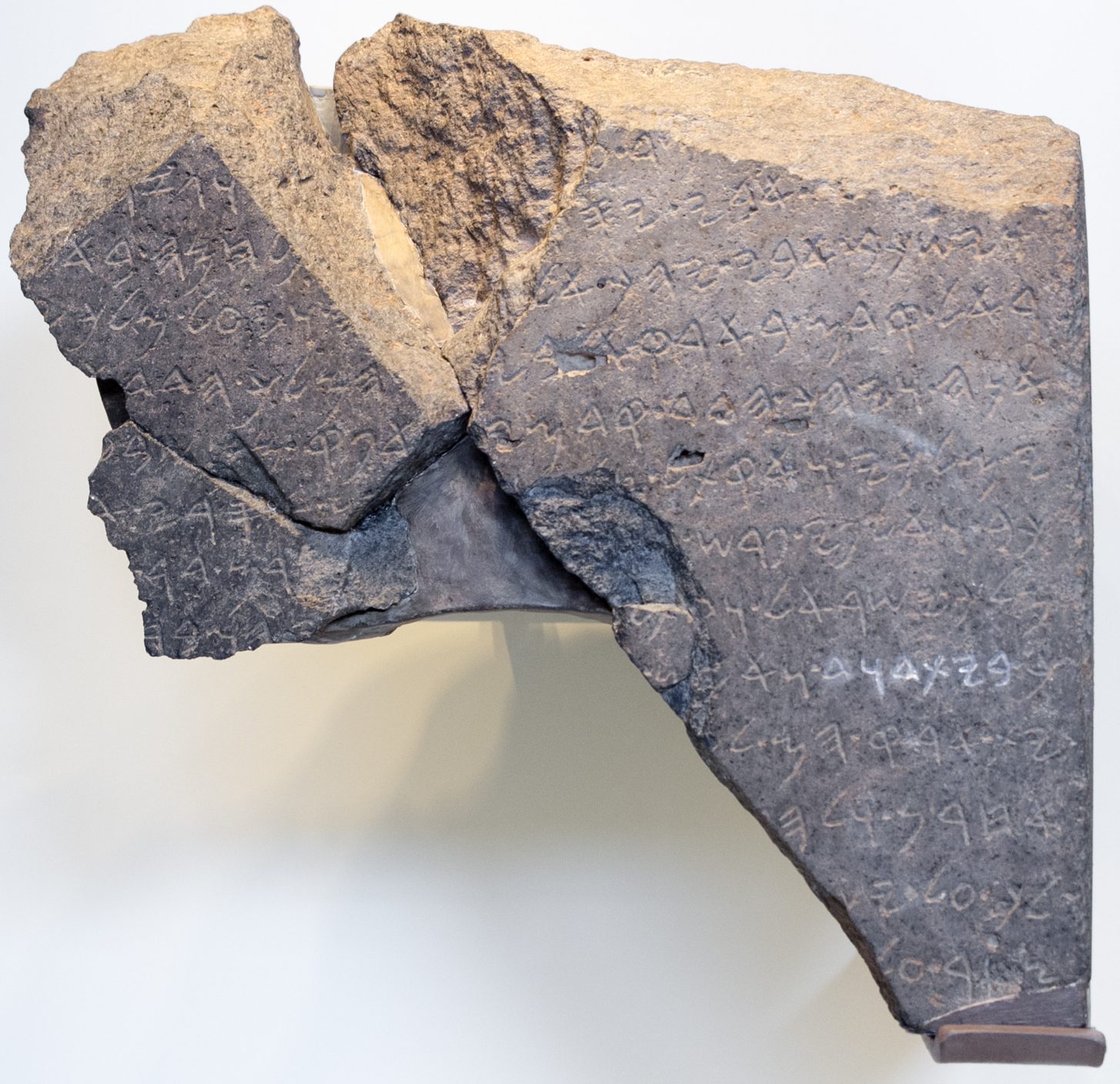
The Mesha Stele has a damaged section - one of several places where the original stone is lost and reconstruction relies on the squeeze alone, or where the squeeze itself is unclear. In 1994, the French epigrapher Andre Lemaire published a reading of one damaged line that proposed the presence of the phrase "House of David" - byt dwd in the Semitic consonantal script - in a portion of the stele that most earlier scholars had left as unreadable or had read differently. Lemaire's reconstruction, if correct, would make the Mesha Stele the second-oldest confirmed extra-biblical reference to the Davidic dynasty, contemporary with the Tel Dan inscription (discovered in northern Israel in 1993-94, which contains the phrase "House of David" clearly and without serious contest).
The scholarly response has been divided. Emile Puech supported Lemaire's reading. Other respected epigraphers - including W. Boyd Barrick and initially others working on the squeeze - have been more sceptical, arguing that the damaged area does not permit the reading with sufficient confidence. The debate has continued, with fresh examinations of the squeeze itself using improved imaging technology. As of the most recent scholarly discussions, the question is not closed: Lemaire's reading remains a serious and respectable scholarly proposal, not a fringe speculation, but it is not universally accepted. It would be wrong to present the "House of David" as a confirmed reading of the Mesha Stele. It would be equally wrong to dismiss it as wishful thinking. It is a genuinely live epigraphic debate among specialists who are looking carefully at the same damaged stone and reaching different conclusions.
What is not contested is the Tel Dan inscription, discovered in two fragments in the summers of 1993 and 1994 at Tel Dan in northern Israel, now held at the Israel Museum in Jerusalem. Tel Dan clearly contains the phrase "House of David" - byt dwd - in an Aramaic inscription from approximately the same period as the Mesha Stele, also from an enemy of Israel boasting about a military victory. The convergence of enemy inscriptions, from different kingdoms in the same generation, both apparently referring to the Davidic dynasty, is already significant regardless of whether the Mesha Stele reading is ultimately confirmed. If Lemaire's reconstruction holds, the Mesha Stele adds a third witness. For now, it remains a question mark worth watching.
The Tel Dan Inscription
A fragmentary basalt stele discovered in two pieces at Tel Dan, northern Israel, in 1993 (fragment A) and 1994 (fragment B). Written in Aramaic, the inscription records a military campaign by a king (possibly Hazael of Aram-Damascus) against Israel and Judah. It contains the phrase "House of David" - byt dwd - in a context that reads as a reference to the ruling dynasty of Judah. This is the oldest confirmed extra-biblical reference to the Davidic dynasty. The identification of "House of David" is not contested in the mainstream scholarship; the reading is secure. The inscription transformed the scholarly debate about the historicity of the Davidic dynasty: a contemporary enemy inscription, from the same century as David's alleged descendants, treating the "House of David" as a real dynasty worth naming. Now held at the Israel Museum, Jerusalem.
Israel Museum, Jerusalem · Tel Dan, northern Israel · Discovered 1993-94The Clermont-Ganneau Squeeze
A paper impression of the Mesha Stele taken c. 1869 by an agent of Charles Simon Clermont-Ganneau, before the stele was broken. The squeeze is the primary source for portions of the text that cannot be read from the surviving stone fragments - including, critically, the sections where scholars debate the reading of "House of David." The squeeze is now held at the Louvre, Paris (Department of Near Eastern Antiquities, AO 5019). Modern multispectral and photographic examination of the squeeze has improved the resolution at which the ambiguous sections can be studied, but has not resolved all disputes. The squeeze is simultaneously the reason we have most of the inscription - it was taken before the breaking - and the source of ongoing interpretive uncertainty, because a paper impression of worn stone in a damaged area leaves room for multiple readings.
Louvre, Paris · AO 5019 · c. 1869The stele that is partly reconstruction
It is worth dwelling on what the Louvre actually contains, because it is not simply the Mesha Stele. It is the Mesha Stele plus the Clermont-Ganneau squeeze plus the fragments plus plaster plus a century and a half of scholarly labour - all fused together into a single object that stands in a glass case and looks, to the unprepared visitor, like an ancient artefact in the conventional sense. The ancient artefact is there - most of the inscription survives on original stone, though the surface area that is plaster is substantial. The rest is reconstruction.
This is not a flaw or a deception. It is the nature of how ancient evidence survives. The Parthenon marbles in London are partly restored. The Nike of Samothrace has no head and her head is not in the Louvre. The Colosseum in Rome is a ruin that has been stabilised to prevent further collapse. The Mesha Stele is a broken object reassembled from a squeeze, fragments, and scholarly inference. The text we have is partly what is on the stone, partly what is on the squeeze, and partly what scholars have reconstructed from the sense of surrounding passages. All of it together gives us more than any single source would. The squeeze saved most of the inscription. The stone confirms what the squeeze preserved. The reconstruction makes the whole object legible in a room rather than as an academic diagram.
There is something worth pausing on here. The Bedouin who broke the stele believed that its value lay in the fragments - that more buyers meant more money than one buyer for the whole. They were not wrong about the economics as they understood them. What they could not have anticipated was that a French diplomat would piece together the broken object from a paper impression and dozens of separately purchased fragments and deposit the result in a Paris museum, where it would be examined by generations of scholars for what it said rather than what it was worth. The stele in the Louvre is a story about how evidence survives: through accident, through the particular tenacity of one man with a press and a set of contacts, through the patience of scholars who compared impression against fragment against context until the text came back.
An enemy king, writing in a foreign language, used the Tetragrammaton as casually as he used the names of towns. YHWH was a name Israel's neighbours knew.
What the stele does not know it is doing
Mesha's inscription was doing what royal inscriptions did: it was making a record of the king's greatness, for the gods and for posterity, in the most permanent medium available. The thirty-four lines on black basalt were not intended to be evidence for anything other than the magnificence of Mesha and the power of Chemosh. The tribes of Israel who occupied Ataroth and Nebo appear as obstacles overcome, not as subjects of interest. The name YHWH appears because it was the name on the vessels Mesha took - an inventory item, not a theological statement. Omri is named because naming the enemy you defeated is how you establish the scale of your victory. The "men of Gad" are mentioned because they had to be expelled from land Mesha wanted. None of this was meant to be evidence for Israel's existence, or God's name, or the Davidic dynasty, or the practice of herem, or anything beyond the glory of Mesha.
But that is what it became. The inscription that Mesha made to celebrate Moab's victory over Israel is now the most important external corroboration of the early history of the northern Israelite kingdom. The king who named YHWH as the god whose vessels he had pillaged gave us one of the oldest known external attestations of the Tetragrammaton. The boast that Omri had oppressed Moab became, when set beside the Assyrian records and the Hebrew Bible, a three-source convergence on a real king. The claim to have expelled the men of Gad from Ataroth placed the tribe of Gad in a specific location at a specific time, in exact correspondence with the biblical geography. The language of herem, used without apology, showed that the same framework appears in both Israelite and Moabite military theology, validating the Bible's use of the term as a description of shared regional practice rather than an Israelite peculiarity.
The Israelites Mesha was boasting about defeating were not gone. Their tribe survived. Their God's name survived - in every synagogue, in the pages of the Hebrew Bible, in the mezuzot on doorposts across the world. Their king's name survived, not only in the Bible but in the records of Assyria. Their dynasty's name may yet prove to survive in the damaged section of this very stele, though that question is still being argued in the journals. And Mesha? Moab? Chemosh? The empire of Assyria that called the northern kingdom "the House of Omri" for a century? All of them are gone. The stone talks. It talks on behalf of a people it was made to diminish, in a language they never used, saying things it never meant to say. And it has been talking for two thousand eight hundred years, from a glass case in Paris, to anyone who knows how to listen to it.
The stone in the glass case
The Louvre is not a quiet building. Most days it is crowded from the moment the doors open: visitors moving in streams from the Winged Victory to the Venus de Milo to the Mona Lisa, following the arrows, following the crowds, following the audio guides. The ancient Near Eastern collection - the Richelieu Wing, the rooms of Mesopotamian and Levantine antiquity - is quieter than most. It attracts specialists, the curious, the people who have done some reading and want to see what they read about. You do not need to book extra tickets or join a special tour. You walk in, find the wing, and look.
The Mesha Stele is black and polished and it has rounded top and thirty-four lines of inscription that most visitors cannot read. It is not large by the standards of the things around it - the Louvre has Assyrian reliefs from Khorsabad, enormous carved slabs of winged bulls and tribute-bearing processions, that dwarf it. The stele does not compete on scale. What it has is the text: those thirty-four lines in Moabite, carved on basalt, that contain Omri and YHWH and the men of Gad and the herem of Nebo and possibly, in the damaged section, the name of David's house.
Stand in front of it long enough and the particular quality of what you are looking at becomes clear. This is not an Israelite document. It is a Moabite document, made by Israel's enemies, in Israel's enemies' language, for Israel's enemies' god. And it is among the most important objects for understanding what the Hebrew Bible is describing when it describes the northern kingdom in the ninth century BCE. The enemy's boast is the corroboration. The stone made to celebrate Moab's greatness is the evidence for Israel's existence. The name YHWH, carved in basalt by a man who worshipped Chemosh, has outlasted Chemosh, Moab, Dibon, Mesha, the city in which the stele stood, the empire that eventually destroyed the kingdom the stele was boasting about, and every intermediate power between Mesha's reign and the glass case in Paris. It is still there. It is still saying YHWH. No one who reads it can pretend otherwise.
Further reading