Rome is generous with monuments to itself. It keeps its arches polished, its emperors labelled, its triumphs on the walking route. The Jewish catacombs do something less theatrical and more persuasive. They are under roads and villas and modern neighbourhoods. They are not one object, not one chamber, not one tidy stop on a museum map. They are several burial complexes - Vigna Randanini, Villa Torlonia, the lost or inaccessible cemeteries of Monteverde and elsewhere - and together they say that Jews in ancient Rome were not a passing aftershock of 70 CE. They were a community with dead to bury, titles to record, symbols to carve, and enough permanence to dig themselves into the tufa outside the city walls.
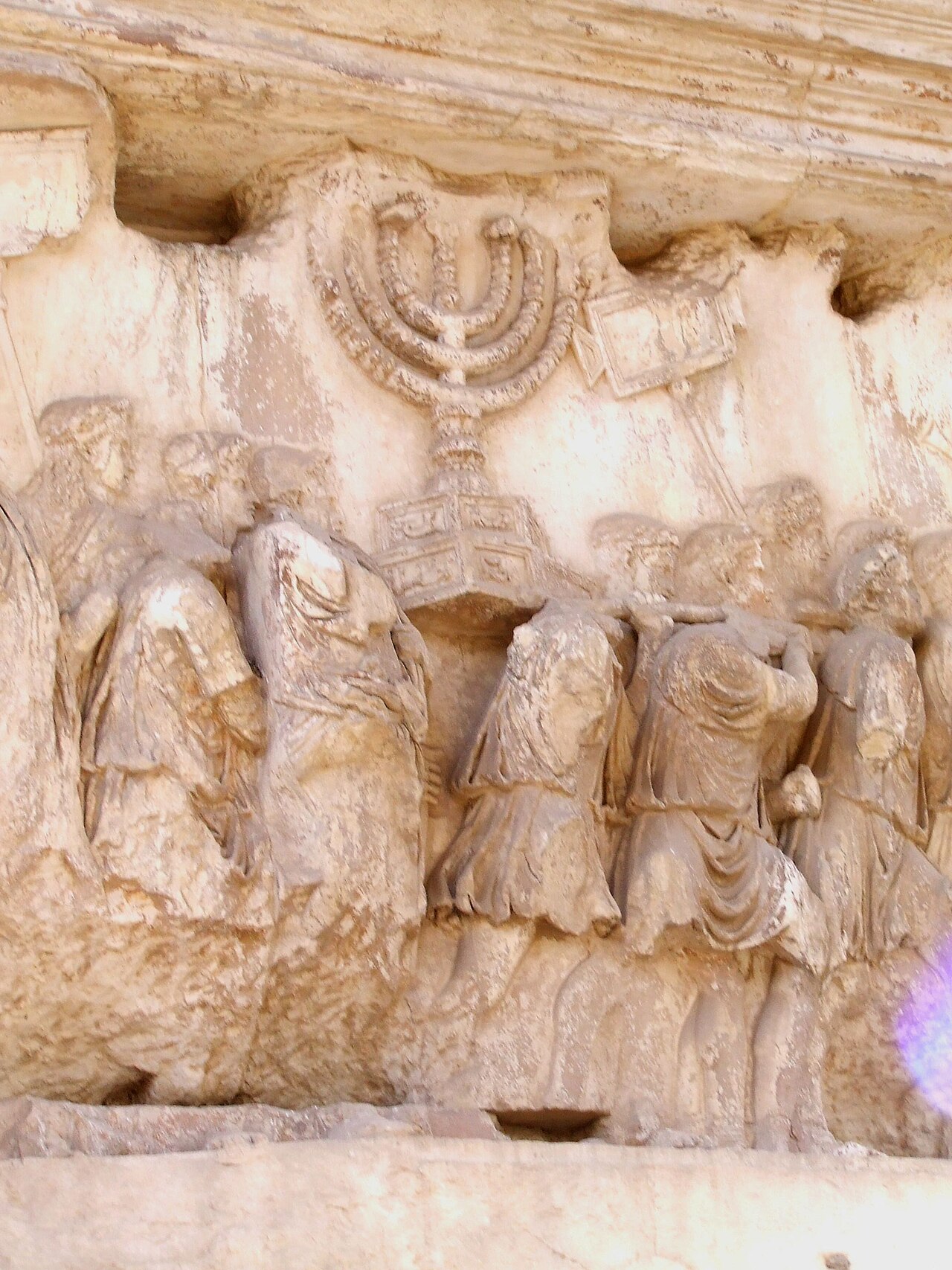
The effect is sharper because it is Roman. This is the city that put the menorah on the Arch of Titus as loot. Then, over the next centuries, Jews in Rome cut menorahs of their own into marble plaques and plaster seals under the same city's soil. Not the menorah in chains this time. The menorah as belonging.

The community under the roads
Rome's documented Jewish underground cemeteries are usually enumerated as six: Monteverde, Vigna Randanini, Vigna Cimarra, the Via Labicana/Vigna Apolloni complex, and two interconnected cemeteries beneath Villa Torlonia, counted separately. Two names are the ones most often encountered now: Vigna Randanini on the Appian Way and Villa Torlonia on the Via Nomentana. Monteverde on the Via Portuense mattered enormously to scholarship once, but much of it was destroyed during nineteenth-century works before archaeology had learned better manners. The other named complexes are known from fragmentary discovery, old reports or limited access, and the six-count is archaeological and historical rather than a count of sites open to visitors - only part of the surviving network is accessible. That is why caution matters here. "The Roman Jewish catacombs" is a collective noun, not a single ticketed destination.
What survives across these sites is enough to show a settled diaspora. The inscriptions are largely in Greek and Latin, which tells its own story about language and daily life in imperial Rome. Hebrew appears much more sparingly, in names, formulae and recognisable Jewish signs rather than as the dominant written medium. The symbols are unmistakable anyway: menorahs, shofars, lulavim, ethrogim, Torah shrines. You do not need many words when the iconography is already speaking plainly.
And then there are the titles. Funerary texts do not only say who died. They sometimes say what a person was in relation to the community - a synagogue leader, a teacher, a lover of the Law, someone honoured for keeping commandments rather than merely possessing relatives. That is the part worth lingering over. These are not the marks of a camp of refugees waiting to move on. They are the marks of organised Jewish life in Rome after the destruction of the Temple, still local, still legible, still stubbornly civic.
Vigna Randanini
The Jewish catacomb of Vigna Randanini lies between Via Appia Antica and Via Appia Pignatelli and was discovered in 1859. Current archaeological study maps roughly 710 metres of galleries across four main construction phases - an initial family hypogeum, two later collective Jewish hypogea, and a final phase that connected and expanded them - and preserves loculi, arcosolia, some kokhim burials and painted chambers. The same study catalogues 212 funerary inscriptions, a figure public summaries often round to about two hundred, chiefly in Greek and Latin. Radiocarbon evidence spans a wide range from the late first millennium BCE to late antiquity, so burial there may have started earlier and continued later than once thought. Menorahs, lulavim, shofars and Torah-related imagery appear among the finds, alongside enough ordinary Roman decorative language to remind you that diaspora Jews were living in Rome, not in a sealed jar. The underground speaks both Jewish and Roman at once.
Vigna Randanini, Via Appia area, RomeWhat the catacombs prove, and what they do not
They do not prove that every Roman Jew thought alike. They do not compress centuries into a single communal snapshot. They do not erase argument about dating, about how early some galleries began, or about how to classify every painted motif. Archaeology very rarely grants that kind of tidiness. What they do prove is presence at scale. A community does not create multiple suburban cemeteries over generations unless it expects to remain where it is.
That matters after 70 CE. The standard Roman image of Jewish history after the destruction is captives in procession, Temple vessels in triumph, Judaea turned into a lesson. The catacombs answer with a different archive. Here are families burying their dead in Rome, not as imperial exhibit but as residents. Here are epitaphs using the city's common languages while preserving specifically Jewish symbols and communal honour. Here is diaspora not as disappearance, but as settlement.
Villa Torlonia
Found in the late 1910s and excavated through 1930, the Jewish catacombs under Villa Torlonia cover more than 13,000 square metres and contain thousands of tombs and over a hundred inscriptions. Their frescoes include classic Jewish imagery, among them a striking Torah shrine and multiple menorah forms. Scientific dating of wood sealed into the tomb stucco has been used to argue for construction phases as early as the late 1st century BCE or 1st century CE, while the cemetery's use continued into late antiquity. The site is not generally open to the public. Rome still keeps some of its clearest Jewish evidence under lock, gas and caution tape.
Villa Torlonia catacombs, Rome · published archaeological recordMonteverde, and the things Rome almost lost
Monteverde deserves to be named even when it cannot be shown properly. Its Jewish catacomb on the Via Portuense was once one of the richest sources for inscriptions from ancient Roman Jewry. Too much of it was destroyed before modern standards of excavation and conservation existed. What remains survives largely through copies, notes, publications and stones removed long ago. That is not ideal evidence. It is still evidence.
The broader pattern is clear enough without pretending the archive is pristine. Across the catacombs, the Jewish community of Rome appears as urban, multilingual and institutionally organised. Not assimilated into invisibility. Not frozen in biblical sepia. Roman enough to write Greek and Latin epitaphs, Jewish enough to mark graves with the menorah and honour people for Torah-shaped virtues and offices. One of Europe's oldest continuous Jewish communities did not leave only memory. It left signage.
The Funerary Inscriptions
Across Rome's Jewish catacombs, epitaphs preserve names, family ties, pious formulas and community honours. Greek dominates many of the surviving texts; Latin is also common; Hebrew is much rarer and usually appears in shorter forms. Some inscriptions and related epitaphic material refer to synagogue life through titles and honorific language - leaders, teachers, lovers of the Law, lovers of the commandments, the righteous. They are small texts, but they do large historical work. They show a Roman Jewish community that had offices, ideals and enough confidence to write them down beside its dead.
Jewish Museum of Rome; catacomb epitaphs from Via Appia, Via Nomentana and Via PortuenseBelow the triumph
Rome's official stone once announced Judaea conquered. Rome's unofficial under-stone says something harder to erase. After the war, after the Temple, after the slogans and the parade reliefs, Jews in Rome went on being Roman Jews. They buried parents and children. They used the languages at hand. They kept their symbols. They named their virtues. They held offices no empire had assigned them.
That is what the catacombs give back. Not a single masterpiece under perfect museum glass, but a network of underground sentences. Enough to make the point. Enough to outlast the caption above ground.
Further reading