Somewhere in the summer of 1993, Gila Cook, the excavation's surveyor and architect, was walking the site at Tel Dan - ancient Dan, in the far north of Israel, near the headwaters of the Jordan - and she noticed a stone that didn't belong. It had been built into a later wall, face inward, reused as rubble. She turned it over. There was writing on it. Old Aramaic, in the Phoenician alphabet, with no vowels: a broken fragment of a royal inscription, carved in basalt, by a king boasting about enemies he had defeated. Among those enemies, in plain letters, was a phrase that stopped the scholarly world in its tracks. BYTDWD. The house of David.

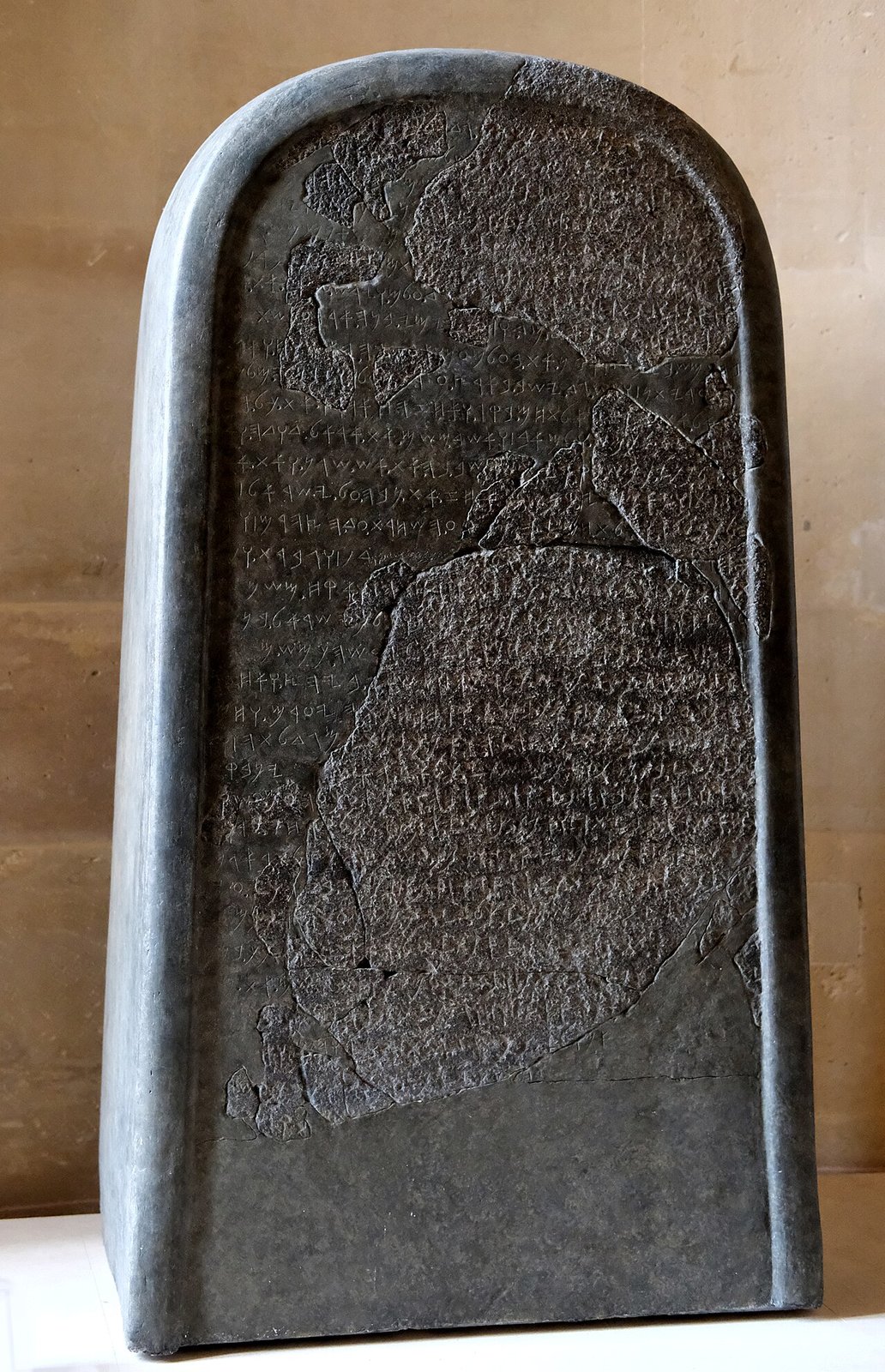
The fragment is now in the Israel Museum in Jerusalem, in the Samuel and Saidye Bronfman Archaeology Wing. It is dark grey basalt, hand-sized in the sense that a large hand could hold it, though you would not be allowed to. Two more fragments were found the following year, 1994. Together - fragment A from 1993, fragments B1 and B2 from 1994 - they constitute the Tel Dan Stele: a victory inscription generally dated to the ninth century BCE, with the precise date debated, often attributed to a king of Aram-Damascus, recording his military triumph over Israel and over the ruling dynasty of Judah. He called that dynasty the House of David. He did not mean it as a compliment. He meant it as a defeat notice. The dynasty he was dismissing is still here. His kingdom is not.
What the stone says
The inscription is a first-person royal victory text - the standard genre of kings who have won battles and want posterity to know it. The author speaks in his own name, describes his enemies, and lists his achievements. The text is in Old Aramaic, written in the Phoenician alphabet: no vowels, no word-dividers in every place you would want them, no name surviving in the damaged portions where you most want a name. What survives is enough.
The king claims to have killed a king of Israel and a king of the House of David. The battle is often connected to the crisis around Ramoth-Gilead in the early 840s BCE - a moment when the king of Israel and the king of Judah were both drawn into the same dangerous frontier politics. The Second Book of Kings describes Jehu's coup, the killing of Jehoram of Israel, and the death of Ahaziah of Judah. The stele sounds like Aram's version of triumph in that same disturbed landscape, but the precise campaign and the names of the kings are partly reconstructed from damaged letters, not fully preserved. The caution matters. So does the surviving dynastic phrase.
The phrase that matters is BYTDWD. In Old Aramaic consonantal script: BYT, meaning "house" or "dynasty"; DWD, meaning David. No word-divider between them, which is unusual - but the construction "house of X" as a dynastic name is a well-known formula in the inscriptions of this period and region. "House of Omri" is what Assyria called the northern kingdom of Israel for a century. "House of Hazael" appears in other Aramaic texts. The form is standard. The content is extraordinary.
The Tel Dan Stele
Three fragmentary basalt pieces (A, B1, B2) of a royal victory inscription in Old Aramaic, written in the Phoenician alphabet without vowels. Fragment A found 21 July 1993 by Gila Cook at Tel Dan, northern Israel; B fragments found 1994, same site. Many scholars attribute the inscription to Hazael, king of Aram-Damascus (r. c. 842-806 BCE), though his name does not survive on the stone - the attribution is inference from context and date. The inscription claims a king's military victories over a king of Israel and a king of the House of David. The phrase BYTDWD - "House of David" - is the oldest widely accepted extra-biblical reference to the Davidic dynasty. Most scholars read the phrase as House of David, while rival readings and the identity of the unnamed Aramaean king remain disputed. The stele was smashed in antiquity and reused as building material. It was buried for approximately 2,700 years before its recovery. The enemy propaganda became the corroboration.
Israel Museum, Jerusalem · Samuel and Saidye Bronfman Archaeology Wing · Found Tel Dan, 1993-94The king without a name
Here is the irony that the stone carries without appearing to know it. The king who carved this inscription was almost certainly Hazael of Aram-Damascus - the most powerful ruler the region had seen in a generation, a usurper who seized the throne of Damascus around 842 BCE and extended Aramean power so far that the Bible calls him a scourge sent by God. Hazael is the man 2 Kings describes with a kind of appalled admiration: the one who smashed the armies of Israel, the one who reduced the kingdom so severely that the king of Israel had only fifty horsemen left. If any king of Aram had the motive and the moment to commission a victory stele proclaiming the death of Israelite and Judean kings, it was Hazael.
His name does not survive on the stone. The portions where a name would appear are damaged. The attribution to Hazael is scholarly inference - strong inference, accepted by most researchers, but inference. The man who made the oldest known enemy reference to the House of David cannot be identified with certainty from the text he commissioned.
The House of David, by contrast, is perfectly legible. BYTDWD is there, clear, undamaged. The dynasty survived on the stone. The king who boasted about defeating it is a ghost.
The long defeat of the victors
Aram-Damascus under Hazael was the regional superpower. It dominated the Levant for two generations. It pressured Israel, it pressured Judah, it took territory and tribute and left records of its dominance in the inscriptions of its kings. The stele at Tel Dan was one such record - broken, eventually, and reused in a wall, as so many steles were when the power that made them faded.
The fading came from the east. In 732 BCE, Tiglath-Pileser III of Assyria took Damascus. He ended the kingdom of Aram-Damascus entirely. The kingdom that had been the superpower of the ninth century, the kingdom that had killed kings of Israel and Judah and carved the victory in basalt - that kingdom stopped existing. Its capital fell. Its dynasty ended. Its gods were not carried forward by any community that survived.
The stele was already buried by then. It would stay buried for about 2,700 years, reused as fill in a wall at a site that remained occupied in later periods before it too was abandoned. Then, on a summer morning in 1993, an archaeologist noticed a stone with writing on it. The stone came up into a world in which the people it had been made to diminish were still here, still reading their ancient texts, still living in the same general territory, still using a descendant of the same alphabet the stele was carved in. The kingdom of Aram is a historical subject. The House of David is still a living reference. The enemy's monument, designed to announce a dynasty's end, arrived in 1993 as evidence of its existence.
The stele was made to announce a dynasty's end. It arrived, 2,700 years later, as evidence of its existence. The enemy's propaganda became our corroboration.
The First Publication
Avraham Biran and Joseph Naveh published the reading of Fragment A in the Israel Exploration Journal within months of its discovery: Biran, A. and Naveh, J., "An Aramaic Stele Fragment from Tel Dan," Israel Exploration Journal 43 (1993), pp. 81-98. A second article incorporating fragments B1 and B2 followed: Israel Exploration Journal 45 (1995), pp. 1-18. The speed of publication was itself a statement - the find was significant enough that the excavators moved immediately to put it on the scholarly record. The reading of BYTDWD as "House of David" was Biran and Naveh's original proposal and remains the majority position.
Israel Exploration Journal, Vol. 43 (1993) · Israel Exploration SocietyThe stone in the glass case
The Israel Museum is not a quiet place. The archaeology wing is genuinely busy - Israelis and tourists and school groups moving through rooms of potsherds and seals and inscribed jars. The Tel Dan Stele is not the largest object in the room. It is three fragments of dark basalt, each small enough that you could miss them if you were looking for something monumental. You are not looking for something monumental. You are looking for three pieces of stone with writing on them that survived 2,700 years of burial and reuse and scholarly argument to sit under glass in Jerusalem.
The kingdom that made the stele is gone. Its capital is gone. Its dynasty is gone. Its gods are gone. The city where the stele was found - Tel Dan - continued through later centuries and was abandoned by the end of the fourth century CE. And here in Jerusalem, in the city of the dynasty the stele was boasting about defeating, the stone sits. BYTDWD. Still legible. Still there. The enemy's witness, testifying for the other side for ever.
Further reading