Room 10b of the British Museum is not a large room. It's a long, slightly low-ceilinged gallery off the main Assyrian circuit, and if you walk through it quickly - as most visitors do - you'll register large stone panels on the walls showing a city under siege, soldiers climbing ladders, people being led away in chains, a king on a throne watching it all. You might read the caption. You might not. Then you'll walk on to the lion hunt reliefs in Room 10a, which are more dramatic, and the moment will pass.
If you stop, though - if you actually stop and read what the panels say - something shifts. The city being attacked is Lachish. The year is 701 BCE. The king watching from the throne, carved in the act of receiving the submission of the conquered, is Sennacherib, King of Assyria, the most powerful man on earth at that moment. And the people being led away in chains are from the kingdom of Judah.

What he built, and why
Sennacherib didn't just fight his wars. He curated them. His palace at Nineveh - the South-West Palace, which he called the "Palace Without Rival" - was a monument to the proposition that Assyria had conquered everything worth conquering, and that this fact should be legible to anyone who walked through its halls. The walls were carved floor to ceiling with victories: cities falling, armies routing, populations bowing. The Lachish reliefs occupied an entire room, the panels running almost continuously from floor to ceiling, showing every stage of the operation in a kind of sequential documentary. The assault ramps. The battering rams. The impaled prisoners outside the city walls - apparently Sennacherib's preferred method of discouraging resistance. Sennacherib himself, larger than everyone else, enthroned and watching.
Lachish was the second city of Judah, a fortified garrison town in the Shephelah, the lowland foothills south-west of Jerusalem. Taking it was the necessary military prelude to any assault on Jerusalem itself. Sennacherib took it. He took it so definitively, and was so pleased about having taken it, that he gave it its own room.
Jerusalem, interestingly, did not get a room.
The Lachish Reliefs - Sennacherib's South-West Palace, Nineveh
Carved gypsum wall panels depicting the Assyrian siege and capture of Lachish in 701 BCE. The reliefs show the assault in sequence: approach, battering rams, scaling ladders, the fall of the city, the population led into exile, prisoners impaled, and Sennacherib on his throne receiving the submission of the survivors. An inscription identifies the scene: "Sennacherib, king of the world, king of Assyria, sat upon a throne and passed in review the booty from Lachish." Excavated at Nineveh by Austen Henry Layard, 1845-1847. The panels were carved to be the permanent, public record of an Assyrian victory. They are now in Room 10b of the British Museum, London, where they have been since 1856.
British Museum, London - Room 10bThe prism that doesn't quite finish the sentence
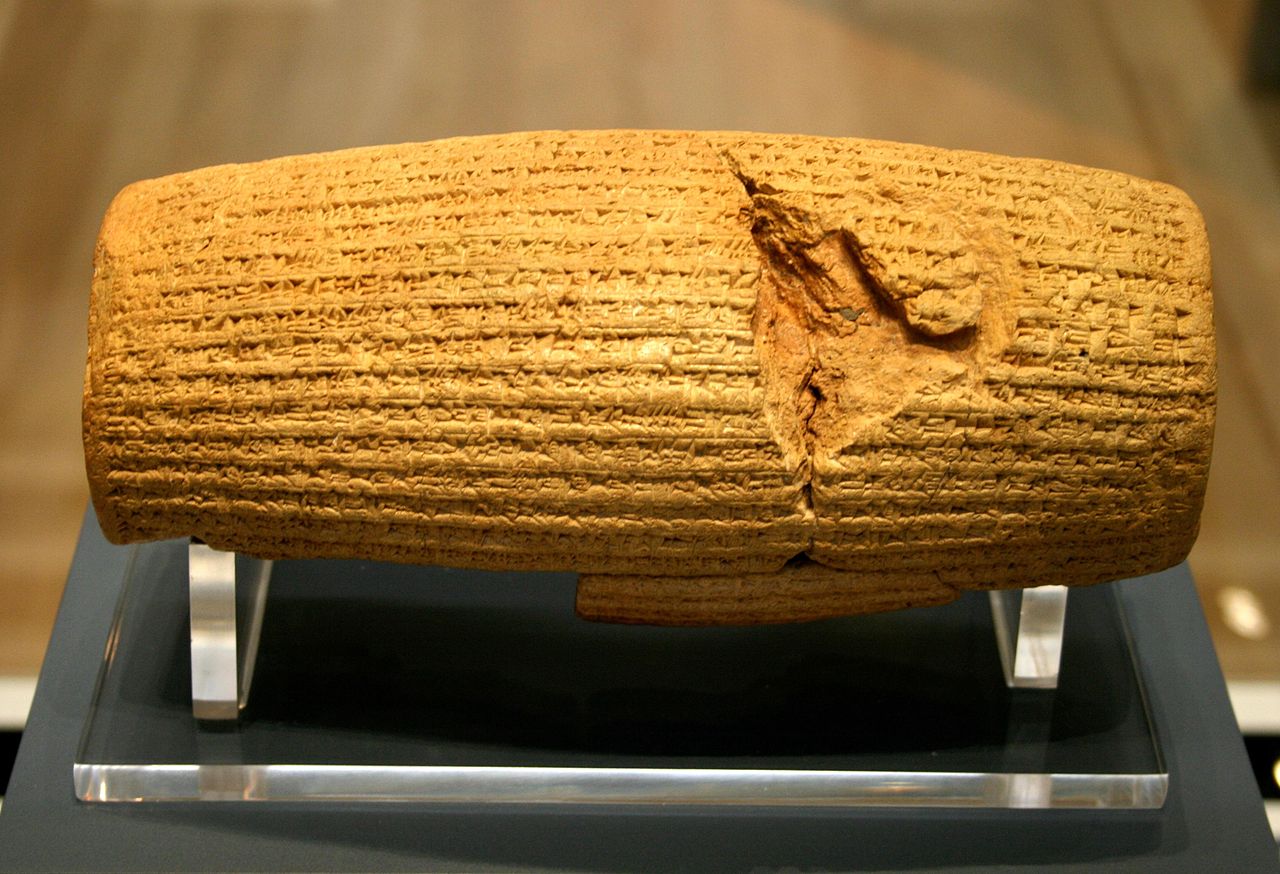
In Room 55 of the same building, a few minutes' walk away, is a hexagonal clay prism about 38 centimetres tall. It is covered in cuneiform script - the annals of Sennacherib's third campaign, written in his own voice. It reaches his invasion of Judah and records what happened to Hezekiah, king of Jerusalem: "As for Hezekiah the Judahite, I shut him up like a caged bird in his royal city of Jerusalem."
A caged bird. Shut in. The language is contemptuous - the king reduced to a prisoner in his own palace - and you can feel the scribe reaching for the right formulation, something that will convey total dominance without actually having to claim a military victory that, apparently, he couldn't claim. Because the sentence doesn't end with a fall. It ends with tribute. Hezekiah paid. Sennacherib took the gold and the silver and the daughters and went home. "Jerusalem" and "captured" do not appear in the same sentence anywhere on the prism.
The Taylor Prism is one of three identical clay prisms recording the same annals. It was found at Nineveh in 1830, purchased by the British Museum in 1855, and it has been sitting there ever since: Sennacherib's own account of the campaign. The reliefs in Room 10b depict Lachish alone and make no claim about Jerusalem either way; the inference that Jerusalem's fate differed from Lachish's comes from comparing this prism with the separate siege and tribute record, not from anything the reliefs themselves say.
The Taylor Prism - Sennacherib's Annals, Third Campaign
A hexagonal baked-clay prism, 38 cm high, inscribed in cuneiform with Sennacherib's account of his eight military campaigns. Column III records the invasion of Judah in 701 BCE. The relevant passage states that Hezekiah was "shut up like a caged bird in his royal city of Jerusalem" and that tribute was subsequently delivered - gold, silver, precious stones, ivory, and members of the royal household. The prism does not state that Jerusalem was taken. Found at Nineveh in 1830 by Colonel Robert Taylor; acquired by the British Museum in 1855 from Taylor's estate. Two further copies of the same text survive: the Chicago Prism (Institute for the Study of Ancient Cultures, Chicago) and the Jerusalem Prism (Israel Museum, Jerusalem).
British Museum, London - Room 55Nineveh fell in 612 BCE
Seventy-nine years after the Taylor Prism was inscribed, and eighty-nine years after Sennacherib stood in front of a stone panel of himself watching Lachish burn, Nineveh was destroyed by a coalition of Babylonians and Medes. The city was sacked so thoroughly that it disappeared from history for over two thousand years. When Xenophon's army marched past the ruins in 401 BCE, they didn't know what the great mounds were. When Alexander crossed the region, the city had been rubble for two centuries. It was not rediscovered until the nineteenth century.
Jerusalem was still there. Under Babylonian rule after 586 BCE, yes - and that is a story this site knows well, and Psalm 137 knows better. Under Persian rule, then Hellenistic, then Roman. Destroyed by Rome in 70 CE and again in 135 CE. But never entirely gone, never forgotten, never reduced to a mound that travellers passed without recognising. The city Sennacherib couldn't finish the sentence about is still there. The city of the king who gave Lachish its own room is not.
The descendants of the people on the panels in Room 10b visit them on school trips.
Further reading
- Wikipedia: Siege of Lachish
- Wikipedia: Lachish Reliefs
- Wikipedia: Sennacherib
- Wikipedia: Taylor Prism (Sennacherib's Annals)
For teachers: a free downloadable lesson pack comparing this evidence with a biblical narrative.
Story & Stone · Now in Glass Cases Nº 1
Next on the shelf: Rome - The Arch of Titus →