The island is called Elephantine - or was called that by the Greeks, who thought the rounded granite boulders at the first cataract of the Nile looked like the backs of bathing elephants. The Egyptians called it Abu. The Jewish garrison stationed there in the fifth century BCE called it Yeb. It is a small island at what was then the southern frontier of the Persian empire's Egyptian province, directly opposite what is now the city of Aswan. The Nile narrows here; the cataracts make it unnavigable; the island is a natural checkpoint. Whoever controls Yeb controls the traffic between Egypt and the African interior. The Persians were serious administrators, and they stationed a serious garrison here. Among its soldiers were Jews.
This is already, before we have touched a single document, an extraordinary fact. The Jerusalem Temple was standing. The Torah was being assembled, edited, and argued over. The great project of Second Temple Judaism was under way - and all the while, a community of Jewish soldiers and their families was living on an island in southern Egypt, observing Passover, celebrating the Sabbath, conducting legal transactions, and writing letters, in a dialect of Aramaic so clear and idiomatic that modern scholars can read it almost without effort. They were not marginal. They were not lost. They were doing the same things Jewish communities have always done - eating, arguing, litigating, praying - and the papyrus they wrote on did not rot.
That last fact is the gift. Egypt's dry climate is one of the great archivists of antiquity. When the Elephantine papyri began to appear on the antiquities market in the 1890s - offered by local inhabitants who had found them, in circumstances that were never fully recorded, at the southern end of the island - scholars recognised immediately what they were looking at. These were not copies of religious texts. They were not the works of scribes. They were the actual administrative and personal documents of a living community: contracts written between named individuals, letters from one person to another, legal proceedings, petitions to distant officials. They are the closest thing we have to a Jewish community archive from the biblical period.

A garrison at the edge of everything
The community at Yeb was not there by accident. The Persian empire, which controlled Egypt from 525 BCE, was a sophisticated operation that drew soldiers from across its vast territories and stationed them where they were needed. A Jewish military garrison in Egypt may have predated the Persian conquest - some scholars argue the community had roots going back to the late Assyrian or early Babylonian periods, perhaps to the upheavals that followed the destruction of Jerusalem in 586 BCE, or even earlier. The documents themselves, which begin in earnest around 495 BCE, do not explain when or exactly why the community arrived. By the time the papyri open their account, the community is already established, confident, and fully functioning.
What the documents reveal is a society with a strong internal life. The garrison community had its own leaders, its own system for resolving disputes, its own religious institutions. They maintained contact with Jerusalem and with Samaria - the two major Jewish administrative centres of the Persian period - and corresponded with Persian officials in the formal, courteous Aramaic of imperial bureaucracy. They were part of the empire's administrative fabric. When they needed something from a governor, they knew exactly how to write the letter.
They also had their own temple. This is the detail that arrests every reader of the Elephantine documents: at Yeb, the Jewish community maintained a temple to their god, whom they called Yahu - that is, YHWH, the God of Israel. The temple is mentioned in the documents as an established fact, presented as something with a long history, not a recent innovation. It was a real building with priests, with sacrifices, with the full apparatus of ancient temple worship. And it existed while the Jerusalem Temple also stood - making Yeb the site of what appears to be a functioning Jewish temple outside the one place that later Jewish law would consider the only legitimate location for such a building. For students of the development of Jewish monotheism and religious law, this is not an anomaly to be explained away. It is a window into the world before the rules had fully set.
What the papyrus remembers
The range of documents in the collection is what makes it so valuable. This is not a royal archive or a religious library. It is, as nearly as we can tell, the accumulated paperwork of a community - which means it includes the mundane as well as the dramatic, and the mundane is often the more revealing.
There are marriage contracts. They specify what each party brings to the marriage, what happens to property if the marriage dissolves, and - strikingly - who has the right to initiate divorce. At least one surviving wifehood contract from Yeb, in the fifth century BCE, gives the wife the same formal right to dissolve the marriage that the husband has: she could stand up before the assembly, declare the formula of divorce, and the marriage was ended, with her property rights intact. This is not how Jewish divorce law would later develop: by the time of the Mishnah and Talmud, the get - the bill of divorce - was the husband's instrument alone to give. The named Elephantine property, litigation and inheritance contracts show women who could own property, bring suit and see their claims upheld; the wider claim that any given woman could leave a marriage on her own initiative depends on the specific wifehood contract governing her case. It is not that the women of Elephantine were unusually liberated by some ancient feminist programme. It is that the legal norms of this community reflected the wider Near Eastern world in which they lived, before later rabbinic legislation moved in a different direction.
There are also loan documents, conveyances of property, records of legal disputes, letters about grain and about money, and correspondence that crosses hundreds of miles - from Yeb to the Persian governors of Judah and Samaria, and presumably back again, though the replies are sometimes lost. What survives is a partial archive, found in conditions that were never ideal. What we have is enough to reconstruct the texture of a life.
And then there are the extraordinary documents - the ones that, even in translation, carry a charge that two and a half thousand years cannot quite dissipate.
The letter about Passover
Around 419 BCE, a letter arrived at Yeb from a man named Hananiah. The letter (TAD A4.1, also known as Cowley 21) concerns the proper observance of the Festival of Unleavened Bread - Passover. The community is told, in precise administrative language, how many days to celebrate, when to abstain from leaven, when to refrain from work. The instructions align with what is commanded in the Torah. The document appears to be an official communication, possibly sent on the authority of the Persian king Darius II himself, though the exact chain of command is not entirely clear from the surviving text.
The implications are layered. Here is a Persian imperial administration - the same administration that governed Judah, Samaria, and Egypt as provinces of a vast bureaucratic empire - apparently transmitting instructions about the correct observance of a Jewish religious festival to a garrison in southern Egypt. The Persian state was not indifferent to the religious practices of its subject communities. It was, in some sense, invested in them. The same logic that led Cyrus to permit the rebuilding of the Jerusalem Temple, and that led later Persian kings to support Ezra's mission to Jerusalem, is visible here at the community level: the empire found that permitting subject peoples to practise their own customs made them more manageable, not less. Piety and administration turned out to be compatible, and the Passover Letter is the administrative confirmation of that compatibility.
It is also simply a remarkable object: a letter, written on papyrus, telling Jewish soldiers in Egypt how to celebrate Passover, approximately 2,440 years ago. The soldiers received it, presumably read it aloud, and kept it. We have it.
The soldiers received the letter, presumably read it aloud, and kept it. We have it.
The Passover Letter (TAD A4.1)
A papyrus letter sent to the Jewish community at Elephantine by a man named Hananiah, giving detailed instructions for the correct observance of the Festival of Unleavened Bread. The letter references authorisation from Arsames, the Persian satrap of Egypt, and possibly from the court of Darius II; scholars continue to discuss the precise administrative chain. The text specifies the dates for the festival (fifteenth to twenty-first of Nisan), the days on which leavened bread is forbidden, and the periods of obligatory rest. It is the earliest known document outside the biblical text to refer to the observance of Passover by a Jewish community, and one of the very few documents from the Persian period to show Persian administrative engagement with Jewish religious practice at the community level. Held in the Staatliche Museen zu Berlin.
Staatliche Museen zu Berlin (Pergamonmuseum complex)The temple that was destroyed - and the letter that asked for help
Around 410 BCE, while the Persian satrap Arsames was away from Egypt, the temple of Yahu at Elephantine was destroyed. The destruction appears to have been instigated by Vidranga, the local Persian garrison commander, acting alongside or at the instigation of the Egyptian priests of the god Khnum - the precise circumstances are debated, but the community's own account, written in the surviving documents, is unambiguous: they believe the temple was deliberately demolished by hostile action, and they are furious about it.
What they do next is a masterclass in the bureaucratic culture of the Persian empire. They write letters. They write to the Persian governor of Judah - Bagavahya (also spelled Bigvai in some scholarly transliterations) - asking for support in rebuilding their temple. They also write to the sons of Sanballat, the governor of Samaria, well known to readers of the book of Nehemiah as a figure of opposition to Judah's rebuilding projects. Both Judah and Samaria - rivals in the land of Israel - are being approached simultaneously by the Yeb community, because both are Jewish-administered provinces of the Persian empire, and the Elephantine garrison needs whatever allies it can find. The letters survive. The response from Jerusalem's religious establishment does not survive, and the Elephantine documents note, somewhat pointedly, that the priests of Jerusalem have not replied.
Bagavahya and the sons of Sanballat did eventually respond - a memorandum survives recording their reply. They supported the rebuilding, with one significant modification: the community could rebuild the temple and restore the grain and incense offerings, but animal sacrifice - the blood sacrifice central to the Jerusalem Temple's cult - should not be resumed. This is a fascinating document in the history of Jewish religious authority: two Persian-period officials in the land of Israel, apparently drawing on religious norms that the Elephantine community had either not adopted or not observed, setting conditions on what kind of worship was permissible in a temple hundreds of miles away in Egypt.
Whether the temple was ever rebuilt is not known. The documents thin out after this point. The Persian period in Egypt came to a turbulent close as the fifth century ended. The Elephantine community disappears from the documentary record, probably dispersed by the upheavals that followed. What they left behind, buried or cached for reasons we cannot reconstruct, is their archive - and the archive has outlasted everything else.
The Temple Petition and the Memorandum of Reply
A group of Aramaic papyrus documents records the Elephantine community's appeal for help in rebuilding their destroyed temple of Yahu. The petition (TAD A4.7) is addressed to Bagavahya, the Persian governor of Judah, and mentions a parallel appeal to the sons of Sanballat, governor of Samaria. A separate document (TAD A4.9) preserves what appears to be a memorandum recording the officials' reply: the temple may be rebuilt and offerings of grain and incense resumed, but animal sacrifice should not be reinstated. This represents the earliest known case of religious authorities in the land of Israel exercising a form of oversight over a Jewish community in the diaspora, mediated through Persian administrative channels. The temple destruction is generally dated to approximately 410 BCE; the petition documents date to approximately 407 BCE. These documents are among the most studied in the Elephantine collection, and are held primarily in Berlin, with related documents at Oxford.
Staatliche Museen zu Berlin; Bodleian Library and Ashmolean Museum, OxfordWhat these objects prove
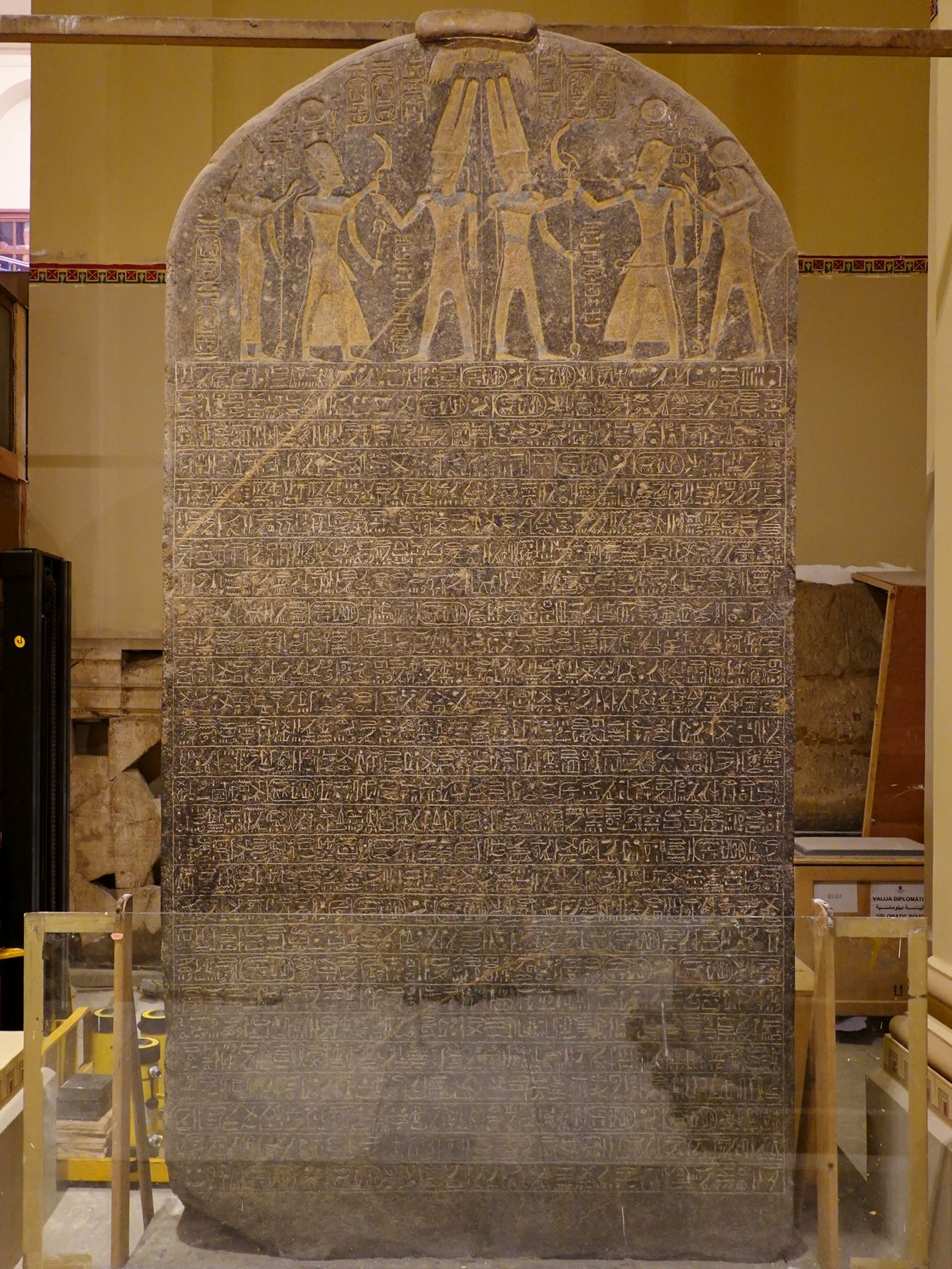
The Elephantine papyri are not unique in confirming that Jewish communities existed outside the land of Israel in the biblical period - other documents, inscriptions, and archaeological finds establish that fact from different directions. What they are unique in providing is texture: the actual words of actual people, in their own hand, about their own lives. The Merneptah Stele (Glass Cases Nº 8) tells us that the scribes of a pharaoh noted the existence of Israel. The Elephantine papyri tell us that a woman named Mibtahiah owned property in her own right, lent money, appeared before courts, and negotiated the terms of her own marriages. That is a different kind of historical knowledge.
They also establish, beyond any reasonable doubt, that Jerusalem was not the only centre of Jewish religious life in the Persian period. There was a temple to YHWH in Egypt, maintained by a community that also observed Passover, kept the Sabbath, and wrote in the administrative language of the empire. That community corresponded with officials in Jerusalem and Samaria, which means those officials knew about it. The Elephantine evidence does not overturn the centralisation claims of the Torah or the later prophets; it complicates the picture in exactly the way that evidence, when it is real, always does.
The papyri are distributed across several institutions now - Berlin holds the largest collection, Brooklyn holds a significant group published by Emil Kraeling in 1953, and Oxford holds further documents at both the Bodleian and the Ashmolean. They are, by any measure, among the most important documents for the history of Judaism in the ancient world. They sit in their cases in their respective cities. They are readable. The soldiers who wrote them are gone without further trace. The papyrus persists.
Further reading