There is a walking tour of central Rome - well-reviewed, four stars, comfortable shoes recommended - that takes you past the Arch of Titus on the Via Sacra, pauses for a few minutes of explanation, and moves on to the next stop. The guide describes the arch's two relief panels. She points out the procession of Roman soldiers carrying the seven-branched menorah, the silver trumpets, the golden table from the Temple in Jerusalem. The group nods, photographs, walks on. This is what victory looks like, nineteen centuries later: a waypoint on a Tuesday afternoon with a packed lunch.
The arch was completed around 81-82 CE, shortly after the death of Titus, and it commemorates the events of 70 CE - the siege of Jerusalem, the destruction of the Second Temple, the end of Judaea as a going concern. Rome wanted the world to know what it had done. It said so in bronze letters, in marble, in coin. The empire that had coined the phrase IVDAEA CAPTA - "Judaea conquered" - wanted a monument to match its own announcement.
They built one. It has stood for nearly two thousand years. It is very good stonework. Tourists photograph it.

What the triumph carried
In the summer of 71 CE, Vespasian and Titus held a triumph in Rome that Josephus describes in lavish, almost nauseated detail. The procession through the city carried the spoils of the Temple: the menorah, the table of showbread, the golden trumpets. The menorah especially - seven branches, the central lamp elevated, the whole thing roughly man-height - was something the crowd had never seen. It came from a place that was now rubble. It announced that the thing was finished.
The arch was built to freeze that moment. The relief carving of the menorah on its inner face is the most detailed surviving image of the Temple's furnishings - no equivalent exists anywhere. It is remarkable workmanship. It is also the clearest visual record available of an object looted from a people whose city had just been burned, whose survivors were being marched to Rome as slaves to build the Colosseum. The quality of the carving is not in question.
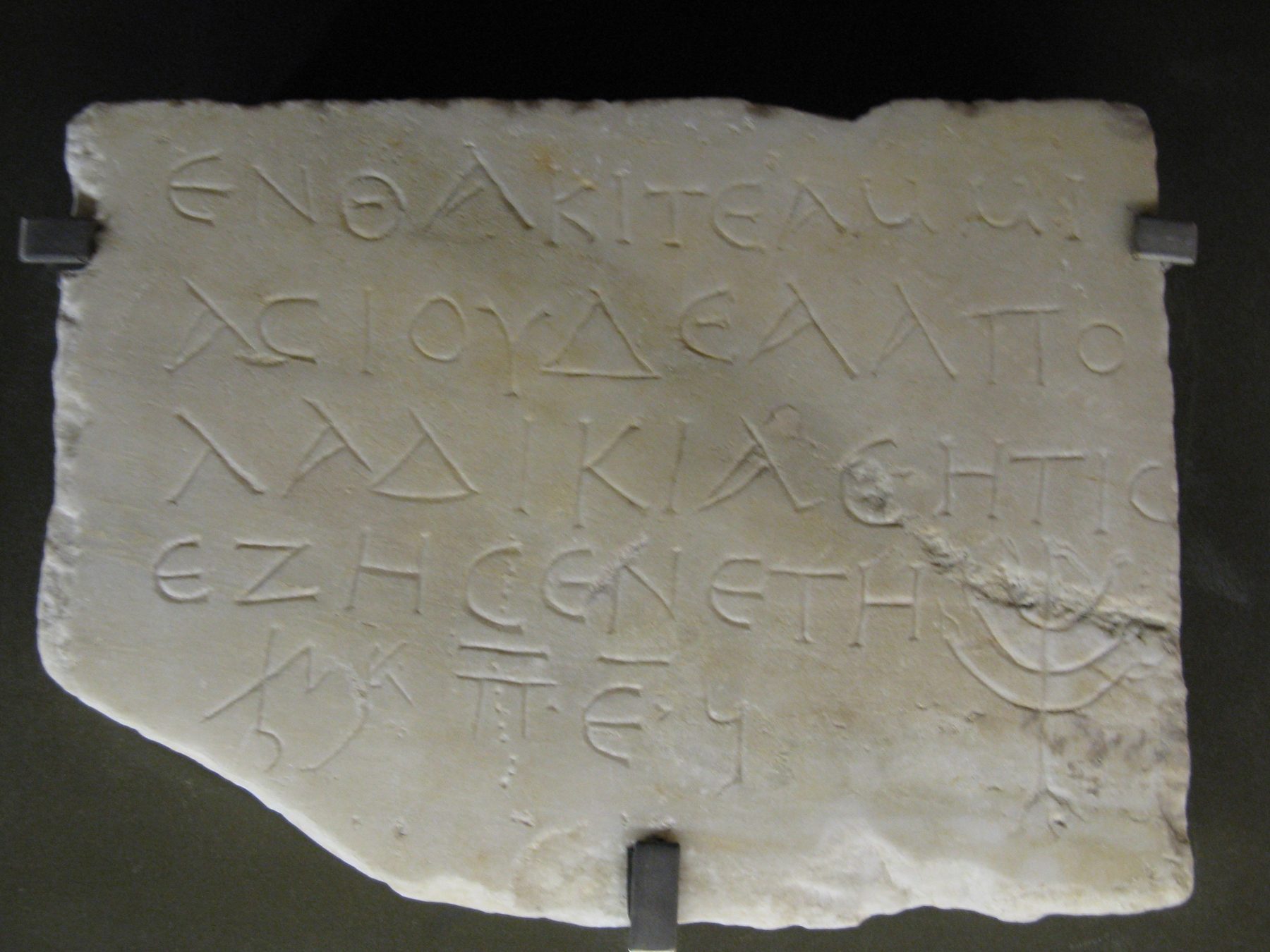
For the Jewish community of Rome, the arch was not a monument - it was a standing insult. The tradition, kept across centuries, was that Jews would not walk beneath it. The chief rabbinate of Rome placed a formal prohibition on passing under the arch. To do so was to honour Titus, and to honour Titus was something no Roman Jew was going to do.
This tradition held for the better part of two thousand years, which is a long time to go around the long way. Then, on 29 November 1947, the United Nations voted to partition the land and create a Jewish state. Three days later, on 2 December 1947, the chief rabbi of Rome - David Prato - told his community that it was time. They would walk under the arch. They would walk backwards: going back, the direction of return, facing the way they had come. The ban was lifted. The direction was reversed.
A contemporary report records a five-thousand-person gathering beneath the arch on 3 December 1947, the day after Prato's announcement. They paraded beneath it. Some went forwards, some backwards; the JTA correspondent reported prayers for the six million dead in Europe and a thanksgiving service at the Rome synagogue. The later tradition associating the crossing with Israel's May 1948 declaration of statehood is described separately and should not be merged with that report. The arch stood where it had always stood. The people walking under it were different from the people who had refused to.
The IVDAEA CAPTA Coins
A series of bronze, silver, and gold coins struck under Vespasian and his successors Titus and Domitian, commemorating the conquest of Judaea. The standard reverse shows a mourning woman - Judaea personified - seated beneath a date palm, with a Roman soldier standing triumphant alongside. The legend: IVDAEA CAPTA. The series ran for roughly twenty-five years and was minted in Rome and across the empire. Rome spent the victory announcement in every denomination it had. Examples are held in named collections including the British Museum (London) and the Israel Museum (Jerusalem), which holds its own example of the coin that announced its captivity.
British Museum, London; Israel Museum, JerusalemThe emblem
In 1948, the provisional government of the new State of Israel held a competition for a national emblem. Four hundred and fifty proposals came in from a hundred and sixty-four applicants. The winning design, by the brothers Gabriel and Maxim Shamir, was then refined: the committee asked them to replace the menorah they had drawn with a different one - the one from the inner face of the Arch of Titus.
The emblem was officially adopted on 10 February 1949. The image that Rome carved to announce the end of Judaea became the image the Jewish state put on its official seal, its government papers, its coins, its passports. The menorah that the triumph carried through Rome in 71 CE - carved in such loving detail on the arch's inner face that it remained the clearest surviving image of the Temple's furnishings - was the model, nearly nineteen centuries later, for the emblem of the state that Rome had declared finished.
There was argument about it at the time. Chief Rabbi Yitzchak Herzog objected on religious grounds - the arch's menorah has a hexagonal base, which contradicts the Talmudic description of a three-legged base, meaning the carving might represent a Roman copy rather than the original. He was overruled. The state decided that the menorah on the arch - whatever its exact fidelity to the Temple original - was the right image precisely because of where it came from. The irony was the point.
The state of Israel was declared 1,878 years after the destruction of Jerusalem. Its official emblem is a tracing of Rome's trophy.
The Menorah Relief, Arch of Titus
The inner face of the arch carries two large relief panels depicting the triumph of 71 CE. The northern panel shows Roman soldiers carrying the Temple spoils in procession: the seven-branched menorah, the silver trumpets, the golden table. It is the most detailed surviving ancient image of the Temple menorah - the object is shown at close quarters, at human scale, with a hexagonal pedestal base and poles for carrying. Rome meant it as a record of conquest; it turned out to be the most accurate record available of the thing it was boasting about having taken. The arch stands on the Via Sacra, Rome; the relief is in situ, open to the public and to walking-tour groups.
In situ, Via Sacra, Rome (open site)The Colosseum, briefly
While you're standing at the arch, the Colosseum is a five-minute walk away. Worth noting, in passing, what funded it. In around 1995 the German epigrapher Géza Alföldy examined a second-century inscription on the Colosseum's architrave and identified traces of an earlier set of bronze letters beneath it - holes where the original dedication had been fixed, before the text was altered by a later emperor. Reconstruction of the letter-hole pattern suggests the original inscription read that the new amphitheatre was built from the spoils of war: ex manubiis. The spoils in question were the Temple treasures carried in the triumph of 71 CE. Scholarly reconstruction, presented as such - the original letters are gone, only the holes remain. But the holes make an argument.
The Colosseum Dedicatory Inscription (Alföldy Reconstruction)
Around 1995, the German epigrapher Géza Alföldy examined the pattern of bolt holes left by a removed bronze inscription on the Colosseum's main architrave. By mapping the holes against standard Roman letter spacing, he reconstructed a probable original text reading that the emperor had the amphitheatre built "from the spoils of war" - ex manubiis - referring to the spoils of the Jewish War of 66-73 CE. The reconstruction is a scholarly inference, not a direct reading: the bronze letters themselves were removed in antiquity and do not survive. The Colosseum stands on the Via Sacra, Rome; the reconstructed inscription is discussed in Alföldy's 1995 paper in Zeitschrift für Papyrologie und Epigraphik.
In situ, Colosseum, Rome (reconstruction: Géza Alföldy, ZPE 109, 1995)Tuesday afternoon
The walking tour moves on. The guide mentions that Latin is studied in schools largely because of Roman administrative and legal legacy - that the empire which carved IVDAEA CAPTA into its coinage is now a civilisation you take as an elective. The arch is a bus stop, more or less. People lean against it waiting for their group to reassemble.
In the old Jewish quarter of Rome, a five-minute walk from the arch, there are restaurants and a museum and a synagogue that has been in continuous use since the sixteenth century. The community it serves is one of the oldest in the world - predating the destruction of Jerusalem, predating the arch, predating the empire that built the arch. They were here when Titus paraded through. They are here now.
The walking tour gives the arch four stars and comfortable shoes. That seems about right.
Further reading
Story & Stone · Now in Glass Cases Nº 2
Next on the shelf: Babylon - Pergamonmuseum, Room 9 →