The Roman Senate had voted Herod king of Judea in 40 BCE. It took him three years and a long, ugly war to make that title real. The Hasmonean prince Antigonus - installed by a Parthian invasion that had swept the Romans temporarily from the Levant - held Jerusalem, and the city's walls and the Temple's sanctity gave him a defensible position that neither prayer nor diplomacy would dislodge. Herod needed Rome's legions, and Rome, having stabilised the region under Mark Antony's command, was prepared to supply them.
The joint force that marched on Jerusalem in the spring of 37 BCE was commanded by the Roman general Gaius Sosius, with Herod commanding his own troops alongside. What followed was a systematic siege in the Roman manner: embankments raised, battering rams advanced, towers built to overlook the walls. The defenders were fierce and the city would not fold quickly. By the time the outer walls gave way the summer was well advanced, and what happened inside Jerusalem in the final weeks was, by any reading of the sources, brutal on all sides.
The record
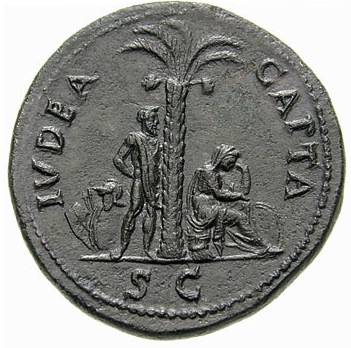
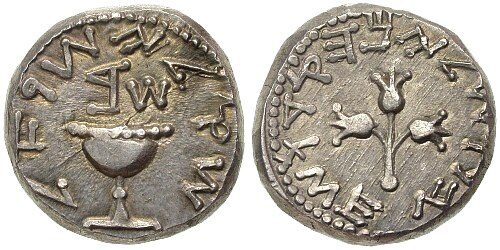
Josephus provides the most detailed account of the 37 BCE siege in both Antiquities of the Jews (Book XIV, chapters 15-16) and Jewish War (Book I, chapter 17). He records that the siege lasted about five months in total, that Sosius entered the city alongside Herod, and that Antigonus was taken prisoner and sent to Mark Antony, who had him beheaded at Antioch - the first execution of a king by Roman order. Josephus notes that Herod argued strenuously against his soldiers looting the Temple treasury, and paid the Roman troops from his own resources to discourage plunder. Numismatic evidence supports the chronology: Hasmonean coinage bearing Antigonus's name stops after 37 BCE, while coins bearing Herod's name begin in the same period. (Classical Numismatic Group; Israel Museum coin collection)
What made the victory complicated - what would make Herod's entire reign complicated - was legitimacy. He had won Jerusalem at the point of Roman swords. His father Antipater was Idumean; his mother Cypros was Nabataean; the Idumeans had been converted to Judaism only a generation before, under John Hyrcanus, and the fact was never forgotten by those who wished to hold it against him. He was not a Hasmonean. He was not a priest. He could build the most magnificent temple compound the ancient world had seen and still walk into the wrong room and hear silence fall. To shore up the Hasmonean connection he had married Mariamne, granddaughter of both claimants in the civil war that had brought Pompey to Jerusalem twenty-six years earlier. It was a political alliance that he also, by every account, loved fiercely - and that he later destroyed with the same suspicious intensity he brought to everything else.
The record
The small bronze coin in the image - a lepton, sometimes called a prutah - is one of the most common physical traces of Herod's reign. Herod's coins are conspicuously aniconic by the standards of his Hellenistic contemporaries: no royal portrait, no divine imagery, only objects (a tripod, an eagle, a helmet, a palm branch) that skirted the prohibition on graven images while still signalling royal ambition. The eagle that appears on some of these coins may echo the golden eagle Herod placed above the Temple gate - an act the Talmud records with disapproval and which, according to Josephus (Antiquities XVII.6.2-3), provoked a protest that ended with the removal of the eagle and the execution of the students who had hacked it down. His coins kept the eagle; the Temple gate did not. The coins in question are held in collections at the Israel Museum, Jerusalem, and the British Museum, London.
It is worth pausing on what Antigonus's defeat actually closed off. The Hasmoneans had been, for a century, something genuinely remarkable: a Jewish priestly family that had seized independence from a Seleucid empire and held it, producing kings and high priests and - for a few decades - a territorial kingdom larger than anything since Solomon. They had also, by 37 BCE, spent two generations tearing themselves apart. The last chapter of Hasmonean rule had been written by Parthian invaders and Roman arbiters and competing brothers, and Antigonus himself had been installed not by popular will but by the cavalry of an eastern empire. His execution at Antioch was the last move in a civil war that the dynasty had been losing for twenty years. Herod did not end the Hasmonean era so much as collect its wreckage.
The record
The Hasmonean palace complex in the Upper City of Jerusalem was excavated from the 1970s onwards by Nahman Avigad and subsequently by the Israel Antiquities Authority in the Jewish Quarter of the Old City. The stratigraphy confirms occupation through the Hasmonean and Herodian periods. Avigad's excavations also uncovered the "Burnt House" - destroyed in 70 CE - and a series of Hasmonean-period buildings and ritual baths that show the scale of the elite residential quarter Herod inherited and then built over. Separately, excavations beneath the Western Wall plaza from 2007 onwards by the Israel Antiquities Authority have traced the Herodian construction sequence, confirming that Herod's Temple platform was built over and around the earlier Hasmonean structures rather than replacing them entirely. (Nahman Avigad, Discovering Jerusalem, 1983; Israel Antiquities Authority Western Wall excavation reports)
The coin in Herod's image is small enough to fit on a fingertip. It circulated among ordinary people buying oil and bread in a city their king had taken at Roman swords' point and was now rebuilding on a scale that still staggers engineers. Herod's Jerusalem was a paradox the tribe has never quite finished arguing about: a Jewish king, appointed by pagans, building the most magnificent expression of Jewish worship that had ever stood, and ruling it with a cruelty that the tradition preserves without flinching. He is not remembered with affection. The Temple he built is what the tradition mourns. Both of those things are true, and the tension between them is part of what 37 BCE bequeathed to the centuries that followed.