Somewhere around the year 200 CE, give or take a generation, the last child grew up speaking Hebrew at home. We don't know her name. Nobody marked the occasion, because nobody marks that sort of occasion - a language doesn't lose its cradle at a funeral, it loses it at a kitchen table, when a mother answers her child in Aramaic because it's simply easier, and the child answers back in Aramaic, and that's that.
This is, normally, the end of the story. When Latin stopped being anyone's mother tongue it became Italian and Spanish and French - it has descendants, but no children. Sanskrit lives in ceremony. Coptic lives in liturgy. Manx and Cornish have their revivalists, heroic and few. The rule, across every continent and every century, is that a language which loses its native speakers has lost them for good.
Hebrew broke the rule. It's the only language in recorded history to lose every native speaker and win them back - to go from no mother-tongue speakers to roughly nine million, with the gap in between lasting seventeen centuries. And the strangest part of the story isn't the return. It's that the language was never silent for a day of it.

A language with a pension plan
Because here's the thing: Hebrew didn't go into a museum. It went into the equivalent of a very long, very active retirement. Jews stopped speaking it at the market and never stopped using it everywhere else - prayer three times a day, contracts, poetry, philosophy, medical texts, business letters between Cairo and Aden, rabbinic responsa criss-crossing Europe. A merchant in eleventh-century Fustat and a scholar in eleventh-century Worms had no spoken language in common. They could write to each other perfectly well, and did.
Children still learned it - not from their mothers but from their teachers, the way English schoolboys once learned Latin, except that Latin was somebody else's inheritance and this was their own. Every Jewish boy who learned his letters learned these letters. For seventeen hundred years, across every community on our map, the tribe kept paying into the pension. Nobody knew what they were saving for. It turned out they were saving for 1882.
The Gezer Calendar
A schoolboy-sized limestone tablet listing the agricultural year - two months of harvest, two of sowing, a month of flax. One of the oldest substantial Hebrew inscriptions known, from around the time the story says Solomon reigned. Not poetry, not scripture: a farming memo. The language starts its written life doing chores.
Istanbul Archaeology MuseumsThe Silver Amulets of Ketef Hinnom
Two rolled strips of silver, each smaller than a thumb, found in a burial cave above the Hinnom Valley in Jerusalem. Unrolled, they carry the priestly blessing from the Book of Numbers - "May the Lord bless you and keep you" - making them the oldest surviving biblical text anywhere, some four centuries older than the Dead Sea Scrolls. The words said over children every Friday night, in silver, before the Babylonian exile.
Israel Museum, JerusalemThe maddest parenting decision of the nineteenth century
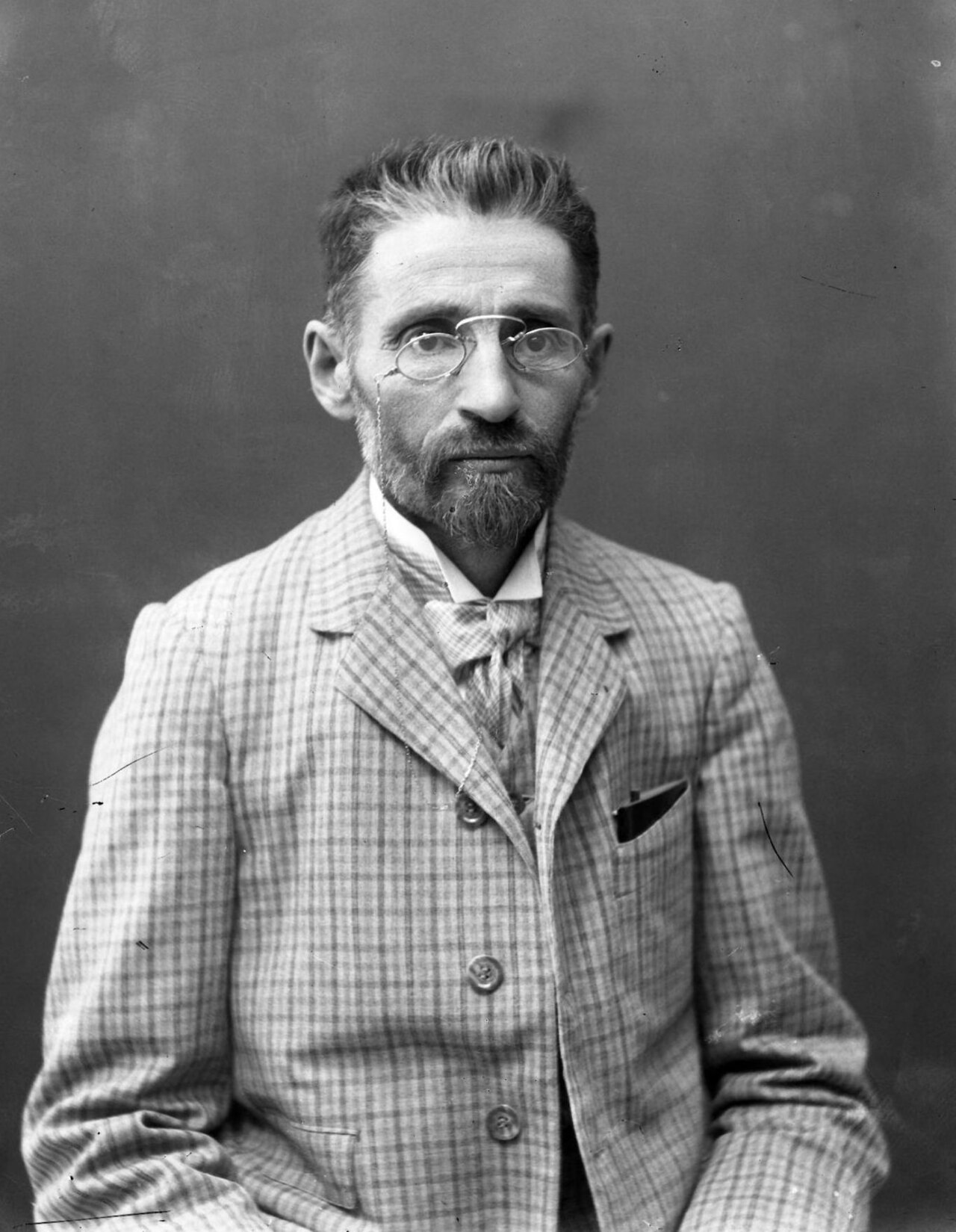
Eliezer Ben-Yehuda arrived in Jerusalem in 1881 with a fixed idea, and fixed ideas don't come more fixed than his: that a people returning to its land should speak its own language, and that the only way to make Hebrew an everyday tongue again was to hand it to a child as a mother tongue. Since no such child existed, he decided to manufacture one.
His son was born the following year, and was raised inside an experiment of total immersion. Hebrew only - at home, in the street, from guests, who were turned away if they couldn't comply. The family had to invent the words for the boy's own world as he grew into it: there was no Hebrew for ice cream, or bicycle, or doll, or newspaper, because nobody had needed one for two thousand years. Ben-Yehuda coined them - glida, ofanayim, buba, iton - the vocabulary of a childhood, drafted at a desk by a man with tuberculosis and a deadline.
It was, by any reasonable standard, an unhinged thing to do to a child, and it worked. The boy - Itamar Ben-Avi, as he renamed himself - reportedly didn't speak at all until he was four, at which point he began speaking the first native modern Hebrew anyone had heard in seventeen centuries. One child. Then schools. Then kindergartens, where the children of immigrants from forty countries found Hebrew was the only language the whole playground had in common. Then, within two generations, everything else.
For seventeen hundred years the tribe kept paying into the pension. It turned out they were saving for 1882.
The Bar Kokhba Letters
Dispatches from the last revolt against Rome, found in a desert cave by the Dead Sea - some in the commander's own brusque Hebrew. One orders supplies of palm branches and citrons so the troops can keep Sukkot mid-war. A rebellion on the edge of annihilation, pausing to requisition the festival shopping. The language's last days as a street tongue, spent exactly in character.
Israel Museum, JerusalemThe Complete Dictionary of Ancient and Modern Hebrew
Ben-Yehuda's life's work: seventeen volumes, tracing every word he could find across three thousand years of texts and minting the ones the modern world needed. He died in 1922 with the job half done; his widow Hemda and his son drove it to completion across another thirty-seven years. A dictionary finished by the family of the first child who spoke it.
Completed posthumously, 1959What the resurrection is actually evidence of
It's tempting to tell this as a great-man story, and Ben-Yehuda was certainly a great something. But one obsessive can't resurrect a language, any more than one man with a defibrillator can revive a patient who's been gone seventeen hundred years. The revival worked for one reason only: the patient had never entirely gone. Every generation in between had kept the language warm - read it, wrote it, prayed it, taught it to its sons. The miracle of 1882 was underwritten by seventeen centuries of unglamorous Tuesday afternoons in cheder.
Which is why this is the right first story for this site. The resurrection of Hebrew is the tribe's whole method, performed on a single object: carry the thing through the long dark, keep it in working order, refuse to let it become a relic - and when the moment comes, hand it to a child. Transmission isn't a metaphor here. It has a name, and he didn't say a word until he was four, and then he never stopped.
Nine million people will argue in this language today - in traffic, in the Knesset, at Friday night tables. Somewhere among them a mother is answering her child in Hebrew because it's simply easier. That sentence, at that kitchen table, is the whole story. It just took the scenic route.
Further reading