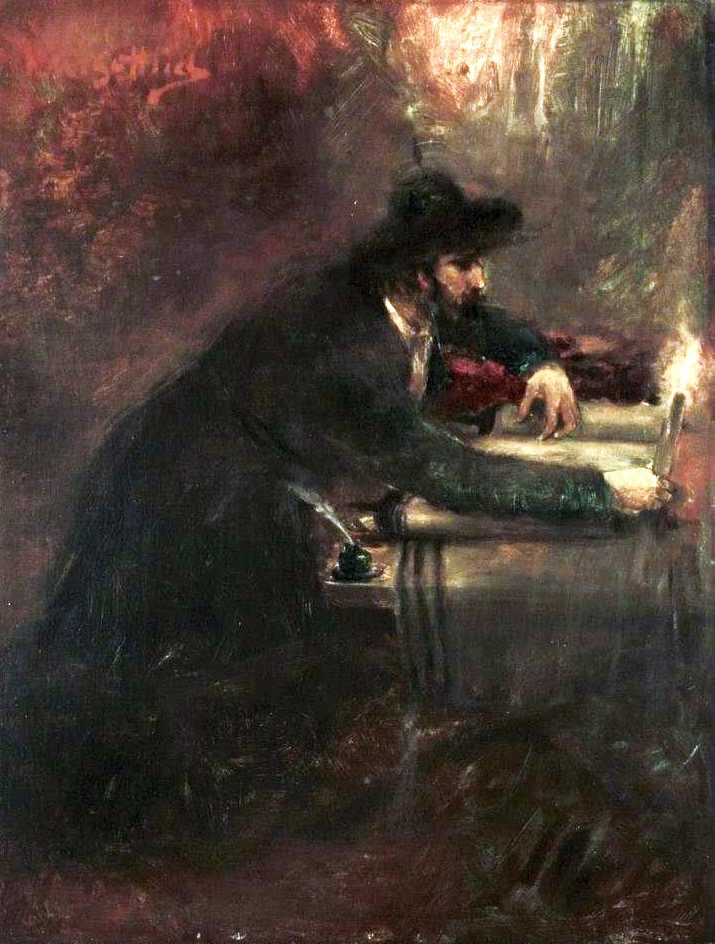
Picture a scholar in tenth-century Jerusalem, surrounded not by the sea of Talmudic commentary that occupied his rabbinic contemporaries, but by the Hebrew Bible itself - leaf by leaf, word by word, root by root. He is a Karaite, which means his entire legal and religious life rests on the written text of scripture alone. For him, this is not an invitation to freedom; it is a staggering responsibility. If he misreads a verb form, he may keep the wrong feast or observe the wrong day. If he cannot distinguish the grammatical weight of a single letter, the whole edifice of his practice wobbles. So he does what serious people do when everything depends on getting it right: he becomes a scientist of the language.
This is the largely untold story behind the Karaite movement. The theological argument - written Torah only, no binding rabbinic tradition - is well known. But theology has consequences. The Karaites' insistence on reading scripture by its own light, without the safety net of an inherited interpretive tradition, drove them to produce some of the most rigorous Hebrew philological work of the medieval world. Grammar was not an academic hobby for them. It was the only tool they had.
The record
Abu al-Faraj Harun (fl. early 11th century CE), a Karaite grammarian working in Jerusalem, composed the Al-Kitab al-Kafi ("The Sufficient Book"), a comprehensive Arabic-language treatise on Hebrew grammar covering morphology, syntax and the verbal system. It is one of the most systematic grammatical works produced in the medieval Hebrew tradition. Abu al-Faraj also wrote the Mushtamil, a shorter grammar that influenced later scholarship on both sides of the Karaite-Rabbanite divide. His work is documented in the Encyclopaedia Judaica (2007 edition) and analysed by Geoffrey Khan of Cambridge University, whose critical editions of Karaite linguistic manuscripts have brought this corpus back into scholarly view.
The intellectual logic was clean and iron. The Karaites had stripped away every interpretive layer between themselves and the text. They could not fall back on "the rabbis say" or "tradition holds." When they encountered the Hebrew conjunction vav at the head of a verse, they had to decide - from the grammar alone - whether it meant "and," "but," "then," or something else. When they read a verbal root, they needed a systematic account of how Hebrew verbs worked across the whole Bible, not an ad hoc ruling from a tractate. Necessity, that fierce engine, produced scholars. The Jerusalem Karaite school of the tenth and eleventh centuries - including Joseph ben Noah and Japheth ben Eli in the tenth century, and Abu al-Faraj Harun in the eleventh - built a tradition of linguistic analysis that was genuinely new. They described Biblical Hebrew as a language with rules, patterns and exceptions, not as a sacred deposit immune to grammatical scrutiny. That was a more modern move than it sounds.
The influence on rabbinic scholarship was real, even if rarely acknowledged in polemical literature. David Qimhi (Radak, 1160-1235), whose Sefer Mikhlol became the standard Hebrew grammar for centuries and whose dictionary Sefer ha-Shorashim was the reference text behind the first Hebrew printing presses, built on the work of earlier Andalusian grammarians. Those grammarians - Jonah ibn Janah, Judah ibn Tibbon, Menahem ben Saruq - were themselves working in a tradition of grammatical seriousness that the Karaite scholars had helped to establish and model. Competition produces libraries, and sometimes the winner uses the loser's tools.
The record
The Karaite grammarian Japheth ben Eli ha-Levi (fl. 960-1000 CE), working in Jerusalem and Ramle, produced an Arabic translation of almost the entire Hebrew Bible together with running commentary - one of the largest exegetical undertakings of the medieval period. His commentaries engage systematically with grammar, semantics and lexicography, and preserve discussions of Hebrew verb forms and syntactic constructions that have no parallel in contemporary Rabbanite literature. Manuscripts of his work survive in the British Library, the Firkovitch Collection in St Petersburg, and the Bibliothèque nationale de France. The scope and methodology of this corpus is documented in the work of Geoffrey Khan (University of Cambridge) and Meira Polliack (Tel Aviv University), whose studies on Karaite biblical interpretation have brought renewed scholarly attention to his grammatical contributions.
There is a certain irony - the satisfying kind - in the Karaite story. A movement that began by saying "the written text is enough" was forced, by that very principle, to become the custodians of its exact meaning. They could not afford imprecision. Their descendants in Jerusalem, Cairo and eventually Constantinople and Crimea kept the tradition of close reading alive through communities that remained small but intellectually serious. When Elijah Bashyachi, the fifteenth-century Karaite legal codifier, wrote the Adderet Eliyahu, he was writing in a tradition that had spent five centuries treating every Hebrew letter as evidence. That is one way to keep a language alive: make your life depend on reading it correctly.
The record
The question of whether Aaron ben Moses ben Asher - the tenth-century Tiberian Masorete whose manuscript of the Hebrew Bible became the authoritative base text for most modern editions, including the Aleppo Codex - was himself a Karaite or Karaite-influenced remains a subject of scholarly debate. The case for Karaite affiliation was advanced by Paul Kahle in the mid-twentieth century and has been revisited by later scholars. The Encyclopaedia Judaica notes the question as unresolved. If the affiliation holds, the very man who fixed the vowel-points and cantillation marks of the standard Hebrew Bible - whose notations every Jewish reader encounters in every printed Torah - was working from within the tradition that declared scripture alone the ground of Jewish life.
Religions produce their sharpest tools when they are arguing hardest. The Karaites argued that the text was everything, and then spent centuries proving what "everything" actually meant: root systems, grammatical categories, verb stems, the precise weight of a prefix. They gave Hebrew linguistics its vocabulary for exactness. The tribe has always known that the argument and the learning are the same thing.