There is a famous photograph, and almost everything about Tel Aviv is already in it. Sixty-odd families stand in a loose ring on a bare dune north of Jaffa, in their best dark coats and hats, squinting into a hard spring sun. There is nothing behind them. No street, no tree, no wall, no shade. They are not posing in front of a city; they are posing in front of where a city is about to be. And they are about to allot the ground beneath their feet by lottery, drawing seashells out of a box. It is one of the least likely ways to found a city ever recorded, and it worked.
That is the thing to hold on to. Tel Aviv did not grow up slowly around a fort or a harbour or a holy site. It was decided. A group of Jewish families in crowded, expensive Jaffa wanted a modern garden suburb of their own, with proper drains and wide streets and Hebrew on the shop signs, and so they bought a stretch of dune and built it. Most ancient cities are accidents that succeeded. This one was an argument made physical: that Jews could plan, fund and run a civic life of their own, in the open, in their own language, and not as a tolerated quarter in someone else's town.
The sand did not stay empty for long.

A suburb that drew lots
The new neighbourhood was called Ahuzat Bayit, "homestead", and it began on 11 April 1909 with that draw on the dunes. Within a couple of years it had taken the name Tel Aviv - "Hill of Spring", the Hebrew title chosen for a translation of Herzl's utopian novel Altneuland - and the choice was its own small manifesto. The name was ancient and brand new at once: a phrase from the prophet Ezekiel, picked up to label a modern dream. Old word, new town. The whole city is in that pun.
What made Tel Aviv unusual was not its size, which at first was tiny, but its intent. It was to be a Hebrew city in the full sense: streets named in Hebrew, children schooled in Hebrew, business and gossip and complaint all conducted in a language that had spent centuries as the tongue of prayer and study and was now being asked to order bread and argue over rent. This dovetailed exactly with the wider Hebrew revival, the astonishing project of turning a sacred language back into an everyday one. Tel Aviv gave that project a place to be ordinary in.
And it grew with almost indecent speed. The garden suburb swallowed its own plan. Tel Aviv became the engine room of the Hebrew revival in print and on stage - publishers, newspapers, a theatre, schools - and then it kept going, past anything its founders had drawn, into a real city with real traffic and a famously short temper.
Ahuzat Bayit on the dunes
On 11 April 1909, sixty-six Jewish families gathered on sand dunes north of Jaffa and allotted the first plots of the neighbourhood of Ahuzat Bayit by a lottery of seashells, organised by Akiva Aryeh Weiss. The neighbourhood soon took the name Tel Aviv, and that date is reckoned the city's founding. It grew from this nucleus into the first modern all-Hebrew city.
Ahuzat Bayit building society, 1909The Hebrew city grows up
Under the British Mandate the town became a genuine city. Waves of Jewish immigration in the 1920s and 1930s poured in, many fleeing Europe as it darkened, and Tel Aviv absorbed them with its characteristic mixture of improvisation and nerve. Whole districts went up at speed, including the great stock of clean-lined modernist apartment blocks that later earned the centre its nickname, the White City. A place that had begun as a circle of families on a dune was, within thirty years, one of the principal cities of the country in the making.
It was never a tidy place, and that is rather the point. Tel Aviv has always been brash, secular-leaning, commercial, argumentative, fond of the beach and short on reverence. Jerusalem looks up the hill at history; Tel Aviv looks out at the sea and gets on with the week. The two cities are often cast as opposites, and there is something to it, but the contrast flatters them both. One guards the memory. The other proves the memory can build something noisy and new and entirely alive.
None of this was a museum of return. Nobody founded Tel Aviv to reenact antiquity. They founded it to live, in Hebrew, now, with cafes and theatres and traffic jams and rent disputes - the unglamorous furniture of a normal national life, which for this people was the least normal and most extraordinary thing of all.
The name on the dune
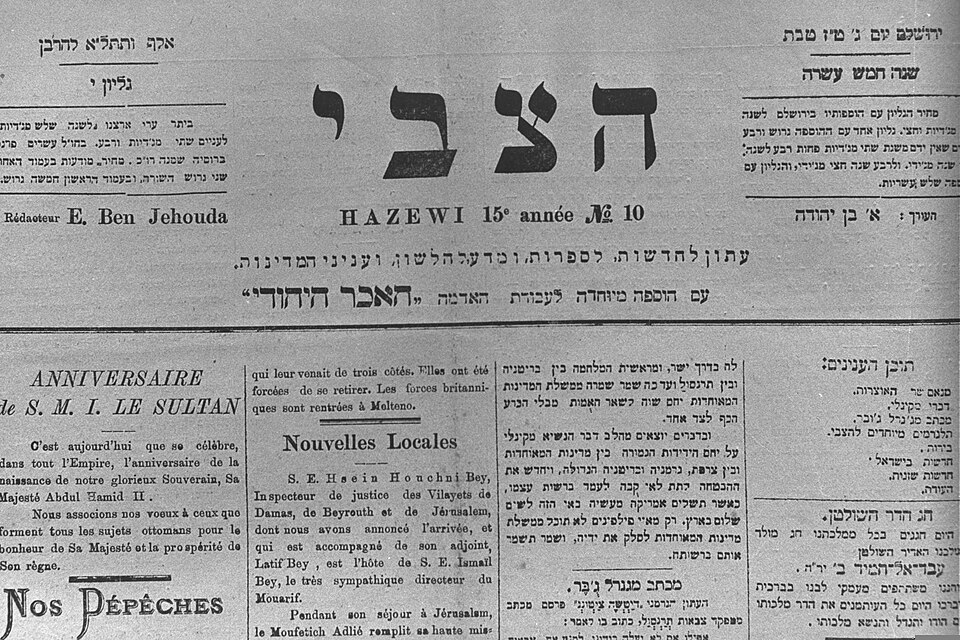
The name Tel Aviv, "Hill of Spring", was adopted for the new neighbourhood around 1910. It had been coined by the writer Nahum Sokolow as the Hebrew title of Theodor Herzl's novel Altneuland; the phrase itself appears in the Book of Ezekiel. The choice fused an ancient Hebrew expression with a thoroughly modern aspiration, which is the whole character of the place in two words.
Sokolow's translation of Altneuland · Ezekiel 3:15The least likely city
Stand again with the families in the photograph and the achievement comes into focus. They are ordinary people in formal coats, standing on nothing, about to gamble their savings on a stretch of sand and a language only lately back in the marketplace. There is no reason it should have worked. Cities are not usually willed into being by sixty-six families and a box of shells. And yet the dune is now a metropolis, the shop signs are in Hebrew, and the lottery photograph hangs on the wall of a city that long ago outgrew it.
That is the deeper claim Tel Aviv makes, quietly, by simply existing and behaving like any other lively, exasperating modern city. A people can do more than remember and endure. It can also plan, fund, argue, build and run an ordinary civic life of its own, in the open and in its own tongue. The sand did not stay empty. That is the whole story, and it is not a small one.
Most ancient cities are accidents that succeeded. This one was an argument made physical - that the sand would not stay empty.
Further reading