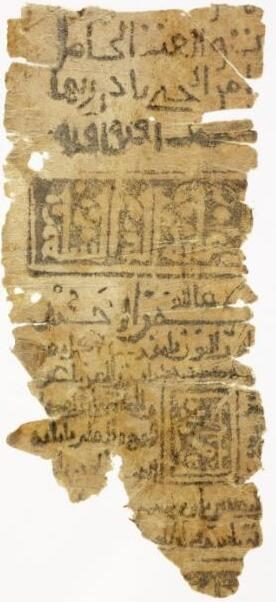
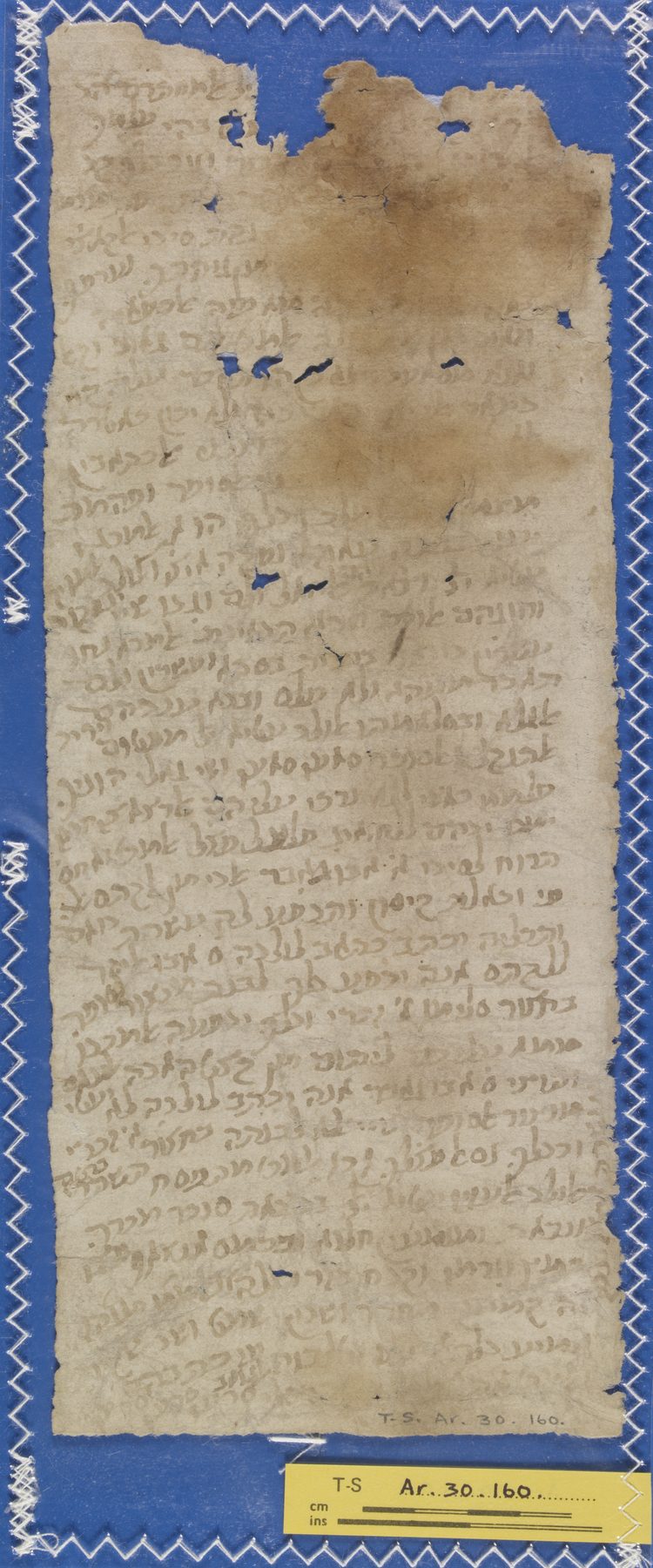
The wonder of the thing is its mundanity. Not a Torah scroll. Not a marriage contract or a rabbinic ruling or a merchant's letter crossing the Indian Ocean. A shopping list. A note about household provisions - the kind of thing you write without thinking, tuck into a pocket, use once, and throw away. Except that this one was not thrown away. This one ended up in a sealed chamber in the loft of a synagogue in Old Cairo, where it sat undisturbed for somewhere between five hundred and a thousand years, until a Cambridge scholar named Solomon Schechter climbed up to look at it in 1896 and found himself standing in the greatest archive of Jewish everyday life ever discovered. The shopping list was in there. It is in there still, at Cambridge, catalogued and preserved. Someone went to market in medieval Fustat and wrote down what they needed, and we have it.
Fustat was the city - the old Arab-founded settlement that preceded what we now call Cairo, on the east bank of the Nile. Its Jewish quarter was a working neighbourhood: merchants, craftsmen, physicians, teachers, money-changers, and the people who cooked for all of them and needed oil and soap and flour and thread. The Ben Ezra Synagogue stood at the heart of this community, and in its loft - in what is called a geniza, from the Hebrew root meaning to store or to hide - its community had been depositing documents for generations. Not valuables. Not sacred objects. Paper. Parchment. Fragments with writing on them.
The rule was simple enough in principle, complicated in practice: a document that might bear the name of God could not simply be discarded. It had to be stored until it could receive proper burial. But what counted as "might bear the name of God"? Hebrew script, by extension of caution. And if Hebrew script, then any document written on Hebrew-lettered paper - which included, in a community that wrote its everyday language in Hebrew characters, practically everything. The shopping list went into the geniza on the same logic as the Torah scroll. It was not sacred. But it was written in a script that was, and a community's carefulness about that distinction turned out to be an act of extraordinary historical preservation that nobody planned.

The fragment and the collection
The shopping lists and household accounts in the Cairo Geniza are not, in themselves, the documents that first made scholars reach for superlatives. Those were the biblical manuscripts, the previously unknown Hebrew text of the Book of Ben Sira, the lost Palestinian Talmud fragments. The mundane documents came later - or rather, their significance came later, as scholars began to understand that this was not just an archive of religious texts but a complete cross-section of a community's written life, including all the parts of that life that people generally do not think worth preserving.
What does a shopping list from medieval Fustat look like? Most likely it is a small fragment - the Cairo Geniza fragments range from tiny scraps to larger sheets, but the household notes tend toward the small - written in Judaeo-Arabic, the everyday written language of Egypt's Jewish community in the medieval period. The handwriting, where scholars can read it, is informal: not the careful square script of a scribe producing a Torah, but the running hand of someone who needed to remember what they were out of. The items would reflect the provisioning of a medieval household in an Islamic-ruled Egyptian city - the kind of commodities that appear, in their aggregate, across hundreds of such fragments in the collection. Olive oil. Soap. Grain. Legumes. Linen thread. The materials of cooking and cleaning and clothing, priced in the currency of a city that was, in the tenth and eleventh centuries, one of the great commercial centres of the Mediterranean world.
The specific contents vary from fragment to fragment, and scholars are careful not to conflate individual documents into a composite picture that no single one actually represents. What the collection as a whole demonstrates - across hundreds of household accounts and market notes - is something extraordinary: a detailed record of the prices, commodities, and domestic economics of a medieval Jewish community, preserved in the handwriting of people who had no idea they were making history.
Goitein's reconstruction
The scholar who did more than anyone else to make the mundane documents speak was Shelomo Dov Goitein, a German-born Jewish historian who spent much of his career at the Hebrew University, then the University of Pennsylvania, and finally the Institute for Advanced Study in Princeton. Goitein began working seriously with the Geniza documents in the 1950s, and he did not stop until his death in 1985, leaving behind a six-volume work called A Mediterranean Society that is one of the most extraordinary acts of historical reconstruction in modern scholarship.
What Goitein did was read the mundane documents - thousands of them, in the fragmentary Judaeo-Arabic that was the collection's most common everyday register - and use them to build an account of how a medieval Jewish community actually functioned. Volume one covers the economic foundations: what people traded, what they charged, how credit worked, what the market in basic commodities looked like. Volume three covers the family. Volume four covers daily life. Together they amount to a portrait of Fustat's Jewish community from roughly 950 to 1250 CE that is more detailed, in many respects, than what we have for most medieval European communities from the same period - because those communities did not have a geniza.
Goitein found prices. He found what a labourer earned and what a physician charged and what a widow paid for linen thread. He found evidence of what people ate - the range of foodstuffs available in a city at the intersection of Mediterranean and Indian Ocean trade - and how they cooked, and what they kept in their kitchens. He found, in aggregate, a life. Not a life as imagined by later generations, or reconstructed from normative legal texts that describe what people should have done, but a life as it was actually lived, in the handwriting of people who were not performing it for an audience. The shopping lists are part of this. They are primary evidence of what daily existence in medieval Fustat cost and contained.
S.D. Goitein, A Mediterranean Society
Six volumes, University of California Press, 1967-1993. A reconstruction of Jewish communal and individual life in the medieval Islamic world, built primarily from the Cairo Geniza documents. Volume 1: Economic Foundations; Volume 2: The Community; Volume 3: The Family; Volume 4: Daily Life; Volume 5: The Individual; Volume 6: Cumulative Indices (completed posthumously). The work draws extensively on mundane documents - household accounts, market notes, personal letters, court records - and is the essential scholarly resource for understanding what Geniza shopping lists and household accounts actually reveal about medieval Jewish domestic economy.
University of California PressJudaeo-Arabic: the script of everyday life
The shopping list would almost certainly be in Judaeo-Arabic. This is worth pausing on, because Judaeo-Arabic is not simply Arabic written carelessly, nor is it Hebrew with Arabic words mixed in. It is Arabic - the spoken, living, everyday language of Jews in medieval Islamic Egypt, the language in which they argued with their neighbours and bargained at the market and spoke to their children - written in Hebrew letters. Not Arabic script. Hebrew letters.
This was the normal practice of Jewish communities in the Islamic world from roughly the ninth century onwards: to write whatever language you actually spoke in the script that your community's religious tradition had sanctified. The same phenomenon occurs elsewhere in Jewish history - Ladino, the Judaeo-Spanish of Sephardic communities, written in Hebrew script; Bukhori, the Judaeo-Persian of Central Asian Jews; Yiddish, the Judaeo-German of Ashkenazi communities. In each case, the spoken language is shaped by the surrounding world; the written script reaches back to Torah. The everyday and the sacred are bound together in the act of writing, even when what you are writing is a note about provisions.
This is precisely why the shopping list ended up in the geniza. The text was almost certainly not sacred by any reasonable definition - it was a household note, not a religious document. But it was written in Hebrew characters. And Hebrew characters, the script of Torah, commanded a certain care. Into the geniza it went, alongside the Bible fragments and the responsa and the merchant letters, because the script did not distinguish between the sacred and the mundane even when the content did.
The India traders and the shopping list
One of the most celebrated sub-collections within the Cairo Geniza is the India traders archive - a body of business correspondence that documents the Jewish merchants who, between roughly 1000 and 1150 CE, participated in the trade networks linking the Mediterranean world to the Indian Ocean. These merchants wrote letters - detailed, personal, commercial letters that crossed from Fustat to Aden to the Malabar Coast and back - and copies or originals of those letters ended up in the geniza. Goitein spent years reading them. The picture they produced was of a sophisticated commercial world in which Jewish merchants operated across vast distances, in Arabic, Hebrew, and Judaeo-Arabic, buying and selling pepper, flax, indigo, and tin.
The shopping list is in the same pile. This is not a metaphor; it is literally true. The geniza received everything - the letter from a merchant in Aden to his partner in Fustat describing a cargo that had been delayed by storms in the Red Sea, and the household note from someone two streets over listing what they needed from the market. Both documents were written in Hebrew letters. Both could not simply be thrown away. Both went into the loft. For a thousand years they sat together in the dark, the epic and the mundane, undifferentiated by anything except the handwriting and the content.
What this says about the geniza - and about the community that maintained it - is something that Goitein understood as foundational to his entire project. The Cairo Geniza is not an archive in any planned sense. Nobody decided what to save. The rule of care did the saving, indiscriminately, across a thousand years. The result is not a curated portrait but something much rarer: a cross-section. The community as it actually was, rather than the community as any official source thought worth recording.
The letter from the India merchant and the household shopping note went into the same loft. For a thousand years they sat together in the dark, the epic and the mundane.
The Ben Ezra Synagogue Geniza, Fustat
The geniza chamber of the Ben Ezra Synagogue in Fustat (Old Cairo) accumulated documents from approximately the late ninth or early tenth century CE until its contents were examined by Solomon Schechter in 1896. The community never carried out the periodic burials that geniza practice prescribed, allowing the chamber to accumulate perhaps a million fragments over roughly a thousand years before Schechter's visit. The synagogue itself, traditionally dated to the ninth century CE, stands on a site associated with Jewish community in Old Cairo considerably earlier; the building has been substantially rebuilt and restored in the modern period. The geniza chamber no longer contains documents.
Fustat (Old Cairo), EgyptThe reversal
There is an irony at the centre of the Cairo Geniza story that repays attention. The rule that preserved the shopping list was not designed to preserve shopping lists. It was designed to honour God - specifically, to avoid the desecration of God's name by consigning it to rubbish or destruction. The rule was about reverence. Its object was theological, not archival. Nobody in Fustat's Jewish community was thinking: let us save our grocery notes for posterity. They were thinking: this scrap has Hebrew letters on it, and we are careful about Hebrew letters.
The mundane documents survived as a consequence - an unintended consequence of an act of reverence so thoroughly habituated that it was no longer felt as a burden. People did not agonise over whether to put a household note in the geniza. They did it because that is what you did. The scruple had become a practice, the practice had become a community norm, and the community norm, multiplied across a thousand years and tens of thousands of pieces of paper, had become - without anyone intending it - one of the most extraordinary archives in human history.
This reversal - sacred rule producing mundane preservation - is perhaps the deepest thing the shopping list has to say. The Cairo Geniza exists because a community took text seriously enough to care for it even when the text was trivial. That seriousness, that weight placed on the written word simply by virtue of the script it was written in, is the thread that runs from the Torah through the merchant letter to the shopping list and into the Cambridge library where all three now sit together, waiting for the next scholar to read them.
What the list holds
Consider what it means to hold - even hypothetically, even at the remove of a catalogue reference and a digital image - someone's shopping list from nine hundred years ago. Not the list of a king or a philosopher or a merchant prince whose name history had reason to keep. The list of an ordinary person in a functioning city, who needed certain things from the market and wrote them down so they would not forget. That person's name is almost certainly not recoverable. Their face is not recoverable. We do not know if they were rich or poor, a man or a woman, old or young. The list tells us only that they were there, and that they had a household that needed provisioning, and that they were careful enough about paper to use a scrap with writing on it rather than waste fresh material - or that the scrap already had Hebrew writing on the reverse, and so it belonged in the geniza whether they intended that or not.
That person had no idea that their grocery note would be studied by scholars in a Cambridge library in the twenty-first century. They had no idea there would be scholars, or a Cambridge library, or a twenty-first century. They had a list. They needed provisions. They wrote it down, and by the logic of a scruple that had long since become habit, the paper went into the loft, and the loft held everything, and the Cambridge train carried it across Europe, and now it is there, catalogued and cared for, as close to eternal as paper gets.
The Cairo Geniza did not set out to be a monument to Jewish persistence. It set out to be a storage room for paper that might contain God's name. It became, in the doing, something larger: a record of how a community lived, at the level of daily transaction, for a thousand years. The shopping list is not the most important document in the collection. But it may be the most instructive one. It tells you what the rule was actually for - not for scholars, not for posterity, not for history - but for a piece of paper. And it is there because someone, in a city called Fustat in a century we can barely imagine, took that piece of paper seriously.
Further reading