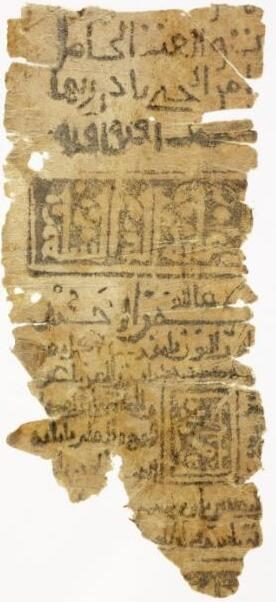
The island of Elephantine sits in the Nile at the first cataract, where the river turns loud and rough before you can reach Nubia. It is a small place - roughly one and a half kilometres long - and for most of the fifth century BCE it was home to a garrison of soldiers stationed there by the Persian empire to guard Egypt's southern frontier. Among those soldiers were Jews. They had a temple. They had a community that spanned at least three generations. They had disagreements with their neighbours about shared walls and access to water. They had a woman named Mibtahiah who married twice, owned property in her own right, and once initiated a divorce proceeding. They wrote all of it down, on papyrus, in Aramaic, and they buried the documents in the ground, and the ground was very dry, and here we are.
More than two thousand five hundred years later, local diggers and European collectors began turning up rolls of papyrus near modern Aswan in the 1890s. By the time scholars had assembled and read what they had, the picture that emerged was extraordinary: not a temple, not a monument, not a royal inscription - but a community, named, argued, transacted and alive. Thirty or more individuals appear in these documents by name. We know who their landlords were. We know what they paid in grain rations. We know who lent money to whom and on what terms, and we know, in at least one case, that a woman went to court and won.
This is what papyrus does that stone cannot. Stone preserves what the powerful decided to preserve. Papyrus preserves the ordinary, because ordinary things were written on it and then - by some accident of disposal, of hiding, of the sheer preservative quality of Egyptian sand - survived. The Elephantine papyri are the ordinary life of a Jewish community in the fifth century BCE, seen from the inside.

Who were these people?
The short answer is that we do not know exactly, and the documents themselves are candid about not telling us. What we know is that by the time the papyri begin - around 495 BCE - the community was already established enough to have a temple, a functioning administration, and a set of internal legal practices that they clearly regarded as their own tradition rather than something borrowed from the Persian authorities above them.
The longer answer, pieced together from the documents themselves and from what we know of the broader history, runs something like this. When the Assyrian empire swept through the northern Kingdom of Israel in the eighth century BCE, it scattered populations across the ancient world - soldiers, craftsmen, administrators, people who ended up far from wherever they had started. Some of those people, or their descendants, may have ended up in Egypt as part of the general traffic of mercenaries and specialists that empires have always moved around their frontiers. When Persia took Egypt in 525 BCE, it inherited whatever garrison arrangements were already in place, and the community at Elephantine appears to have simply carried on under new management.
They are not, in these documents, presenting themselves as exiles. They are not performing grief about distance from Jerusalem. They are getting on with it - with their temple, their law, their contracts, their arguments, and their lives. The persistence is not anguished. It is, if anything, practical.
A temple to YHW
The most startling single fact in the Elephantine archive is that these people had a temple. Not a prayer house, not a gathering space - a temple, with altars, with priests, with the offering of incense and burnt sacrifice. And the deity it was dedicated to was, the documents make clear, the same deity worshipped in Jerusalem: YHW, a form of the name written without the vowels that tradition eventually attached to it.
This should, by the theology of the Jerusalem establishment, not have been happening. Deuteronomy had established the principle - probably formalised during the reforms of King Josiah in the late seventh century - that there was one legitimate place of sacrifice, one chosen site, and that site was Jerusalem. Yet here was a Jewish temple in Egypt, apparently functioning for at least a century, and the correspondence shows that when it was destroyed the community wrote directly to the high priestly authorities in Jerusalem to petition for permission to rebuild. The authorities in Jerusalem, for their part, appear to have been more flexible about the arrangement than the official theology would suggest. No reply from Jerusalem survives. But the temple, from what the documents indicate, was rebuilt.
What to make of this theologically is a question scholars have not finished arguing. What the documents themselves show is a community that understood its own practice as legitimate, that appealed to Jerusalem's authority as the relevant one, and that received enough encouragement - or at least not enough discouragement - to carry on. This is not a breakaway sect. It is a community at the edge of the known Jewish world, doing what communities at the edge of things do: adapting, maintaining, continuing.
The Letter to Bagavahya (TAD A4.7 / A4.8)
Two related versions of a petition from the Jewish community at Elephantine to Bagavahya, Persian governor of Judea, and to Delaiah and Shelemiah, sons of Sanballat, governor of Samaria. The letter describes how the temple to YHW at Elephantine was destroyed around 410 BCE by Egyptian priests in collaboration with the local Persian commander Vidranga. The community states it has already written to the high priest in Jerusalem without receiving a reply. It petitions for authorisation to rebuild and to resume the offering of incense and grain. The petition is dated to year 17 of the Persian king Darius II. No written reply survives, but circumstantial evidence in later documents suggests the temple was rebuilt.
Staatliche Museen zu BerlinMibtahiah, documented
In a world where most ancient individuals survive only as names in a list or a dedicatory inscription, Mibtahiah is something rarer: a person we can actually follow. She appears across multiple documents from the Elephantine archive - scholars count at least eleven in the family archive, spanning more than sixty years - beginning in the middle of the fifth century BCE. She inherits property from her father, Mahseiah, who had been a prominent member of the community. She marries a man named Jezaniah. She marries again, after his disappearance from the record, an Egyptian builder named Eshor son of Djeho, who took the name Nathan. She owns slaves. She owns a house. She initiates, at some point, a divorce proceeding - and in the Elephantine legal tradition, this was within her power to do.
That last detail stops most modern readers. In the rabbinic law that would develop several centuries later, divorce was almost entirely a male prerogative - a husband could grant a get, a bill of divorce, but a wife had no equivalent power. The Elephantine marriage contracts show something different: formulae in which both husband and wife could declare the marriage dissolved, in which both parties had acknowledged rights to property, in which the transaction was understood as involving two parties with something approaching equal legal standing. Whether this reflects a local tradition, a pre-rabbinic norm, Aramaic legal custom borrowed from the surrounding culture, or some combination of all three is precisely the kind of question scholars have been arguing about since the documents were published.
What is not in dispute is Mibtahiah herself. She is one of the most fully documented individuals in the ancient Jewish world - more fully documented, it might be noted, than most men of her era and place. The archive kept her.
The Passover Letter (TAD A4.1)
A letter sent by a man named Hananiah to Jedaniah and the Jewish garrison at Elephantine, giving instructions for the correct observance of Passover and the Festival of Unleavened Bread. Hananiah's precise authority is uncertain - he may have been an envoy from Jerusalem, a Persian official, or both. The letter specifies the dates of the festival according to the Persian calendar and instructs the community on the days during which leavened bread should not be eaten or seen. It is one of the oldest documents in existence to reference the observance of a Jewish festival by name in a community context, and it implies a connection - administrative or religious or both - between the Elephantine community and authorities elsewhere in the Persian empire.
Staatliche Museen zu BerlinThe grain rations and the shopping lists
Not everything in the archive is dramatic. A great deal of it is the texture of daily life - which is, in its own way, the most astonishing thing the papyri contain. There are administrative lists recording the monthly rations of grain distributed to members of the garrison. There are receipts. There are loan agreements. There are notes about property boundaries and disputes over party walls. There are the small transactions that constitute, in aggregate, the actual experience of living somewhere and being part of a community that functions.
In one document, a member of the community acknowledges a loan of silver; in another, a property boundary is described with sufficient precision that you could, in principle, locate where the house stood relative to the streets and neighbours named around it. These documents were not written for posterity. Nobody buried them intending them to be found. They were the administrative paper of an ordinary life, set down because that is what you do when you need a record and papyrus is available, and then discarded or stored and eventually lost to sand - and then, twenty-five centuries later, found.
The Elephantine community lived at a remove of roughly two and a half thousand kilometres from Jerusalem, on the far southern edge of a Persian-administered Egypt, in a place where the river went loud and the frontier began. They kept their festivals. They kept their names - overwhelmingly Hebrew or Yahwistic names, even after generations in Egypt. They kept their law, or something they understood as continuous with it. They kept, in other words, themselves. The papyrus kept them.
These documents were not written for posterity. Nobody buried them intending them to be found. The ordinary life of a Jewish community, seen from the inside.
What the papyri changed
Before the Elephantine documents were published, the dominant scholarly picture of Judaism in the fifth century BCE was constructed largely from the biblical books of Ezra and Nehemiah - texts produced by, and largely concerned with, the Jerusalem establishment and its priorities. Those texts describe a community intensely focused on questions of separation, of religious purity, of the danger of assimilation. They present a picture of the tribe in which deviation from Jerusalem's norms is the great anxiety.
Elephantine complicates that picture without invalidating it. What the papyri show is that Judaism in the fifth century BCE was more various - geographically, legally, theologically - than the Jerusalem sources suggest. The community at Elephantine was not assimilated; by every marker available in the documents, they maintained their identity distinctly. But they were maintaining it in ways that the Jerusalem sources don't describe and might not have endorsed - a temple in the wrong place, marriage contracts with women's rights in them, a community of soldiers on an empire's frontier working out what it meant to be Jewish in circumstances nobody back home had quite planned for.
They worked it out. The thread from Jerusalem to Elephantine and back is not a thread of strict institutional control; it's a thread of recognised kinship. When the temple was destroyed, they wrote to Jerusalem. Jerusalem did not write back - or if it did, the reply hasn't survived. But the fact that they wrote, that they expected a reply, that they appealed to the same God under recognisably the same name - that is the thread. It ran across the Egyptian desert for more than a century, and the papyrus proves it.
Further reading