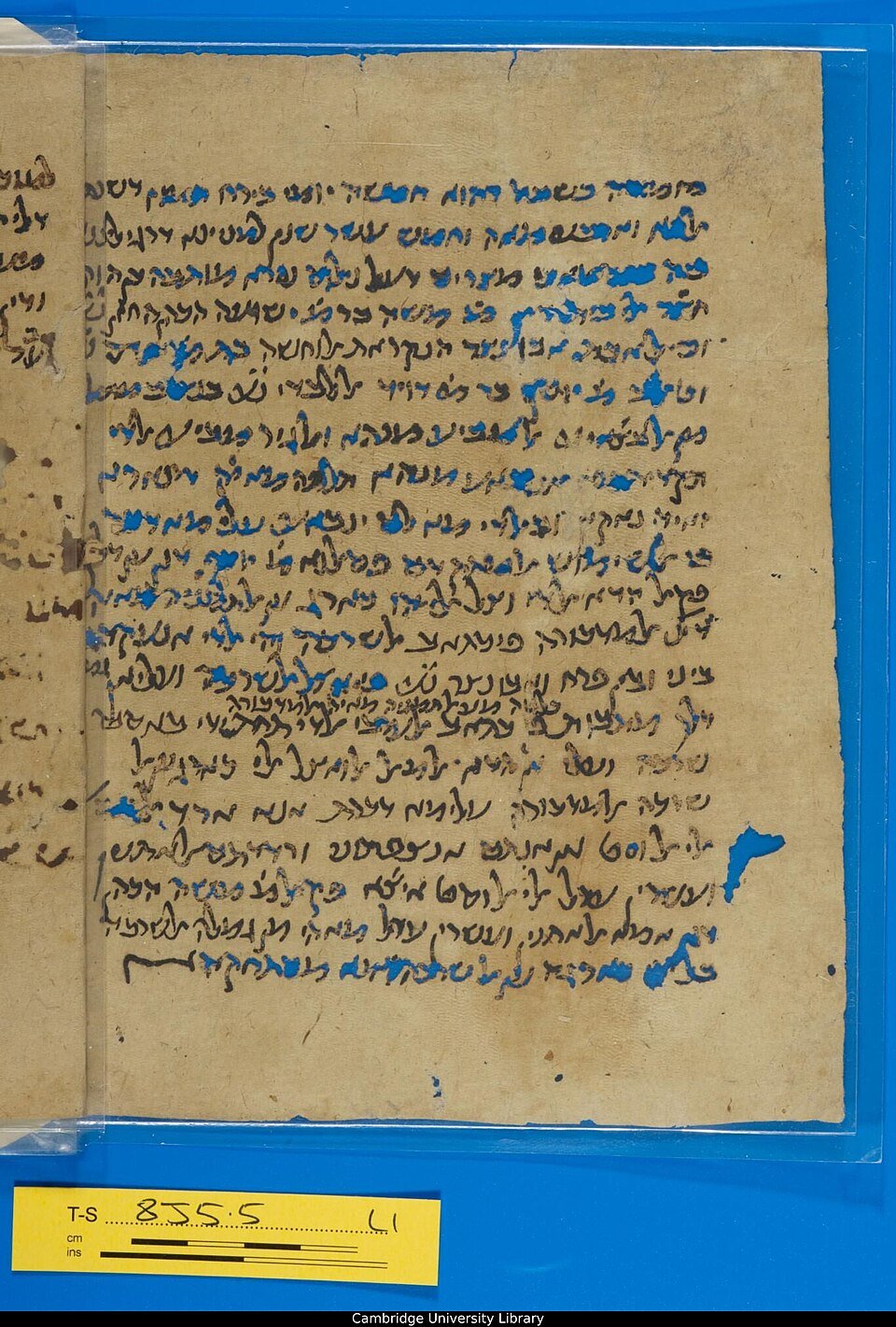
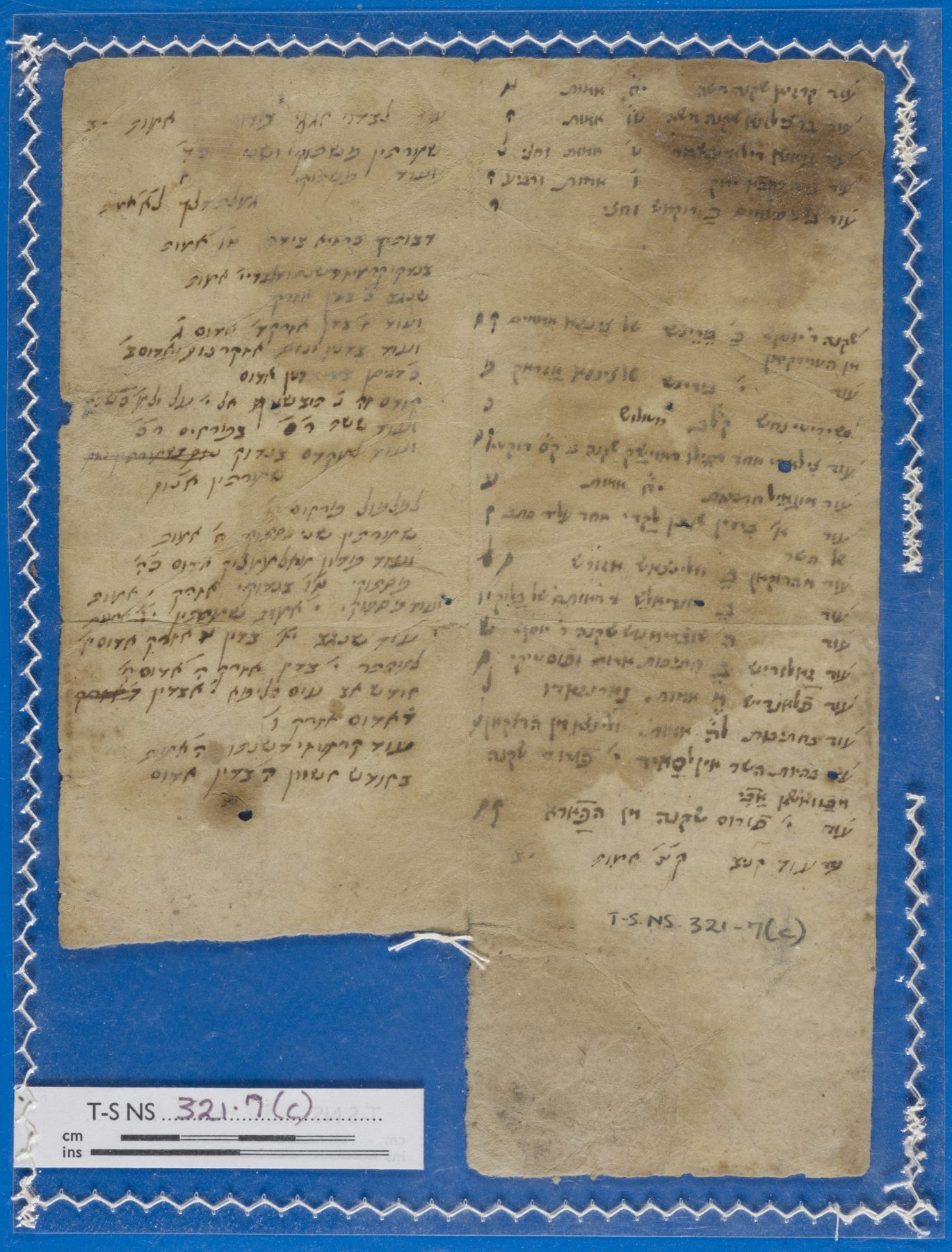
There is something very Jewish about the route. A scrap of writing is put aside in medieval Fustat because it contains sacred writing, especially texts bearing the divine name, and related Hebrew-script papers are therefore set aside rather than casually discarded. Centuries pass. Scholars, dealers, collectors, and libraries pull the hoard apart and send it in batches across Europe and America. One portion comes north to Manchester, to the John Rylands Library, where the paper is flattened, catalogued, digitised, and read again. A note once too worn or too holy or too ordinary to destroy becomes, in another age, evidence.
The temptation with the Cairo Geniza is to talk as though it were one thing in one room and then, by extension, one thing in one library. The first half is true enough. For centuries the Ben Ezra Synagogue in Fustat, now part of Old Cairo, accumulated discarded writings in its geniza - a storeroom for texts that should not simply be thrown away. The second half is not true at all. The Geniza as we study it now is scattered. Cambridge holds the largest share. New York, Oxford, Manchester, Paris, Jerusalem, St Petersburg, Philadelphia and other places hold more. Pages of one manuscript may be split between institutions. A shopping note in one library may speak more clearly when read beside a letter in another.
That is why the Rylands fragments matter. Not because Manchester owns the Geniza. It does not. They matter because the Geniza survives as a historical archive through its fragments, plural, distributed, imperfectly reunited by catalogues, photography, and scholarship. The papers travelled. The archive, oddly enough, stayed put.

What the chamber kept
The medieval Jewish community of Fustat wrote a great deal, because serious urban communities do. They wrote Bible texts, legal rulings, marriage contracts, merchant letters, court records, school exercises, poems, accounts, bills, lists, requests, quarrels, and receipts. Much of it was in Hebrew. Much of it was in Judaeo-Arabic - Arabic language written in Hebrew script. Some documents were literary and carefully copied. Others were quick, functional, nearly throwaway. The genius of the Geniza is that it refused to distinguish too sharply between the lofty and the useful.
That is why historians adore it. Other medieval archives often preserve what institutions wanted remembered: charters, decrees, polished texts, the paperwork of power. The Cairo Geniza also preserves what a living minority community handled every week and then set aside. You can see trade stretching from the Mediterranean to the Indian Ocean, but you can also see a family trying to settle an inheritance, a student practising a hand, a communal officer keeping accounts, a creditor asking to be paid, someone arranging the needs of a household before sunset. The great archive of medieval Jewish daily life is made of pieces never designed to be grand.
A synagogue storeroom became an archive by accident
The surviving Cairo Geniza documents span roughly the 6th to 19th centuries, while the Ben Ezra Synagogue's geniza chamber was used from the early 11th century onward. Because sacred writings, especially texts containing divine names, were not to be discarded casually, related Hebrew-script papers were deposited rather than destroyed. The result was not a curated archive but a layered deposit of religious, literary, legal, and everyday documents. The archive's accidental quality is the whole marvel. Nobody planned the historian's delight.
Ben Ezra Synagogue, FustatFrom Cairo to Manchester
The movement of Geniza material into modern collections belongs to the late nineteenth and early twentieth centuries, when European scholars and collectors realised that the neglected paper in Old Cairo contained extraordinary texts and extraordinary evidence. Solomon Schechter's 1896-97 removal of a huge body of fragments to Cambridge is the best-known episode, but it was not the only one. Smaller acquisitions, dealer networks, earlier removals, later sales, and private collections all contributed to the archive's dispersal. It is a story of scholarship, rescue, opportunism, preservation, and imperial-era collecting habits, all on the same page.
Manchester's holding is tied above all to Moses Gaster, the scholar, collector, and former Haham of the Sephardi community in London. Material from his collection entered the John Rylands Library in the mid-twentieth century. That matters because the Geniza did not arrive in Manchester as one clean shipment from the Ben Ezra chamber itself. It arrived through the circuits by which fragments left Egypt, were handled by scholars and collectors, and then entered libraries where they could be conserved and studied. The route is messy. So is history.
Set that against the building that now houses the collection: the John Rylands Library on Deansgate, all late-Victorian stone confidence and stained-glass seriousness. Fustat's paper landed in industrial Manchester, in a city built by cotton, canals, and commerce. There is a faint aptness in that. A mercantile archive found another mercantile city. The traders of the medieval Mediterranean wound up shelved in the north of England, where readers could piece their world together again.
Fragments entered Manchester through modern collecting history
The Rylands Cairo Genizah holdings were formed through the modern dispersal of Geniza material, especially via the collection of Moses Gaster, acquired by the John Rylands Library in 1954. Today the University of Manchester preserves and digitises more than 11,000 fragments. Manchester is not the archive's centre of gravity, but it is one of the places without which the larger archive cannot be reconstructed.
John Rylands Library / University of ManchesterOne archive, many shelves
The right way to imagine the Geniza now is not as a broken vase, beyond repair, nor as a set of isolated curiosities. It is closer to a dispersed manuscript city. Its houses are libraries. Its streets are catalogues, digital repositories, shelf marks, concordances, and the patient work of scholars matching one hand to another, one torn edge to another, one document to its reply in a different country. The archive has been physically fragmented twice: once by time, and again by collection history. Yet it remains legible.
That is why the Rylands fragments are best understood in the plural. No single leaf can stand for the whole Geniza, and no single Manchester fragment should be burdened with pretending to do so. The strength of the collection lies in aggregate. A legal text here, a letter there, a liturgical piece elsewhere, and a researcher begins to recover networks, habits, vocabularies, and local lives. The fragments keep their modesty. The archive supplies the scale.
And there is something moving in the afterlife of that modesty. People in medieval Cairo wrote because they had business to conduct, prayers to copy, quarrels to settle, children to teach, food to buy, and obligations to meet. They did not write for Manchester. Yet Manchester now keeps part of their paper safe, and by doing so helps return their city to view. That is not resurrection. Paper rarely gets anything so dramatic. But it is a very Jewish kind of survival: partial, distributed, stubborn, and legible if you know how to read across the gaps.
Digitisation and cataloguing reunite what shelves separate
Because Geniza manuscripts were dispersed among many institutions, modern scholarship depends on cross-collection cataloguing and digital imaging. Projects at Cambridge, Princeton, Friedberg, and Manchester help identify joins, trace related documents, and restore context to fragments now held far apart. The Geniza's unity today is scholarly rather than architectural, but it is unity all the same.
Dispersed archive / digital reunificationFurther reading
- Wikipedia: Cairo Geniza
- Wikipedia: John Rylands Research Institute and Library
- University of Manchester Library: Cairo Genizah Collection
- University of Manchester: John Rylands Cairo Genizah Project
- Cambridge University Library: Taylor-Schechter Genizah Research Unit
- Cambridge Genizah Unit: Fragment of the Month