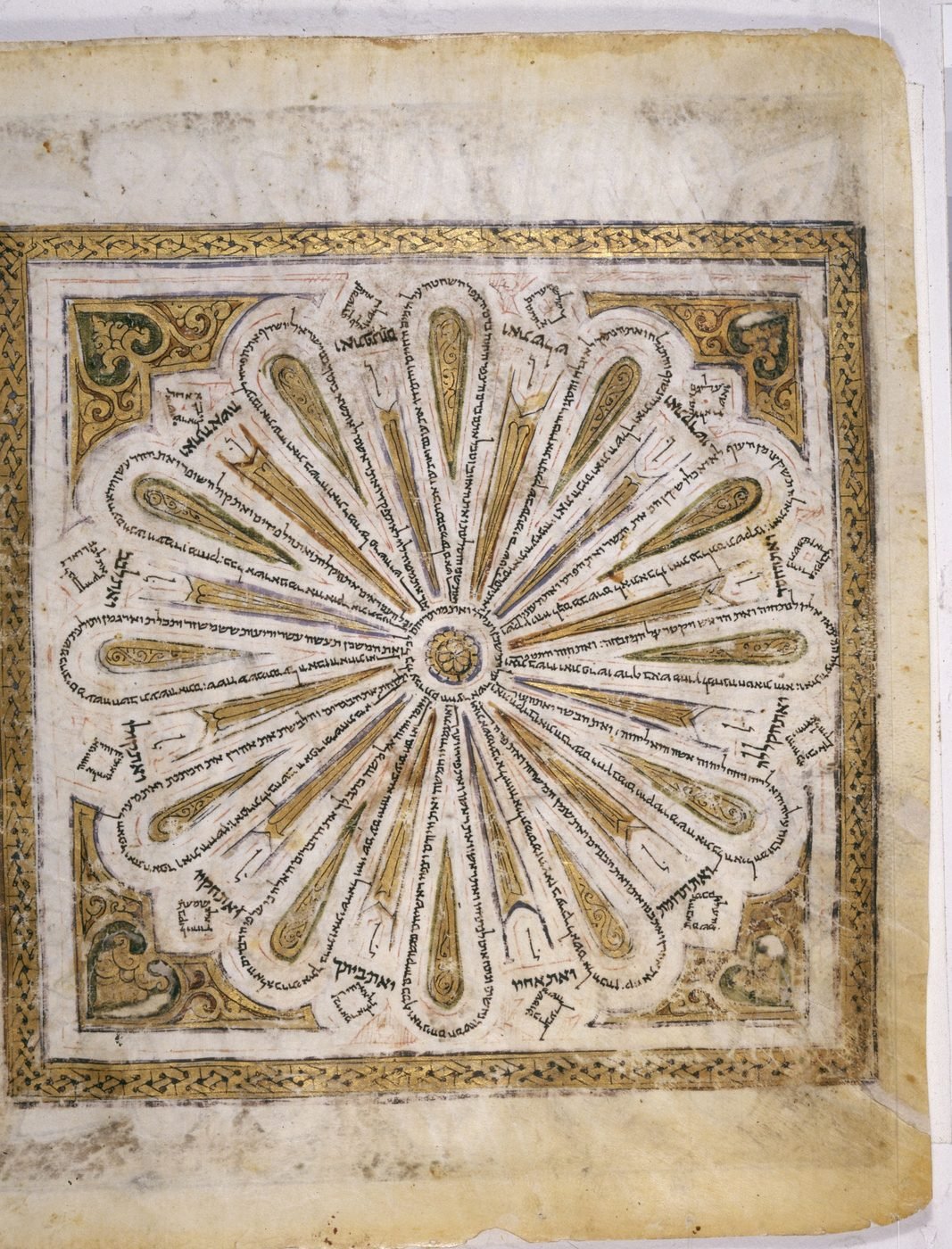
Start with what this object is, because the thing itself is extraordinary before anything terrible happens to it. The Aleppo Codex - Keter Aram Tzova, the Crown of Aleppo - is a bound manuscript of the Hebrew Bible produced in approximately 930 CE in Tiberias, on the western shore of the Sea of Galilee. It is not simply a copy of the Hebrew Bible. It is the vowelled, cantillated, fully annotated authoritative text, produced at the apex of the Masoretic scholarly tradition by the man who represented that tradition's culmination. Every word is pointed. Every syllable is marked for its chant. Every marginal note that records the count of letters, the frequency of words, the scribal traditions for unusual forms - every one of those notes is in place. Scholars call this level of textual care Masoretic tradition. The Aleppo Codex is its greatest surviving monument.
The vocaliser responsible was Aaron ben Moses ben Asher, the last and greatest of the Tiberian Masoretes. His family had maintained the Tiberian tradition of biblical vocalisation for five or six generations; Aaron was the one who brought it to its definitive form. The scribe who wrote the consonantal text was Shlomo ben Buya'a; the two worked together to produce a manuscript that combined the finest scribal hand with the most authoritative Masoretic vocalisation. The system of vowel points and cantillation marks that appears in every printed Hebrew Bible today - those tiny dots and dashes and marks beneath, above, and beside the consonantal text - is essentially the Tiberian system as codified by the ben Asher school. When you open a Hebrew Bible and read the text with its vowels intact, you are reading in a form that Aaron ben Asher established in Tiberias over a thousand years ago. The Aleppo Codex is the manuscript in which he did it.
Maimonides endorsed it - specifically, in the section of the Mishneh Torah on the laws of writing a Torah scroll, for the question of how to arrange the open and closed sections (petuhot and setumot) of the text. The Rambam states that he relied on the famous codex known in Egypt, the manuscript containing all twenty-four books of the Bible, known by the name of Ben Asher, which he himself had seen. This manuscript had been in Jerusalem; it was known as Ben Asher's corrected text. Maimonides used it as his authoritative reference for this specific scribal question. When the most significant Halachic authority of the medieval period gives his explicit reliance on a particular manuscript, subsequent generations take note. The Aleppo Codex's authority was not merely scholarly. It was backed by the greatest Jewish legal mind of the Middle Ages.

What the text actually does
It is worth pausing on what a fully Masoretic text represents, because the achievement is not immediately obvious to anyone who has not worked closely with the Hebrew Bible. The consonantal text of the Hebrew Bible - the letters without vowels or cantillation - had been more or less fixed for centuries before Aaron ben Asher's time - so long established that it had already been translated whole into Greek, as the Septuagint, more than a thousand years before he set to work. The question was how to read it. Hebrew has a grammatical system in which the same sequence of consonants can produce very different meanings depending on how you vocalise them; in poetry and legal prose alike, the difference between one vowelling and another can be the difference between two entirely distinct readings of a verse. Which vowelling is correct? Which cantillation - which melodic-syntactic marking that tells you where a phrase ends and how it relates to what follows - is authoritative?
The Masoretes answered these questions by establishing a received tradition and encoding it in notation. But they went further. They also counted. They counted the letters in every book, noted the middle letter of each book, recorded how many times unusual words appeared, flagged scribal traditions about letters that were written but not pronounced and letters that were pronounced but not written. The margins of a fully Masoretic manuscript are dense with these notes - the Masorah Parva in the margins, the Masorah Magna in the upper and lower margins - recording everything the tradition had preserved about the text's exact form. This is not pedantry. It is an extraordinary act of textual scholarship designed to prevent error from creeping in through the chain of copying. Every scribe who copied from a Masoretic master copy could check their work against the counts, the notes, the marginal records. The system was designed to be self-verifying.
The Aleppo Codex is the finest surviving product of this system. Other Masoretic manuscripts exist, including the slightly later but complete Leningrad Codex, dated 1008/9 CE, now held at the Russian National Library in St Petersburg. But the Aleppo Codex, in the portions that survive, is recognised by scholars as representing Aaron ben Asher's text with the highest degree of accuracy. It is not merely a copy of the tradition; it is, in a meaningful sense, the tradition's primary document.
The road to Aleppo
How the codex came to be in Aleppo - the ancient Aram Tzova of the manuscript's Hebrew title - is itself a story that has been told in several versions, not all of them consistently supported by the documentary record. One account, accepted by a number of historians and based on medieval sources, holds that the codex was in Jerusalem in the eleventh century, when it was seized - along with other Jewish treasures - by a Crusader force during the conquest of the city. In this account, the codex was taken to Egypt, where it was ransomed back from the Crusaders by the Karaite Jewish community there. It subsequently came to Aleppo through channels that are not entirely clear, perhaps as a gift or bequest to the Syrian community.
This account should be held with appropriate care. The precise chain of custody between tenth-century Tiberias and the Aleppo synagogue is not documented with the specificity that scholars would wish. What is reasonably well established is that the codex was in the Central Synagogue of Aleppo - the Knesset HaGedola, also known in some accounts as the Mustarib Synagogue - for something in the order of six centuries before the events of 1947. The community of Aleppo regarded it not primarily as a scholarly resource to be studied and consulted, but as a sacred object to be venerated and protected. It was rarely shown to outsiders. Access was tightly controlled. The practice of not displaying it, of not allowing it to be copied or photographed, was a matter of communal policy maintained over generations.
This protective secrecy had a paradoxical consequence. Because the codex was so rarely examined, precise documentation of its contents before the twentieth century is limited. When scholars finally had sustained access to it after it reached Jerusalem in 1958, they were working partly from memory, partly from earlier partial descriptions, and partly from comparison with other Masoretic manuscripts - primarily the Leningrad Codex - to reconstruct what the complete manuscript must have contained. The community's careful guardianship preserved the codex physically; it also meant that when portions went missing, establishing precisely what had been lost required inference as much as direct record.
The community of Aleppo regarded the codex not as a scholarly resource to be studied, but as a sacred object to be venerated. The secrecy that protected it also meant that, when parts were lost, establishing what was gone required inference as much as record.
November 1947
The United Nations voted on the partition of Palestine on 29 November 1947. In Aleppo, as in other cities across the Arab world, the response to the vote included violence against the Jewish community. On 1 December 1947, the Great Synagogue was attacked and set on fire. The synagogue building was burned. The Talmud Torah school next to it was burned. Dozens of Jewish-owned properties in the community were destroyed.
The codex survived. It had been hidden before the fire reached it - accounts differ on by whom, where exactly, and in what sequence. Some accounts describe it being moved several times in the chaos of the riots and their immediate aftermath, passed between members of a community that was disintegrating around it. What is certain is that when the community's remaining members eventually secured the codex, it was no longer complete. The fire itself, or the confusion of hiding and moving the manuscript in haste, or something that happened during those terrible weeks - something had taken away a substantial portion of the manuscript.
What was gone was, in terms of Jewish significance, the most important part. The surviving text begins at Deuteronomy 28:17 - meaning most of the Torah, all four books from Genesis through the middle of Deuteronomy, was gone. Gone also were portions of other books. What remained was most of the Nevi'im - the Prophets - and most of the Ketuvim - the Writings - though not all of even those sections were intact. Of a manuscript that had once contained the complete Hebrew Bible, approximately 60 per cent remained - some 294 of an estimated 487 leaves surviving, the rest lost. Around two-fifths had vanished.
The journey to Jerusalem
The codex remained hidden in Aleppo for nearly a decade after 1947. The Jewish community of Aleppo - one of the oldest in the world, with roots going back to antiquity - was leaving. Emigration had been underway before the riots; after them, it accelerated rapidly. The community that had guarded the codex for six centuries dispersed to Israel, to South America, to the United States, to wherever its members could go. The codex was hidden in the home of a community member, then, according to some accounts, in other locations, as those responsible for it navigated the practical and political difficulties of getting it out of Syria.
In 1958 the codex was brought to Israel. The precise means of its passage out of Syria have been described in various ways in different accounts; one version involves the Turkish consul, another involves it being concealed inside a washing machine or similar container. The Syrian government had prohibited the export of Jewish cultural property, and the extraction of the codex was not a straightforward transaction. What arrived at the Ben-Zvi Institute in Jerusalem was the surviving portion - the two-thirds that had not gone missing - and those responsible for its transfer had done what they could.
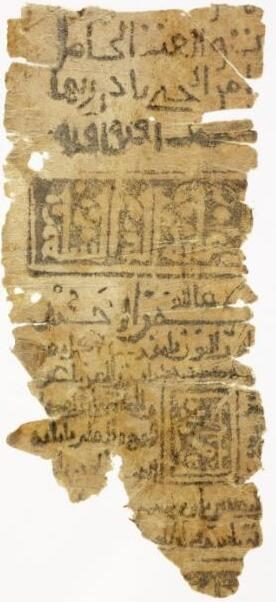
The Ben-Zvi Institute conducted investigations into what had happened to the missing pages. Researchers examined the fire damage to the synagogue, interviewed community members who had been present, and followed leads that suggested some pages might have entered the antiquities market in the years after 1947. Some small fragments - portions of pages from the codex - have appeared in various locations over the decades. The Ben-Zvi Institute has been reported to have acquired some of these fragments. But the bulk of the missing portion - the Torah section, the complete Pentateuch - has not been recovered. Whether it was destroyed in the fire, hidden separately and lost, or whether portions survive somewhere in private hands, is not known. The investigations have not produced a definitive account, and the question remains open.
The Aleppo Codex (Keter Aram Tzova)
Parchment manuscript of the Hebrew Bible, produced in Tiberias, c. 930 CE. Scribe: Shlomo ben Buya'a. Vocalised and cantillated by Aaron ben Moses ben Asher, the leading Tiberian Masorete of his generation. Contains most of the Nevi'im (Prophets) and most of the Ketuvim (Writings); most of the Torah (Pentateuch, from Genesis through Deuteronomy 28:16) and other sections are missing, believed lost or destroyed following the 1947 Aleppo riots - approximately 40 per cent of the original manuscript gone. Held at the Israel Museum, Jerusalem, on deposit from the Ben-Zvi Institute (Yad Izhak Ben-Zvi). The manuscript is the primary textual authority for the Tiberian Masoretic text. The Biblia Hebraica Stuttgartensia (BHS) is based on the Leningrad Codex, with the Aleppo Codex consulted for corrections where both survive. Its successor, the Biblia Hebraica Quinta (BHQ), incorporates the Aleppo Codex more systematically in the sections where it is extant, though the Leningrad Codex remains the base text throughout.
Israel Museum, Jerusalem (on deposit from the Ben-Zvi Institute)The Leningrad Codex: the complete witness
No account of the Aleppo Codex is complete without its companion. The Leningrad Codex - MS Firkovich B 19 A, held at the Russian National Library in St Petersburg - was produced in 1008/9 CE, approximately eighty years after the Aleppo Codex. It is the oldest complete manuscript of the Hebrew Bible in existence. Like the Aleppo Codex, it is a Tiberian Masoretic text, and its scribes indicated that they were copying from a manuscript corrected by Aaron ben Asher. Whether they were copying directly from the Aleppo Codex or from another manuscript in the same tradition is a question that specialists debate; what is clear is that the two manuscripts are closely related textually and represent the same authoritative tradition.
The relationship between the two manuscripts is now of immense practical importance. Because the Leningrad Codex is complete and the Aleppo Codex is not, the Leningrad Codex fills the gap left by the missing sections. The Biblia Hebraica Stuttgartensia - the standard scholarly critical edition of the Hebrew Bible for the last half-century - is based on the Leningrad Codex, with the Aleppo Codex consulted for corrections where both manuscripts survive. The successor edition, the Biblia Hebraica Quinta, incorporates the Aleppo Codex more systematically in the sections where it is extant - but the Leningrad Codex remains the base text throughout both editions. Every modern critical edition of the Hebrew Bible used in academic scholarship ultimately depends on these two manuscripts - and behind them both, on Aaron ben Asher in Tiberias in the tenth century.
The Leningrad Codex is available for study and has been fully digitised. The Aleppo Codex has also been digitised, and both are accessible to scholars through the Biblia Hebraica digital project and related resources. The distance between the tenth century and the present, in terms of the scholar's access to the text, has never been smaller.
The Leningrad Codex
Parchment manuscript of the complete Hebrew Bible, produced in 1008/9 CE. MS Firkovich B 19 A, Russian National Library, St Petersburg. The oldest complete manuscript of the Hebrew Bible in existence. Tiberian Masoretic text; its scribes indicated derivation from a manuscript corrected by Aaron ben Moses ben Asher. The base text for both the Biblia Hebraica Stuttgartensia (BHS) and the Biblia Hebraica Quinta (BHQ) - the standard scholarly critical editions of the Hebrew Bible - with the Aleppo Codex consulted alongside it for correction and, in BHQ, incorporated more systematically where it survives. Complete where the Aleppo Codex is missing, including most of the Torah section (Pentateuch). Has been fully digitised and is accessible through multiple scholarly platforms. Its relationship to the Aleppo Codex - whether it was copied directly from the Aleppo manuscript or from a related exemplar - is a subject of ongoing specialist debate.
Russian National Library, St Petersburg (MS Firkovich B 19 A)Maimonides and the authority of the text
In the Mishneh Torah - the great legal code that Maimonides completed in Egypt in the late twelfth century - there is a passage in the section on the laws of writing a Torah scroll (Hilkhot Sefer Torah, 8:4) that has secured the Aleppo Codex's authority for eight centuries. The context is the question of how to arrange the open and closed paragraph divisions (petuhot and setumot) of the Torah - a matter with real legal consequences for the validity of a scroll. Maimonides states that he relied on the codex containing the twenty-four books of the Bible, known by the name of Ben Asher, which he himself had seen in Egypt - a manuscript that had been in Jerusalem and was famous. He states that this codex is the one he relied upon for the authoritative form of these divisions.
The question of which manuscript Maimonides actually saw has been debated. Some scholars have held that it was the Aleppo Codex itself, which they believe was in Egypt at the relevant time. Others have suggested it was a related manuscript in the same tradition. The details of the manuscript's location in Maimonides' day are not established with certainty. What is established is the effect of his endorsement: subsequent generations of Jewish scholars and communities accepted the ben Asher text as the authoritative standard for the Torah scroll, in large part because Maimonides said so. An authority that could settle disputes about the form of the Torah - disputes with real legal consequences for the validity of a Torah scroll used in synagogue reading - was not a scholarly nicety. It was a practical necessity, and Maimonides provided it.
The endorsement is remarkable in another way. Between Aaron ben Asher in tenth-century Tiberias and Maimonides in twelfth-century Egypt lay two centuries and the entire disruption of the Crusades. The fact that Maimonides could still refer to the ben Asher codex as a living textual authority - something he himself had physically examined - tells us something about the manuscript's care and the seriousness with which the tradition of Masoretic scholarship was maintained. The text did not drift in those two centuries. It was kept.
The text that outlasted everything
Consider the chain. Aaron ben Asher vocalises the definitive text in Tiberias around 930 CE. By the time Maimonides sees it in Egypt, perhaps 250 years later, it has survived long enough and travelled far enough to be known as the authoritative standard. Maimonides cites it explicitly, which fixes its authority for the subsequent centuries. The manuscript reaches Aleppo - by whatever route - and is kept there for roughly six hundred years by a community that treats it as too precious and too sacred to be freely examined. In 1947 the synagogue burns. The codex is hidden. The community disperses. The manuscript arrives in Jerusalem in 1958 with around two-fifths of itself missing. And the portion that remains is still the textual authority that sits behind every critical edition of the Hebrew Bible produced by scholars working anywhere in the world today.
The text has outlasted the manuscript. The manuscript, even in its damaged form, has outlasted the community that guarded it. The community, in choosing to hide the codex rather than flee with their own safety, ensured that whatever survived the fire survived at all. Every scholar who opens the Biblia Hebraica Quinta, every student who works with the ben Asher text in any form, is the downstream beneficiary of those choices made in the chaos of December 1947 in Aleppo.
The missing pages are somewhere - destroyed in the fire, or not; in private hands, or not; gone entirely, or perhaps one day recoverable. A fragment of Exodus 8 was returned as recently as 2007. No one knows what else may yet surface. That uncertainty is its own kind of statement about what the manuscript world is like: things survive that should not have survived, and things are lost that should have been imperishable. The Aleppo Codex is both at once. What we have is extraordinary. What we have lost matters enormously. Both things are true simultaneously, and the honest position is to hold them without resolving the tension in either direction.
The surviving portion is in Jerusalem, in the Israel Museum, on deposit from the Ben-Zvi Institute. You can go and see it. The Hebrew text in the cases, pointed and cantillated in Aaron ben Asher's hand, is the same text that Maimonides read in Egypt, that Jewish communities in Aleppo venerated for six centuries, that scholars across the world read in their critical editions today. The Crown of Aleppo. What a thing to have made. What a thing to have kept.
Maimonides, Mishneh Torah - Hilkhot Sefer Torah 8:4
In the section of the Mishneh Torah governing the laws of writing a Torah scroll (Hilkhot Sefer Torah 8:4), Maimonides (Rabbi Moses ben Maimon, 1138-1204) cites the Ben Asher codex in the specific context of determining the correct arrangement of petuhot and setumot - the open and closed paragraph divisions that govern the layout of a valid Torah scroll. He states that he relied upon "the codex containing the twenty-four books which had been in Jerusalem, known by the name of Ben Asher, who corrected it over many years and verified its accuracy many times," and records that he personally saw it in Egypt. This citation is the primary medieval textual authority for the ben Asher tradition and is understood to refer to the Aleppo Codex or its immediate exemplar. The endorsement fixed the authority of the ben Asher text for Sephardic and, subsequently, for broader Jewish practice. The precise identification - whether Maimonides saw the Aleppo Codex specifically or a closely related manuscript - is a matter of ongoing scholarly discussion; the practical effect of the citation on the codex's authority is not in dispute.
Mishneh Torah, Hilkhot Sefer Torah 8:4Further reading