There is a kind of craftsmanship so confident it hides itself. The scribe Samuel ben Jacob, working in Cairo in the year 4769 of the Jewish calendar - 1008 CE by another reckoning - produced a manuscript of the complete Hebrew Bible that does not announce itself as a monument. And yet that is what it became. Not because it was the most celebrated manuscript of its age - that honour belonged to the Aleppo Codex - but because it survived complete when other great codices did not, and because completeness, it turns out, is its own kind of authority.
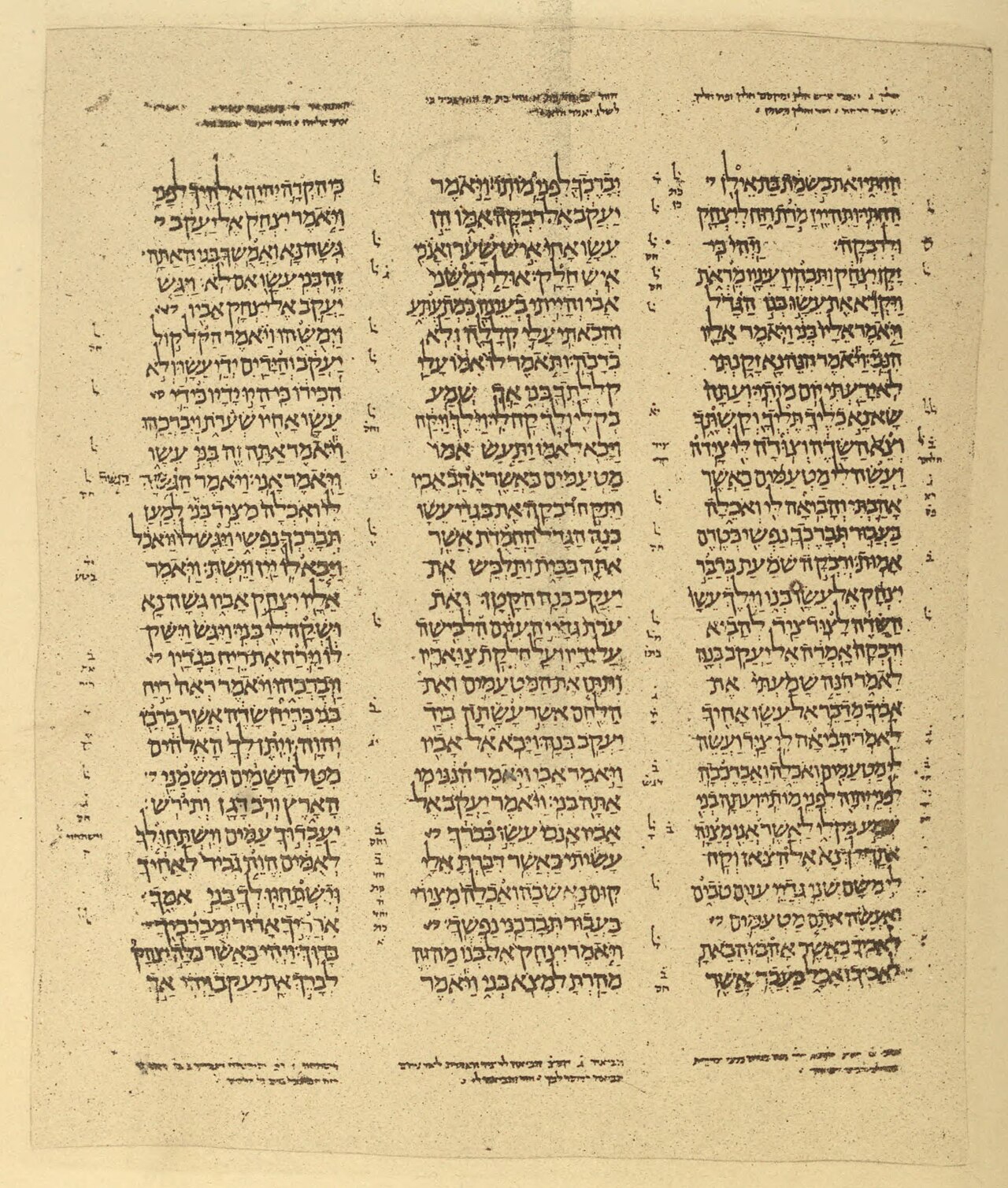
Samuel ben Jacob was working within the Tiberian Masoretic tradition, the great school of scholars who had spent centuries fixing to the page what the reading tradition carried in the ear. He copied not only the consonantal text of the twenty-four books but the full apparatus that surrounds it: the vowel points under and above the letters, the cantillation accents that guide the chant of public reading, and the Masoretic notes in the margins - tiny counts and warnings and cross-references that functioned as a self-checking system against the drift that accumulates in any copied text. A medieval scribe working without that system was working without a net. Samuel ben Jacob worked with the net fully deployed.
The record
The Leningrad Codex carries a colophon - a scribal endnote - dating its completion to 1008/1009 CE. The colophon names the scribe as Samuel ben Jacob and records that the manuscript was copied, vocalised, and furnished with Masoretic notes "from the corrected books" associated with the ben Asher tradition. The manuscript - formally catalogued as Firkovich B 19 A - has been held since the nineteenth century at what is now the Russian National Library in St Petersburg. It is the oldest complete dated manuscript of the Hebrew Bible known to scholarship. (Russian National Library, St Petersburg; colophon data reported in the standard introduction to Biblia Hebraica Stuttgartensia, Deutsche Bibelgesellschaft, 1977.)
The carpet pages stop you. Among the decorated folios scattered through the manuscript - the pages that break from column after column of careful text into something closer to architecture or geometry - the most striking are the micrographic panels. The one shown here, folio 477b, is a full-page rosette: a large wheel-like form whose petals are not drawn but written. Every petal, every spoke, every arc of the border is formed by lines of scriptural text in lettering so fine it resolves only under magnification. Step back and you see a gilded ornamental design. Step in and you see the Bible. That double vision - the text as structure, the structure as text - is exactly the spirit of the Masoretic enterprise compressed into a single page. The tradition believed that every letter mattered, that nothing in the text was accidental. The carpet pages make that conviction visible.
The record
The Leningrad Codex is the primary base text for the two major modern critical editions of the Hebrew Bible: Biblia Hebraica Stuttgartensia (Deutsche Bibelgesellschaft, first edition 1937, standard edition 1977) and its successor Biblia Hebraica Quinta (Deutsche Bibelgesellschaft, from 2004). Both editions use the Leningrad Codex as their primary textual witness because it is complete where the more prestigious Aleppo Codex - damaged after the 1947 attack on the Great Synagogue of Aleppo - is not. Digitised colour images of the entire manuscript are freely available through the Friedberg Jewish Manuscript Society's Ktiv portal and through the Internet Archive.
The full manuscript was brought to what is now St Petersburg in the nineteenth century by the Karaite collector Abraham Firkovich, and its significance for scholarship was established through the work of Paul Kahle, who championed its use as a base text in the early twentieth century. The Aleppo Codex retained its prestige - Maimonides had trusted it, and it represented the ben Asher tradition in its highest surviving form - but it was the Leningrad Codex that the editors of critical Bibles could actually use in full. In a discipline where completeness is everything, the manuscript that arrived whole became indispensable.
The record
The manuscript's Masoretic apparatus includes both the Masorah parva (brief marginal notes recording unusual forms, frequency counts, and scribal cautions) and the Masorah magna (longer notes above and below the text columns giving extended lists and cross-references). The decorative pages - carpet pages, colophon illustrations, and geometric panels - are believed to be the work of a different hand from the scribe, possibly added or completed after the main text was copied. Their style reflects the broader tradition of Islamic geometric ornamentation current in Fatimid Egypt at the time. (E. Würthwein, The Text of the Old Testament, 2nd ed., Eerdmans, 1995, pp. 35-37.)
What makes the Leningrad Codex worth contemplating is not merely its age or its completeness but what that completeness cost. Someone in Cairo in 1008 CE worked through the entire Hebrew Bible - not just its text but its pointing, its accents, its marginal apparatus, its illuminated openings - and delivered it intact. The manuscript then survived a thousand years of transfer, storage, and political upheaval to arrive at a library in a city that would rename itself twice before scholars finished studying it. That it exists, whole, is partly luck. That it became the foundation for every modern printed Hebrew Bible is something more than luck. It is what happens when careful work meets fortunate survival.