There is a painting - Anthony van Dyck's, seventeenth-century - of a bishop blocking an emperor at a cathedral door. The emperor is Theodosius I. The bishop is Ambrose of Milan. The year is 388 CE, and the argument is about a synagogue. A Christian mob in Callinicum on the Euphrates had burnt it down. Theodosius ordered it rebuilt at church expense. Ambrose refused to administer the sacrament until the order was rescinded. The emperor gave way. The synagogue was not rebuilt. This is how Jewish law worked now - not in Roman courts alone, but at the intersection of imperial will and episcopal pressure, and the Jews were not always the ones who set the terms.
Italy's Jews were among the oldest diaspora communities in the world. By the time Theodosius issued the Edict of Thessalonica in 380 CE, making Nicene Christianity the empire's only legitimate religion, Jewish families had been in Rome for three centuries and more - merchants, craftsmen, freedmen, scholars, surgeons, actors and senators' clients, buried in catacombs on the Appian Way with menorahs cut into the stone. They had been there before Christianity had a name. Now they were learning to live inside an empire that had chosen a different name for the divine.
The record
In 393 CE, Theodosius I issued a constitution preserved in the Codex Theodosianus (16.8.9, in the 438 CE compilation) affirming that Jews were not barred by law, that synagogues were protected from seizure, and that Jews could not be compelled to work or appear in court on the Sabbath. The Callinicum affair had shown what mob action and episcopal lobbying could accomplish; this law was a partial counter-pressure, a reminder that the empire still ran on written law as well as sermon. It did not reverse Callinicum. But it put limits on the next one. Source: Codex Theodosianus 16.8, collected edition by Mommsen and Meyer (1905), Book XVI.
The Jews of Italy read these imperial edicts carefully, because they had to. The law was inconsistent - sometimes protective, sometimes punitive, often both in the same generation - and the community's best tool was the law itself, used as the Romans had taught them to use it. Synagogue elders petitioned. The Jewish patriarch in Palestine corresponded with diaspora communities and with emperors. Wealthy Jewish families cultivated imperial contacts. This was not weakness. It was the political intelligence of a people that had learnt, over centuries, that the written rule was sturdier than the mood of the crowd. They were right more often than they were wrong.
Life in fourth-century Italy was not a single experience. In Rome, the community centred on the Trastevere and Ostia neighbourhoods, with at least eleven synagogues attested by inscriptions and the great catacombs of the Via Appia and Via Nomentana. In Milan, where Ambrose held court, the Jewish presence was smaller but strategically placed: the city was the western imperial capital, and proximity to power, even hostile power, had its uses. In Aquileia, the northern port city and trade hub, a Jewish community is attested from at least the fourth century. These were not scattered refugees. They were embedded urban communities with property, professional networks, and roots.
The record
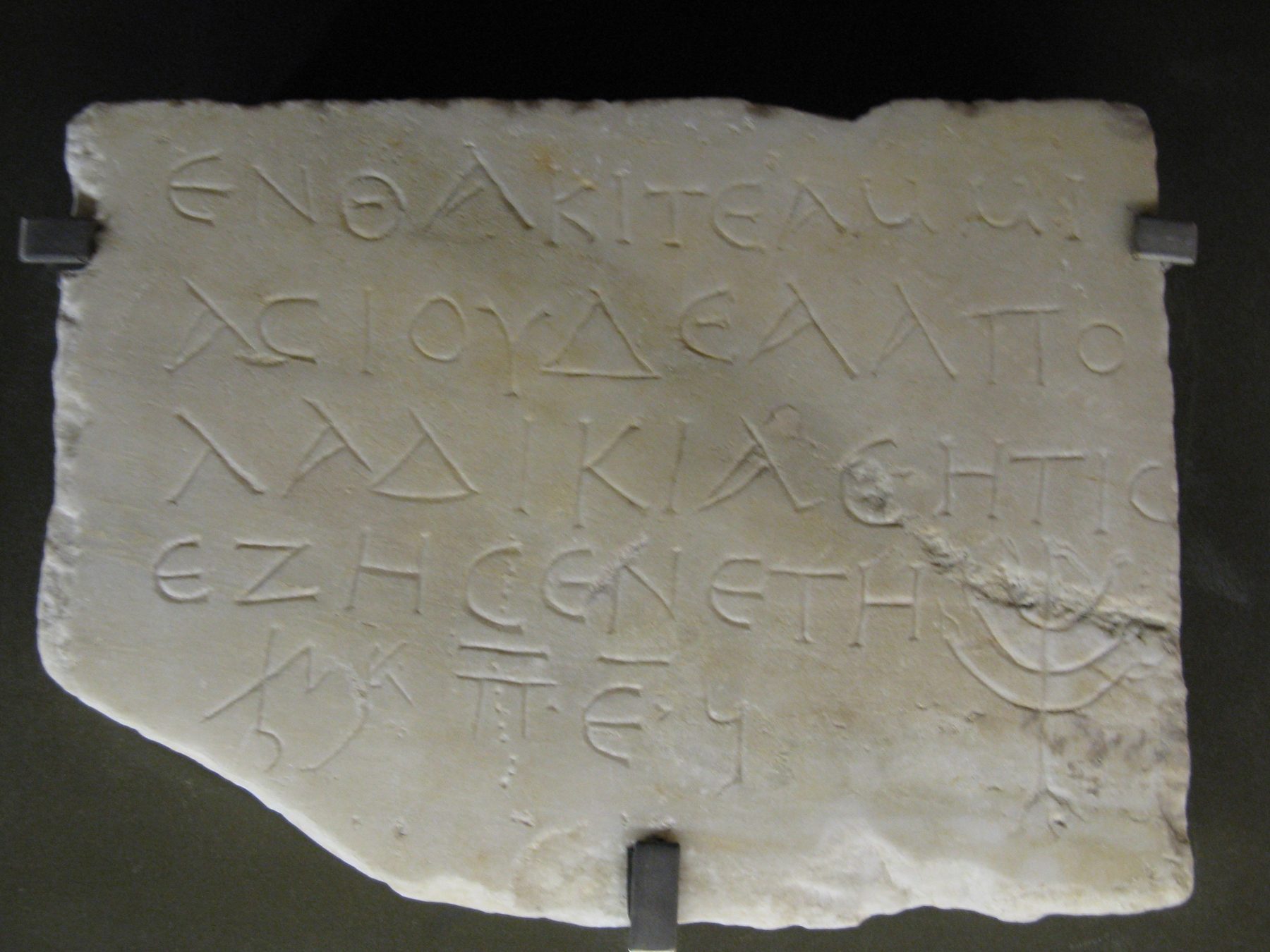
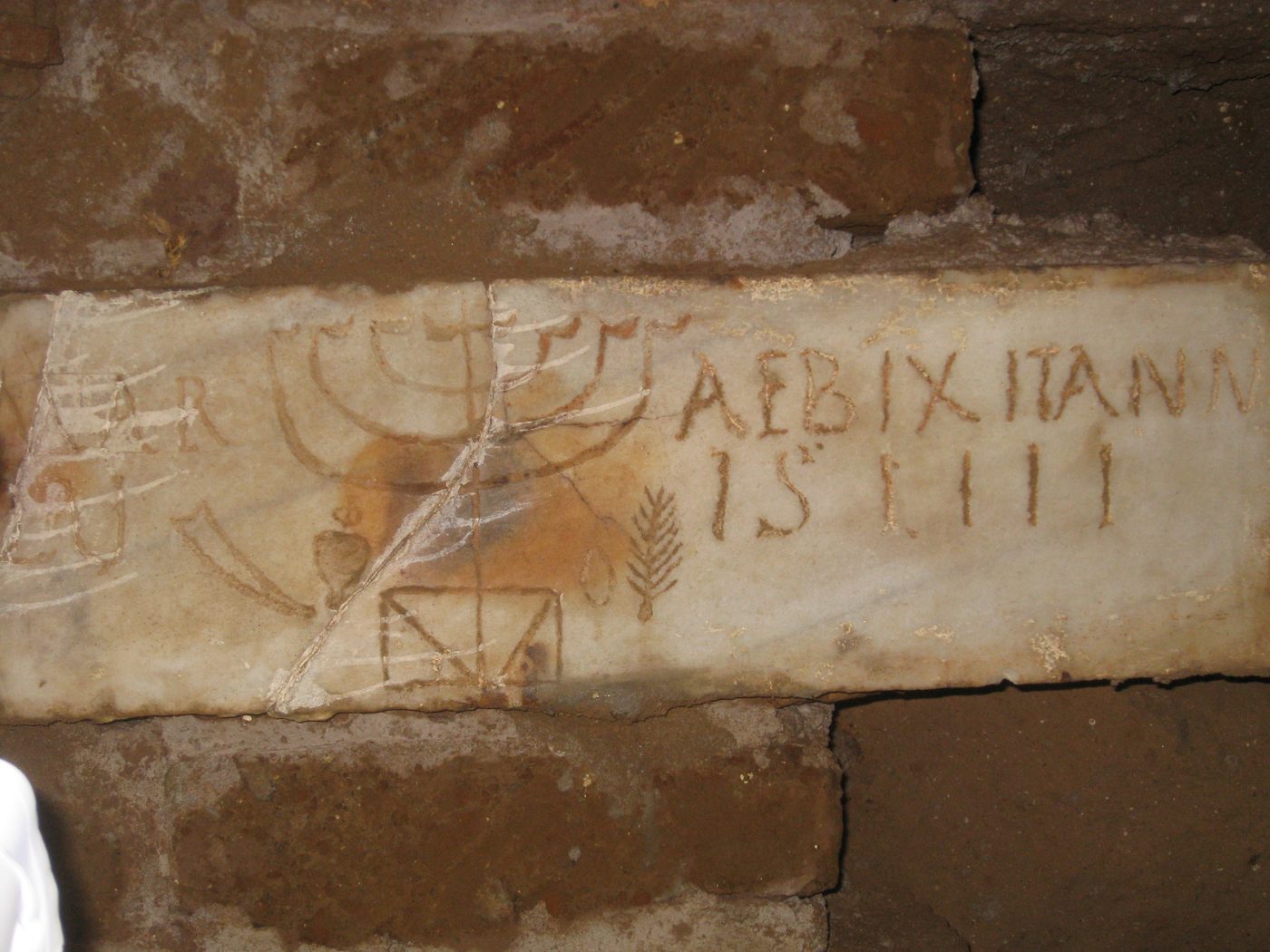
The Jewish catacombs of Rome - principally the Villa Torlonia catacombs (discovered 1859, excavated more thoroughly in the twentieth century) and the Vigna Randanini catacombs on the Via Appia Pignatelli - contain hundreds of inscriptions in Greek, Latin, and Hebrew dating from roughly the second to the fifth centuries CE. Menorah imagery, shofar depictions, and the word shalom appear alongside Latin names, Roman occupational titles, and the names of synagogue officials such as archisynagogos (head of the synagogue) and gerusiarch (head of the council). The material record is unambiguous: Rome's Jews were culturally integrated, Latin-speaking, and collectively organised across many generations before and during the Theodosian period. Source: Noy, D., Jewish Inscriptions of Western Europe, Vol. 2: The City of Rome (Cambridge University Press, 1995).
What did it feel like to be a Roman Jew watching the empire change allegiance? The synagogue liturgy already had a category for it. The blessing for the sovereign - the prayer for the welfare of the government, whatever government that happened to be - had been part of Jewish practice since the Babylonian exile. You prayed for Persia, then for the Hellenistic kings, then for Rome when Rome was pagan, then for Rome again when Rome was Christian. The prayer didn't change. The name in it did. There is a kind of confidence in that: a people certain enough of its own continuity that it can afford to wish the king well, whoever the king is this century.
The record
Ambrose of Milan's letter to Theodosius arguing against rebuilding the Callinicum synagogue (Letter 40, written 388 CE) is preserved in Ambrose's collected correspondence. In it, Ambrose states explicitly that a synagogue is "a haunt of unbelief, a home of impiety, a refuge of insanity, damned by God himself" - and uses this as an argument that the emperor, as a Christian, cannot compel Christians to restore it. The letter is one of the most candid expressions of episcopal anti-Jewish pressure on imperial policy in late antiquity. That Theodosius initially ordered restitution before yielding shows that legal instinct and pastoral pressure were in genuine tension. Source: Ambrose of Milan, Epistulae, Letter 40 (Ep. 74 in some numbering), translated and discussed in Neil B. McLynn, Ambrose of Milan: Church and Court in a Christian Capital (University of California Press, 1994).
The fourth century did not destroy Italy's Jews. It made their world more complicated, and they made themselves more expert in navigating complexity. The communities that had buried their dead in catacombs decorated with menorahs would go on - in Rome, in Ostia, along the trade routes north - for another millennium and more. The empire changed its theology. The Jewish habit of endurance, petition, and prayer for the king did not.