Somewhere above the Hinnom Valley, in the long summer of 1979, a thirteen-year-old named Nathan was making himself annoying. He was a volunteer on Gabriel Barkay's excavation - one of those half-helpful, half-exasperating presences that every dig leader knows - and he'd been tugging at Barkay's sleeve once too often. So Barkay sent him off to clean a side chamber, Chamber 25 of Cave 24, where nothing important was expected. That should keep him out of trouble for a while.
Nathan, bored and unobserved, started hitting the floor with a hammer. He broke through. Below the apparently cleared chamber floor was an undisturbed repository - a sealed space full of grave goods that had survived the Babylonian destruction of Jerusalem, the Persian conquest, the Hellenistic period, Alexander, Rome, the Crusades, the Ottomans, the British Mandate, and Israeli statehood, lying intact under a buried cave in the Hinnom Valley until an irritating thirteen-year-old cracked it open by accident on a slow afternoon. Inside, among the grave goods, were two tiny cylinders of rolled silver. It took three years to open them.

The oldest words
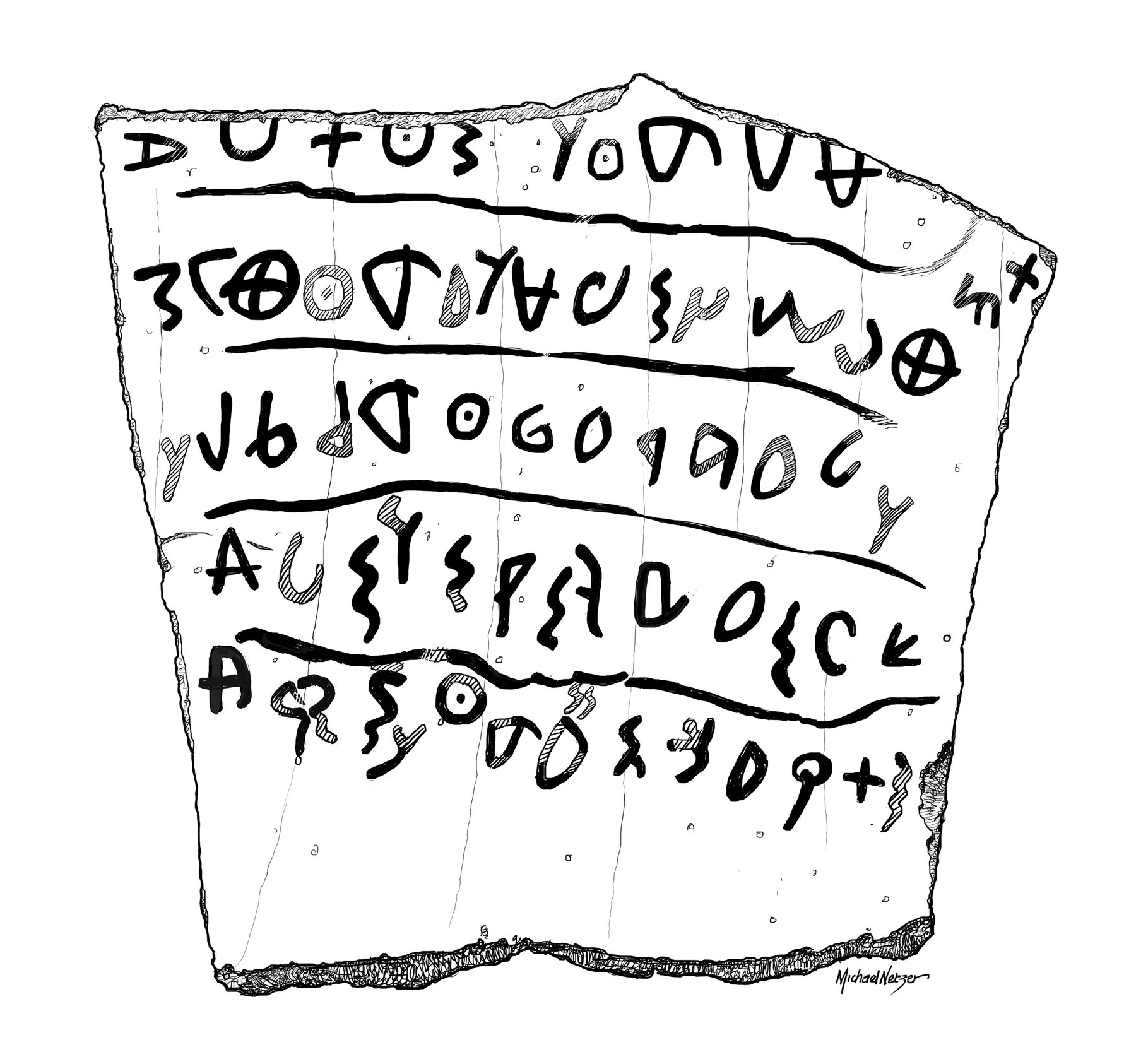
When conservator Joseph Shenhav finally opened the scrolls in 1982, working with surgical instruments under a microscope, advancing millimetres per session so as not to crack the corroded silver, what appeared on the inner surface was a text that everyone in the room recognised at once. It was the Priestly Blessing from the Book of Numbers - "May the Lord bless you and keep you; may the Lord make his face shine upon you and be gracious to you; may the Lord lift up his face upon you and give you peace."
This was remarkable for reasons that compounded quickly. The scrolls dated to around 600 BCE - the late First Temple period, just before the Babylonian exile that destroyed Jerusalem in 586. The Dead Sea Scrolls, until that moment the oldest known biblical manuscripts, dated from the third century BCE at the earliest. The Ketef Hinnom amulets were four centuries older. Not older by a generation, not older by a decade: four complete centuries, a gap equivalent to the distance between us and the English Civil War.
The scrolls pushed the origin of this specific text - three verses, fifteen Hebrew words - back further than anyone had thought possible. Before this find, some scholars had argued that the Books of Moses reached their final written form only in the exile period or later. Now there was physical evidence that at least one passage was being written and worn as an amulet before Jerusalem fell. The words were already old before the city was destroyed.
The Ketef Hinnom Silver Scrolls
Two thin sheets of silver, rolled tightly into amulet cylinders and worn - it's thought - around the neck of the dead. Found in 1979 in Cave 24, Chamber 25, at Ketef Hinnom, Jerusalem, during excavations led by Gabriel Barkay. Dated by stratigraphy and palaeography to the late seventh or early sixth century BCE - approximately 600 BCE. Both carry versions of the Priestly Blessing from Numbers 6:24-26. They are the oldest surviving manuscripts of any biblical text. The Dead Sea Scrolls are four centuries younger. A bored teenager found them by hitting a floor with a hammer.
Israel Museum, Jerusalem - Archaeology WingWhat the blessing is
The Priestly Blessing - the Birkat Kohanim - is three verses from Numbers that the Torah instructs the priests to speak over the Israelites. It's one of the oldest continuous liturgical formulas in Jewish practice: said by priests in the Temple, then adapted by the synagogue, then taken into the home. On Friday evenings, before the Sabbath meal, parents place their hands on their children's heads and say these words. The same words. The exact same words that are on those two pieces of silver in Jerusalem. The same words that someone wrapped tightly around a loved one before burial in the seventh century BCE, in the hope, perhaps, that the blessing would travel with them wherever they were going.
That's the spine of this story, and it's worth sitting with for a moment. The continuity here isn't symbolic or metaphorical - it's literal. The text on those scrolls matches the text in the prayer book on the Friday night table. Not a version of it, not a precursor: the same blessing, the same Hebrew words, the same cadence. The tribe has been saying this thing to its children for at least 2,600 years without interruption - across the Babylonian exile, the Persian return, the Hellenistic disruption, the Roman destruction, the long diaspora, the European catastrophe, the return. Every one of those Friday nights, someone said it.
You could make the case that the Ketef Hinnom amulets are the most powerful single object this site will ever discuss - not because of what they contain, but because of the line they draw. They connect a burial cave in pre-exilic Jerusalem to every Friday night table in the world. They show a tradition not beginning somewhere in the dim abstraction of antiquity, but operating, in written form, at a specific moment in a specific city, worn by a specific person who someone loved enough to bury with a blessing.
The same Hebrew words, the same cadence, for at least 2,600 years without interruption. Every one of those Friday nights, someone said it.
The Priestly Blessing
Three verses specified in the Book of Numbers as the words the priests shall speak over the Israelites: "May the Lord bless you and keep you; may the Lord make his face shine upon you and be gracious to you; may the Lord lift up his face upon you and give you peace." Fifteen words in the Hebrew, rising in a three-five-seven cadence. The text on the Ketef Hinnom scrolls is the oldest surviving physical copy. The same text is recited in synagogues on festival days and spoken by parents over their children on the eve of Shabbat. The practice of parents blessing their children on Friday nights is attested in medieval Ashkenazi sources; the custom appears across all major Jewish communities. The words haven't changed. The impulse behind them probably hasn't either.
Israel Museum, Jerusalem (physical scrolls); Numbers 6:22-27 (textual source)Three years to read a sentence
The three years Shenhav spent opening the scrolls deserve their own moment. He worked under a microscope with instruments finer than surgical tools, moving in fractions of a millimetre per session. The silver had corroded over 2,600 years into something brittle and unpredictable; one mistake and the text would crack away before it could be read. He soaked them in solution to remove the corrosion, applied an elastic emulsion to support the surface, and advanced incrementally, session by session, across months that extended into years.
It's a different kind of patience from the patience that wrote the words in the first place - the slow, deliberate labour of a scribe pressing a stylus into silver, making something small enough to wear but legible enough to mean. Then the patience of the burial, the centuries in the dark, then Shenhav's three years of recovery. The blessing has been passed hand to hand for a very long time. Sometimes the hands are wearing gloves and holding tweezers under a magnifying lamp. The intention is the same.
Nathan, the thirteen-year-old with the hammer, apparently wasn't told at first what he'd found. Somewhere there's a version of this story in which he grew up, had children of his own, and on Friday evenings put his hands on their heads and said the blessing without ever knowing he was the one who found it. The tribe runs on exactly that kind of accidental continuity.
Further reading
Story & Stone · The Tribe in Objects Nº 2
Back to Nº 1: The Birth Certificate Issued as a Death Notice →