Some Jewish addresses sit on a coast and trade with the sea. Tahert sat on a road and traded with a desert. That is the more surprising place to find a Jewish quarter, and it is exactly where the early Maghreb put one. The town stood on the high plateau of what is now western Algeria, near present-day Tiaret, and from the late eighth century it was the seat of a small but serious Berber state. Jews lived there as part of its working life, not its decoration.
The state was the Rustamid imamate, founded around 776 and governed by an Ibadi dynasty of Persian descent. It was landlocked, austere in its theology, and improbably cosmopolitan in its commerce. Tahert became a hinge between the Mediterranean world to the north and the gold and salt of the Sahara to the south. A town like that needs people who can speak several languages, keep accounts across great distances, and be trusted at both ends of a long credit line. Jewish merchants did exactly that work.
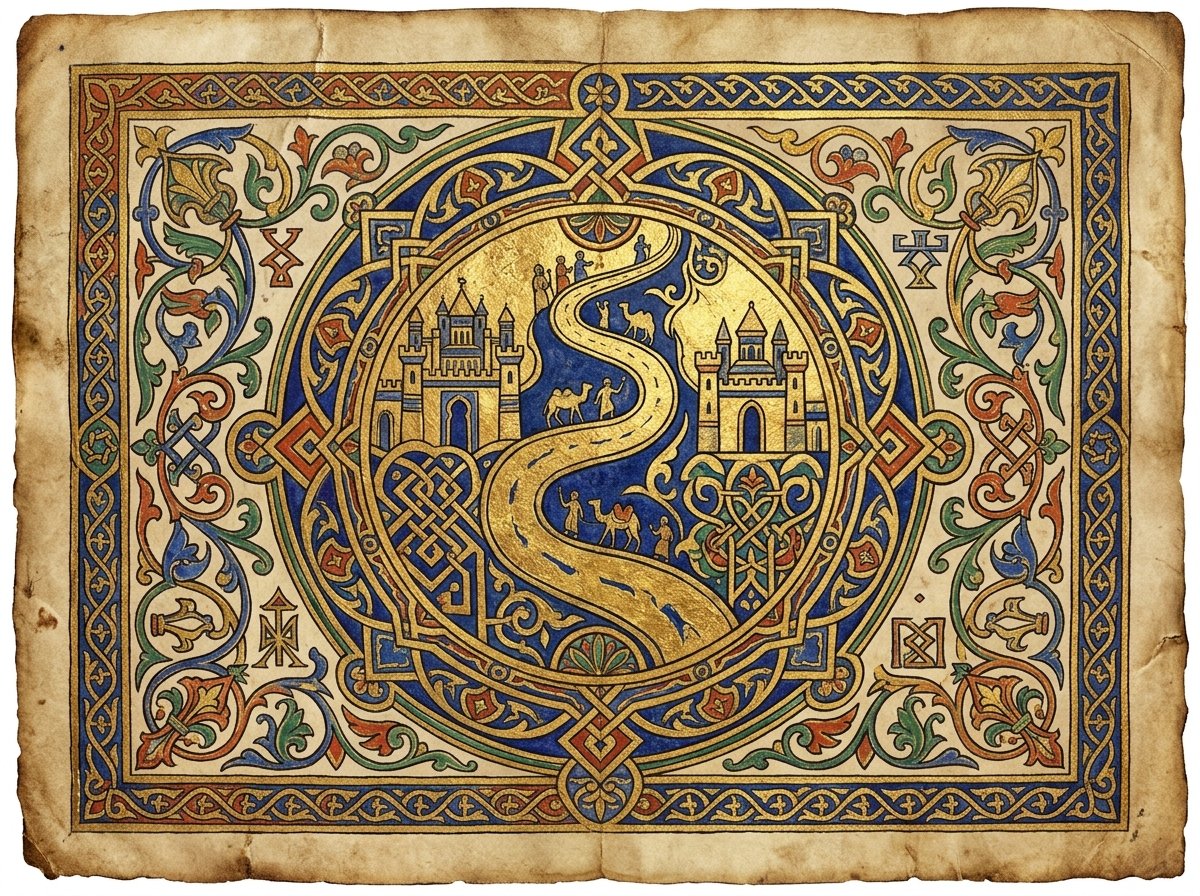
So the interesting thing about Tahert is not that it had a synagogue and a quarter. It is where the quarter was: not a port, not a famous capital, but an inland market town that mattered because a road ran through it. Jewish North Africa was never only its coastline. It reached into the interior, along the caravan tracks, wherever exchange and the law that governs exchange were needed.
The town on the caravan road
The Rustamid period gave Tahert about a century and a half of stability, from roughly 776 to 909, and that stability is what allowed trade to deepen into something structured. The Arabic geographers remembered the town as wealthy and tolerant, with Muslims of rival schools, Christians and Jews living and dealing in the same streets. For a medieval city that is not a sentimental detail. It is an economic fact: a market that turns away no one's caravan grows faster than a market that does.
Into that opening came the long-distance Jewish traders the sources call the Radhanites, merchants whose networks reportedly stretched from the Frankish lands and al-Andalus across to India and China. Tahert is named among the places their routes touched. Whether or not every leg of the Radhanite map can be drawn with confidence, the direction of travel is clear enough: this was a town plugged into intercontinental commerce, and Jews were among the people who plugged it in.
It helps to picture the geography honestly. Kairouan, far to the east in Ifriqiya, was the great scholarly and commercial centre of the early Maghreb. Sijilmasa, to the south-west on the edge of the Sahara, was the gateway to the gold routes. Tahert sat between them on the plateau, a node on the same lattice. None of these towns stood alone. They were links, and a link with Jews in it is a link that can carry a letter, a loan and a legal question as easily as a load of cloth.
An Ibadi state on the plateau
The Rustamid dynasty ruled an Ibadi imamate from Tahert from about 776 until the Fatimids destroyed it in 909. Arabic geographers describe the capital as prosperous and notably mixed, with Jewish and Christian residents alongside Muslims of competing schools. The town's wealth rested on its position athwart the routes linking the Mediterranean coast to the trans-Saharan trade. It was conquered, not abandoned, when the Fatimid advance ended its independence.
Encyclopaedia of Islam · Rustamid dynastyWhy an inland town earns a place on the map
It is tempting to file a town like Tahert under "minor" and move on. That instinct misreads how diaspora actually works. A scattered people does not survive by clustering in a few great cities and leaving the spaces between them empty. It survives by inhabiting the spaces between, by being present at the junctions where goods and law and learning change hands. Tahert is one of those junctions, caught in the record at an early date.
The community there did not outlive its city by much. When the Fatimids broke the Rustamid state in 909, the political world that had made Tahert important dissolved, and the centre of Maghrebi Jewish gravity settled more firmly on Kairouan and, later, on the coastal cities. But the point of Tahert is not its ending. It is its existence: proof, dated and placed, that the early Jewish Maghreb was already a network rather than a handful of isolated dots, and that the network ran inland, along the roads, into the dry country where the caravans formed up.
A people scattered across a continent does not live only in its great cities. It lives at the junctions. Tahert was a junction, and the Jews were at it.
A node on the long routes
Medieval and modern accounts place Tahert on the commercial lattice that joined the Mediterranean to the Sahara, the same world that ran through Kairouan to the east and Sijilmasa to the south-west. Jewish merchants, including the long-distance traders known as the Radhanites, are associated with this trade. The town's significance lies in that connectivity rather than in any surviving monument, since little of Rustamid Tahert stands today.
Encyclopaedia Judaica · Encyclopaedia of IslamFurther reading