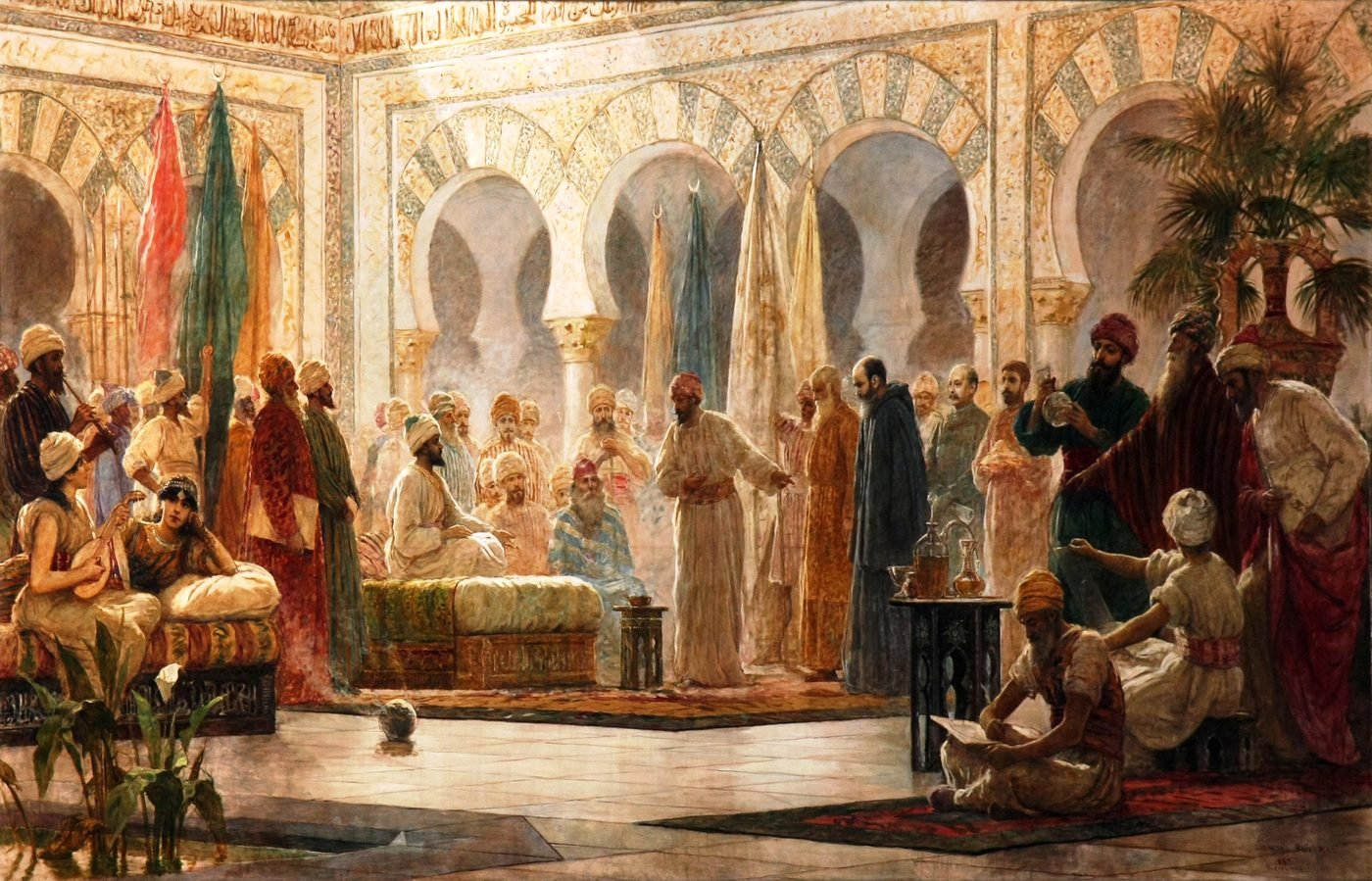
The argument started, as so many lasting arguments do, over a word. The poet and lexicographer Menahem ben Saruq had compiled what he believed was the first comprehensive dictionary of Biblical Hebrew, the Mahberet, in Cordoba around 960 CE. It was an extraordinary achievement - a single Jewish scholar, working in the court of Hasdai ibn Shaprut (the Jewish statesman who served the Caliph Abd al-Rahman III), had catalogued the roots of the Hebrew Bible and organised them systematically for the first time. The Jewish community of al-Andalus was proud of it. Then Dunash ibn Labrat arrived from North Africa, having studied in Baghdad under the great Saadia Gaon, and proceeded to demolish the Mahberet point by point. He counted more than two hundred errors. Some of Menahem's roots, Dunash argued, were not true roots at all - he had misread the structure of the language. The fight was vicious; it involved accusations and counter-accusations, rival students writing polemical treatises, personal insults preserved in manuscript for a thousand years. And out of that fight, Hebrew grammar was born as a discipline.
What the two men were really arguing about was the nature of the Hebrew root. Arabic linguistics - the most advanced philological science of the medieval world - had established that Arabic words derive from three-consonant roots, and that nearly the entire vocabulary of the language can be analysed by tracing words back to those roots and noting how prefixes, suffixes, and vowel patterns modify meaning. Dunash, trained in this tradition, understood that Hebrew worked the same way. Menahem had often allowed one-, two-, or four-consonant roots, smoothing over what he took to be irregular forms. Dunash was right and Menahem was wrong, but the correction mattered far beyond the two men's quarrel. The insight that Hebrew is a triliteral root language - a language of three-letter skeletons clothed in vowels and affixes - made it possible to read Hebrew scientifically, to distinguish between homonyms, to trace a verb's exact meaning across every context in Scripture, to understand why a word shifts shape as it moves through its grammatical forms. It turned reading the Torah from an act of received tradition alone into something you could also reason through.
The record
Menahem ben Saruq's Mahberet (composed c. 960 CE) survives in manuscript and was edited and published in modern critical form by Herschell Filipowski (London and Edinburgh, 1854); a further critical edition by Angel Saenz-Badillos was published by the University of Granada (1986). Dunash ibn Labrat's polemical response, Teshuvot Dunash al Menahem (Criticisms of Dunash against Menahem), also survives; it was edited by Filipowski in the same 1854 volume. The subsequent counter-responses by Menahem's students and Dunash's students - remarkable documents of medieval philological controversy - are surveyed in detail by Angel Saenz-Badillos and Judith Targarona Borras in Grammaticos Hebreos de al-Andalus (Siglos X-XII) (Cordoba, 1988). The Hasdai ibn Shaprut connection - Menahem served as his secretary; Dunash dedicated his work to him - is documented in the biography of Hasdai in Encyclopaedia Judaica, 2nd ed. (2007), vol. 8.
The generation after the quarrel produced the two thinkers who completed what Dunash had begun. Judah ibn Hayyuj, working in Cordoba around 1000 CE, demonstrated in two systematic treatises that every Hebrew verb - without exception - derives from a three-consonant root, including the so-called weak verbs whose letters seemed to disappear in certain conjugations. He showed that those letters were not missing: they were there, hidden by rules of phonology, predictable once you knew the system. This was a genuine scientific discovery. It meant that Hebrew grammar was not a set of exceptions to be memorised but a system to be understood. A reader armed with ibn Hayyuj's analysis could pick up any page of the Bible and parse it correctly without having to have heard the reading from a teacher - they could work it out. A generation later, Jonah ibn Janah (Abu al-Walid Marwan ibn Janah), also of Cordoba and later Saragossa, built on ibn Hayyuj's foundations to produce the two-part Kitab al-Tanqih - a root dictionary and a grammar combined in a single, coherent work - which remained the standard reference on Hebrew grammar for centuries. The intellectual tradition they created was conducted largely in Arabic, the prestige scientific language of their world, and then progressively translated into Hebrew so that communities outside the Arabic-speaking world could use it.
The record
Judah ibn Hayyuj's two grammatical treatises - Kitab al-Af'al Dhawat Huruf al-Lin (On Verbs with Weak Letters) and Kitab al-Af'al Dhawat al-Mithalin (On Verbs with Doubled Letters) - were composed in Arabic in Cordoba c. 1000 CE and translated into Hebrew by Abraham ibn Ezra in the twelfth century; the Arabic originals were edited and published by Wilhelm Bacher, Die grammatische Terminologie des Jehuda b. David Hajjug (Vienna, 1882), and the broader account of his contribution is given in Stefan Weninger et al. (eds.), The Semitic Languages: An International Handbook (De Gruyter, 2011), chapter on medieval Hebrew linguistics. Jonah ibn Janah's Kitab al-Tanqih - comprising the grammar Kitab al-Luma and the lexicon Kitab al-Usul - was composed c. 1030-1040 CE; the Hebrew translation of the grammar by Judah ibn Tibbon (twelfth century) survives in print and is the basis of the standard modern edition by Michael Wilensky and David Tene (Jerusalem, 1964). The influence of Arabic philological method on all these grammarians is traced by Joshua Blau in The Renaissance of Modern Hebrew and Modern Standard Arabic (University of California Press, 1981).
There is something quietly extraordinary about what this generation accomplished. The Hebrew Bible had been read and transmitted for more than a millennium before anyone sat down to ask: what are the structural laws of this language, and can we write them down? The Masoretes of Tiberias had already standardised the text's consonants, vowels, and cantillation marks - a monumental act of preservation completed by the tenth century. Now the grammarians of al-Andalus did something different: they explained why the text was the way it was. They built the analytical tools that Abraham ibn Ezra would later carry into his biblical commentaries, that David Kimhi (the Radak) would systematise in his twelfth-century grammar and dictionary for communities from Provence to Italy, and that would eventually equip Christian Hebraists of the Renaissance and the translators of every subsequent Bible in every European language. The argument between Menahem and Dunash - petty, personalised, ferociously argued over a disputed word - turned out to be the argument in which the Jewish people acquired the means to read their own book with fully open eyes.
The record
David Kimhi's Sefer Mikhlol (grammar, c. 1200 CE) and Sefer ha-Shorashim (root dictionary, c. 1210 CE), composed in Narbonne and drawing explicitly on ibn Hayyuj and ibn Janah, became the standard grammatical reference in northern Europe for the remainder of the medieval period and were among the earliest Hebrew books to be printed - the dictionary was printed in Rome c. 1469-1472, making it one of the earliest Hebrew printed books in existence. The copy in the Biblioteca Apostolica Vaticana (MS Urb. Ebr. 1) is among the best-known manuscript witnesses. The chain of transmission from the Andalusian grammarians through Kimhi to the Renaissance Hebraists is documented by Frank Talmage, "David Kimhi and the Rationalist Tradition," Hebrew Union College Annual 39 (1968), pp. 177-218, and more broadly in Meira Polliack (ed.), Karaite Judaism: A Guide to Its History and Literary Sources (Brill, 2003), which traces the parallel grammatical tradition among Karaite scholars who also contributed to the discipline.
The grammar of the holy tongue is not a constraint on the language; it is the instrument that sets it free. When a Jewish child today sits down to learn that a Hebrew verb has a three-letter root, that a vowel pattern signals a particular grammatical relationship, that the same root can carry opposite meanings depending on its conjugation form - they are receiving a tool forged in tenth-century Cordoba, out of rivalry and rigour and the persistent conviction that the text repays the effort of understanding exactly what it says.