Fez was founded in 789 CE by Idris I, the great-great-grandson of the Prophet, on the banks of the Fez River. Within a generation it had a Jewish quarter. This was not an afterthought. The Jews were already there - settled across the Maghreb in communities that predated the Arab conquest by centuries, some tracing roots to the destruction of the First Temple, others to the Roman diaspora, others to Berber tribes who had adopted Jewish practice long before any creed came riding out of the Arabian peninsula. When the Idrisid city rose, it built around people who were already rooted in the soil.
By the tenth century, Fez had become one of the hubs through which Jewish intellectual life flowed between East and West. Letters went from Fez to the Geonim in Baghdad. Trade goods - textiles, dyes, metalwork - went between Fez and the ports of the Mediterranean. Talmudic questions and responsa travelled the same roads as bolts of cloth. The community produced its own scholars and welcomed those passing through. A city so placed on the axis between the Islamic world's eastern heartland and the emerging Sephardi world to the north was never going to be merely a footnote.
The record
The tenth-century Fez community is attested in the letters of Rabbi Dunash ibn Tamim, a physician and poet who studied under the great Talmudist Isaac Israeli in Kairouan before settling in Fez. Dunash wrote on grammar, astronomy and biblical commentary, and his correspondence with the Geonim of Baghdad confirms that Fez was already integrated into the main circuits of medieval Jewish scholarship by the mid-900s. His works are discussed in the standard scholarly literature on Maghrebi Jewry, including H. Z. Hirschberg's A History of the Jews in North Africa (Brill, 1974), which remains the foundational reference for this period.
The city's geography mattered. Fez sat at the crossroads of the Saharan caravan routes and the Mediterranean coastal trade, which meant that Jewish merchants in Fez were well positioned at precisely the moment when the Mediterranean economy was knitting itself back together after the disruptions of late antiquity. The Geniza documents - the great cache of medieval Jewish papers recovered from a Cairo synagogue - contain letters in which Fez merchants appear alongside their counterparts in Alexandria, Palermo, and the Levantine ports. They are writing about linen, pepper, dyes, and credit, and they are writing in the relaxed shorthand of people who deal with one another regularly. Fez was not at the edge of the Jewish world. It was inside it.
The record
The Mellah of Fez - the Jewish quarter that gave its name to all subsequent Moroccan Jewish quarters - was established in 1438 by the Marinid sultan, who relocated the existing Jewish community from the Andalusian quarter to a new walled district adjacent to the royal palace. The move was ostensibly for protection during a period of urban unrest; it also placed the community under direct royal oversight. The Mellah's distinctive architecture - tall, narrow houses with interior courtyards and windows opening inward rather than onto the street - is documented by the Moroccan scholar Mohammed Mezzine and in the archives of the Institut National des Sciences de l'Archéologie et du Patrimoine, Rabat. The site is now a UNESCO World Heritage-listed part of the medina of Fez.
The arrival of the Sephardi exiles after 1492 remade Fez a second time. The refugees from Spain came with their own liturgy, their own legal customs, their own pronunciation of Hebrew, and a very clear sense of who they had been. Tensions with the older toshabim - the settled Maghrebi Jews who had been there for centuries - were real and are well recorded. So, eventually, was the synthesis. Fez became the place where Iberian and Maghrebi Jewish traditions negotiated the terms of living together, and by the sixteenth century the city's rabbinical courts were producing legal decisions that drew on both traditions without apology. The Maghreb did not just receive the Sephardi world. It helped form it.
The record
Rabbi Samuel ibn Danan (c. 1400-1498) led the Fez community through the arrival of the 1492 Sephardi refugees and composed responsa addressing the conflicts between the minhagim - customs - of the newcomers and the established community. His decisions are preserved in manuscript and are cited in Joseph Chetrit's The Jews of Morocco (Hebrew University Magnes Press, 2007), which documents the legal, linguistic, and cultural negotiation between the two groups. The Fez rabbinical tradition he represented continued to influence Moroccan Jewish legal practice for the next four centuries.
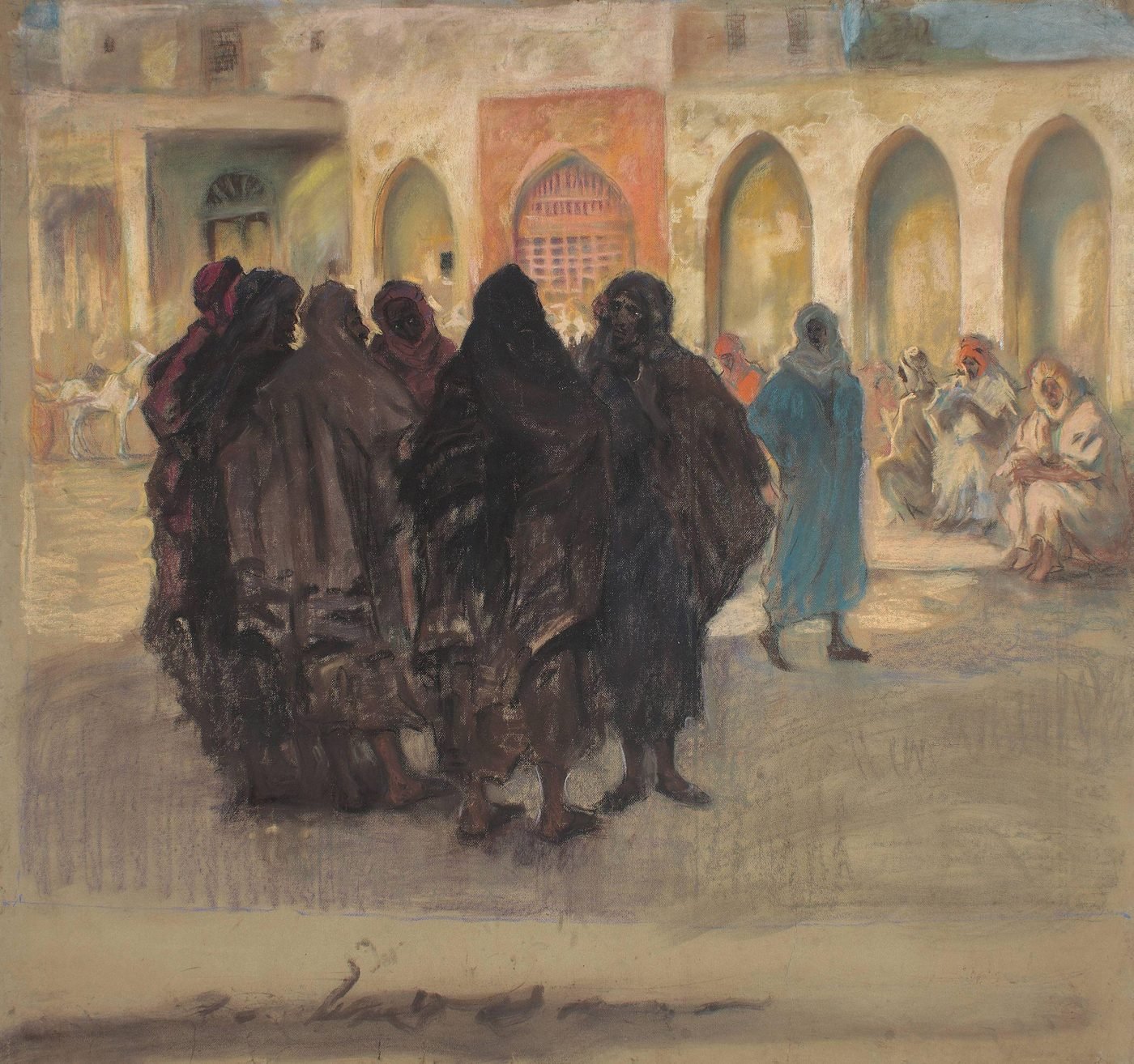
The woman in the watercolour at the head of this piece is dressed in a style that has absorbed centuries of layering - the cut partly Andalusian, the embroidery partly Berber, the occasion impossible to pin to any single origin. This is what a community looks like when it has been in one place long enough, and also when it has been made and remade by arrivals that brought their whole houses with them. The Jews of Fez were North Africans and Iberians and something older than either category. They did what Jews have always done with the cities they were given: they made them theirs.