Most great Jewish cities have a quarter. New York had the Lower East Side, Baghdad its mellah by the river, Salonica its harbour lanes. Los Angeles has a county. Jewish life here does not crowd into one old street; it spreads across a basin a hundred miles wide, from the kosher delis of Pico-Robertson to the Persian banquet halls of Beverly Hills to the synagogues threaded through the San Fernando Valley. The shape looks loose. It is, in fact, how the place holds together.
The nickname "Tehrangeles" catches one bright strand of this and mistakes it for the whole rope. The post-1979 Persian arrival was real and transforming, but it landed on a Jewish city already a century deep. Los Angeles had been quietly accumulating Jews since the 1840s, building temples, banks, studios and schools long before the first El Al-adjacent suitcase came through customs from Tehran. The city's gift is not that it produced one Jewish community. It is that it has comfortably housed several at once, each keeping its own accent.
Pioneers, peddlers and a banker
The first Jews came with the rest of the gold-rush traffic, as merchants serving a dusty cattle town. Jacob Frankfort, a tailor, is recorded as the first Jewish resident in 1841, when Los Angeles was still Mexican. Harris Newmark arrived in 1853 at nineteen and stayed sixty years, long enough to write the memoir that remains a primary source for the early city. Isaias Hellman, a Bavarian who reached town in 1859, turned a dry-goods counter into a bank and helped fund the founding of the University of Southern California. These were not Jews waiting nervously at the edge of a frontier. They helped lay it out.
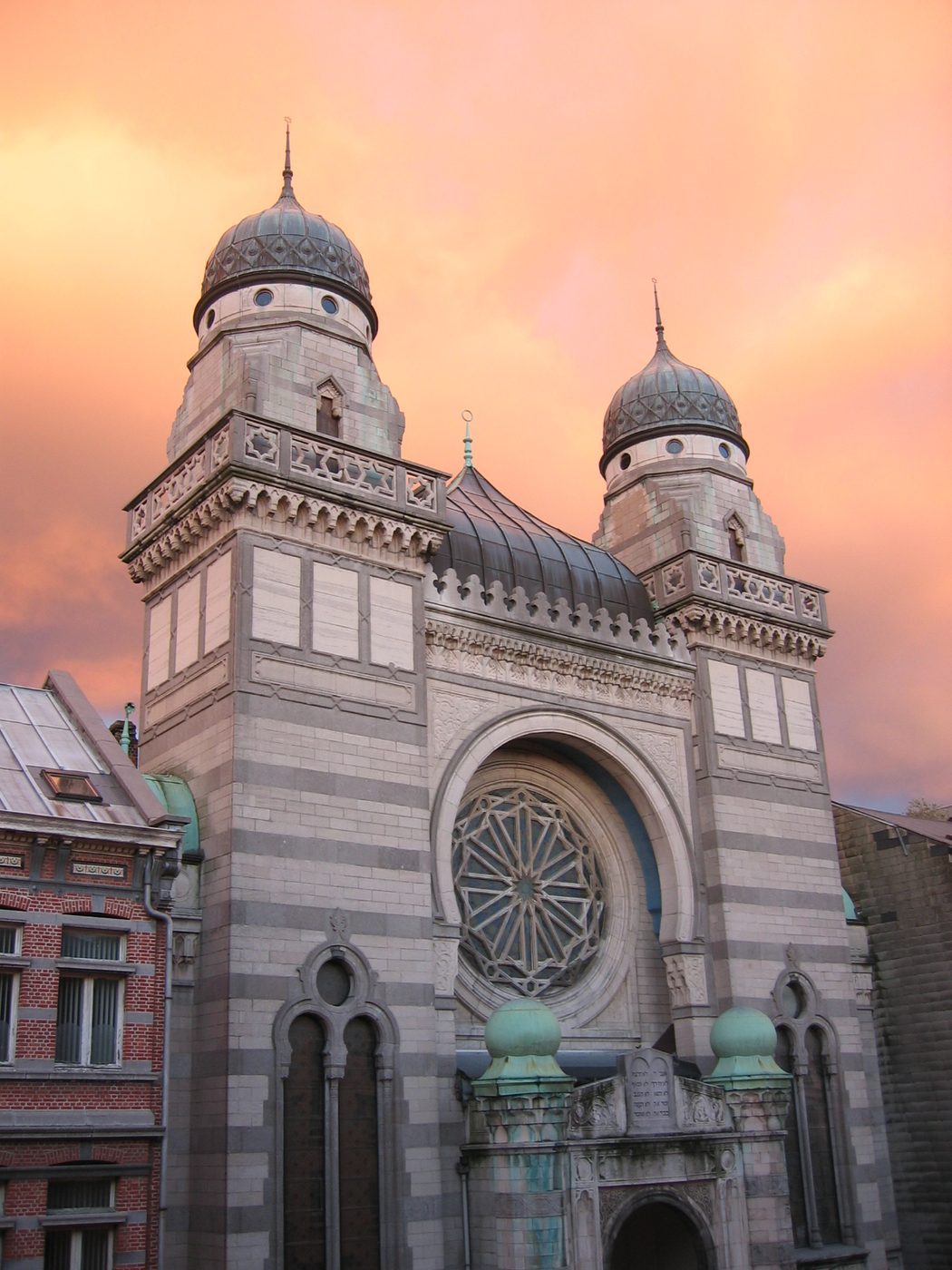
By 1862 they had a congregation, B'nai B'rith, the oldest in the city, which would in time take the name of the boulevard it sat on and become Wilshire Boulevard Temple. The Moorish dome it raised on Wilshire in 1929 was a statement: a Jewish community announcing permanence in the language of architecture. The frontier town was gone. The Jews who had helped build it were staying.
Congregation B'nai B'rith
Los Angeles Jews chartered Congregation B'nai B'rith in 1862 and hired Abraham Wolf Edelman as their first rabbi. It is the oldest Jewish congregation in the city. Renamed Wilshire Boulevard Temple in 1933, it completed its Byzantine-Moorish sanctuary on Wilshire Boulevard in 1929, a dome visible for blocks and meant to be.
Wilshire Boulevard Temple, congregation historyBoyle Heights, then the long drive west
For the first half of the twentieth century, the heart of working Jewish Los Angeles was Boyle Heights, east of the river. In the 1920s and 1930s it held perhaps a third of the city's Jews, the densest Jewish settlement west of Chicago, its spine the shops and union halls of Brooklyn Avenue. The first Canter's Deli opened there before it followed the crowd west. It was a multi-ethnic neighbourhood, Jews living alongside Mexican, Japanese and Russian Molokan neighbours, and the memory of that mixing still colours how the city tells its story.
Then the community did the most Los Angeles thing imaginable: it got in the car. After the Supreme Court struck down racially restrictive housing covenants in 1948, Jewish families moved west and north - to the Fairfax district, to the Westside, eventually to the Valley. By 1960 only a small fraction of the city's Jews still lived in Boyle Heights. The community did not shrink. It dispersed, which in Southern California is a form of confidence, not flight.
The Jews who invented Hollywood
No account of Jewish Los Angeles can skip the studios, because for a stretch of the twentieth century the most powerful Jewish-built institution on earth was a row of soundstages in the San Fernando Valley and on the Westside. Carl Laemmle founded Universal, Adolph Zukor built Paramount, the Warner brothers built Warner Bros, Louis B. Mayer and Samuel Goldwyn gave their initials to MGM. Immigrants and sons of immigrants, mostly from the same Eastern European world that filled Boyle Heights, they built the dream factory that taught America what to want - and, in doing so, often kept their own Jewishness carefully off the screen. The story is told well in Neal Gabler's An Empire of Their Own, and the irony in his title is the whole point.
The founding moguls
Universal Pictures (Carl Laemmle, 1912), Paramount (Adolph Zukor and Jesse Lasky, 1916), Warner Bros (the Warner brothers, 1923) and Metro-Goldwyn-Mayer (Louis B. Mayer and Samuel Goldwyn, 1924) were founded within a single dozen years, overwhelmingly by Jewish immigrants and their children. The American film industry was, at its origin, a largely Jewish creation built on the western edge of the country.
Neal Gabler, An Empire of Their OwnTehrangeles
The Iranian Revolution of 1979 sent tens of thousands of Persian Jews out of a community more than two and a half thousand years old, and a great many of them came to Los Angeles. They settled in Beverly Hills, Westwood and the Valley, and they did not arrive empty-handed: this was among the wealthiest and most organised immigrant waves the city had ever absorbed. By the 2000s the Los Angeles area held the largest Persian Jewish community in the United States, and Beverly Hills - where Iranians came to make up a fifth of the population, the great majority of them Jews - acquired the affectionate name Tehrangeles.
What they joined was an older Jewish city, and the joins are visible if you look. Sinai Temple, founded in 1906 as the first Conservative congregation in Southern California, is today roughly half Ashkenazi and half Persian - two liturgical worlds keeping house under one roof. Nessah Synagogue, founded in 1980 by the son of a chief rabbi of Iran, carries the Mashhadi and Tehrani rite straight into Beverly Hills. The accents did not flatten into one. They learned to share a freeway.
Mapping a metropolitan Jewry
A Brandeis University research team, working with NORC at the University of Chicago, surveyed 3,767 households in 2021 and estimated about 565,000 Jewish individuals in roughly 300,000 households across Los Angeles County - a quarter more Jewish households than in 1997. Around 27,000 of those Jews hold Israeli citizenship.
2021 Study of Jewish Los Angeles, Brandeis UniversityMost Jewish cities are a quarter. Los Angeles is a county, and the looseness is not weakness. It is the architecture.
The capital of the diaspora's second city
Los Angeles will never be the oldest Jewish place on the map, and it has no ruins to point at. What it has is scale and openness: a Jewish community that arrived as merchants, built temples and studios, scattered itself across a basin, and then kept absorbing new arrivals - Holocaust survivors, Israelis, Persians, Moroccans, a Rhodesli remnant from the Aegean - without ever insisting they all become the same kind of Jew. It is the second city of American Jewry by every measure that counts, and the first by sheer variety. The county looks loose. Loose is how it has stayed itself.
Further reading
Story & Stone · Atlas Places Nº 5
Next on the shelf: Beersheba: The Southern Gate →