Antwerp is a city built to move things - cargo up the Scheldt, credit across the counting-house, and, eventually, the hardest small objects on earth from one careful hand to another. The Jews of Antwerp learned the city's grammar early: it rewards precision, discretion and a long memory for who paid on time. What grew out of that, over four centuries, was not a tolerated minority on the docks but one of the most concentrated centres of Orthodox Jewish life in Europe, sitting a few tram stops from the harbour cranes.
The records reach back a long way. The first document naming Jews in Brabant is the 1261 will of Duke Henry III, who wished them expelled; they were not, in the end, but the medieval presence was thin and precarious. The deeper roots came in the sixteenth century, when Portuguese conversos - Marranos fleeing the Inquisition - settled in the booming port and lived, quietly, partly as Jews. The community that endures today is younger and plainer in its origin: it was formally constituted in 1816, when barely a hundred Jews lived in the city.
The hundred who became thirty thousand
From that hundred the community grew with the port. Through the late nineteenth and early twentieth centuries, Yiddish-speaking Orthodox Jews arrived from Eastern Europe in successive waves, drawn above all by the diamond trade then concentrating in Antwerp. By the eve of the Second World War the city held roughly 30,000 Jews - a community large enough to support its own schools, its own congregations and its own internal arguments, and confident enough to wear its Orthodoxy in the street.
The diamond connection is the famous part, and it is not a myth. Antwerp became, and remains, one of the world's great diamond centres, and Jewish cutters, dealers and brokers were central to it. But the cliché flattens the truth. The Jewish quarter was never just a trading floor. It was a full city-within-the-city of synagogues, yeshivot, kosher kitchens and mikvaot, the kind of place where a business deal and a Talmud argument might use the same vocabulary of exactness.
The congregation is constituted
Antwerp's modern Jewish community was formally established in 1816, when around a hundred Jews lived in the city; a census in 1829 recorded 151. From that small base the community grew with the port and the diamond trade to roughly 30,000 on the eve of the Second World War. Its principal congregations - Shomre Hadas and Machsike Hadas - took shape in the nineteenth and early twentieth centuries.
History of the Jews in Antwerp; Jewish Museum of BelgiumOccupation, loss and an unlikely return
The German occupation of Belgium broke that world. Antwerp's Jews were rounded up, deported through the Dossin barracks at Mechelen, and murdered in the east; the community was reduced to a remnant. By every reasonable expectation, a port community built largely on twentieth-century immigration should have dissolved after such a blow, its survivors melting into Brussels or Israel or America.
Instead, Antwerp did something rare. It rebuilt as a markedly more Haredi city than the one destroyed. Survivors and new arrivals - Hasidic families among them, with courts including Satmar, Belz and others - re-established institutions, and the diamond trade gave the returning community an economic spine. The result, visible today, is a Jewish quarter of black hats and Yiddish near the Centraal station, with thousands of Hasidic Jews among a Haredi population in the tens of thousands. The lamps near the docks did not just come back on. They came back brighter.
A port community built on twentieth-century arrivals was almost wiped out, and by rights should have dissolved. Instead Antwerp rebuilt as one of the most observant Jewish cities in Europe.
The synagogue that survived
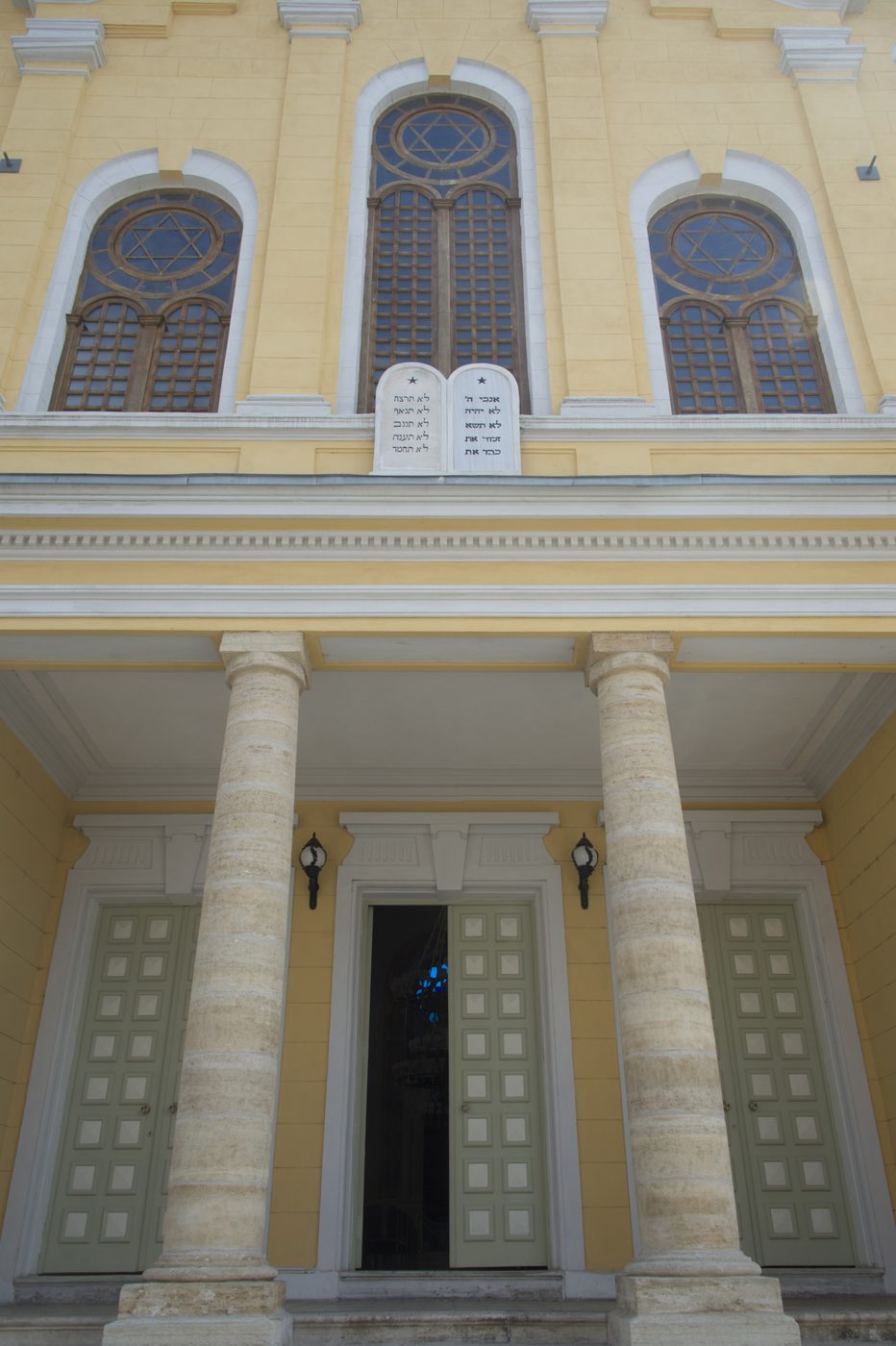
The Eisenmann Synagogue, established by Jacob Eisenmann and completed in 1907, is the only synagogue in Antwerp to survive the Holocaust and the Nazi occupation of Belgium intact. It remains in use as an Orthodox congregation and stands as the city's surviving stone witness to the pre-war community.
Eisenmann Synagogue, Antwerp; Jewish Heritage EuropeWhat the port still says
Antwerp never made Jewish life ornamental. It made it useful, stubborn and public - which is, if you think about it, a higher civic compliment than mere tolerance. A city that treats your presence as load-bearing is a city that expects you to stay.
So the story here is not the familiar diaspora elegy of arrival, flourishing and disappearance. It is arrival, flourishing, catastrophe - and then a second flourishing that few cities ever manage. The Scheldt still carries the cargo. The quarter still carries the prayers. And the diamonds, as ever, change hands in rooms where everyone knows exactly what a word is worth.
Further reading