Hong Kong is a Baghdadi story told on the far side of the world. When Britain took the island under the Treaty of Nanking in 1842 and turned a fishing harbour into an entrepot, the Sassoons and the families in their orbit followed the trade east, and a Baghdadi Jewish community grew up among the godowns and the shipping offices. It was small from the start. It was never marginal.
These were Jews who had carried Baghdad with them across the Indian Ocean - Hebrew, Judeo-Arabic, a Babylonian rite, a head for accounts and a long memory for family obligation. They had already settled Bombay and Calcutta. Hong Kong was the next address on a chain of addresses, and they treated it the way merchants treat a new port: they built a cemetery, they built a club, and in time they built a synagogue with a mother's name carved over the door.
The house by the harbour
The first Jewish settler is usually named as Elias David Sassoon, of the great Baghdadi merchant family, and the firm of David Sassoon and Co. opened a Hong Kong branch in 1857, the year the community is generally reckoned to have been formally established. E.D. Sassoon and Co. followed with its own branch in 1867. A Jewish cemetery was laid out in Happy Valley in the 1850s, with the first recorded burial in 1857, which is one of the plainer ways a community announces it intends to stay: it buys ground for its dead.
What followed was the slow furniture of communal life. A small Sassoon-funded synagogue served the community before the permanent building. The Jewish Recreation Club opened in 1905 and was enlarged with Kadoorie money four years later. None of this was on a European scale. Hong Kong's Jews numbered in the dozens through the nineteenth century - 71 souls in an 1881 count, a little over a hundred by 1897. But a community is not measured only by its headcount. It is measured by what it builds, and these merchants built to last.
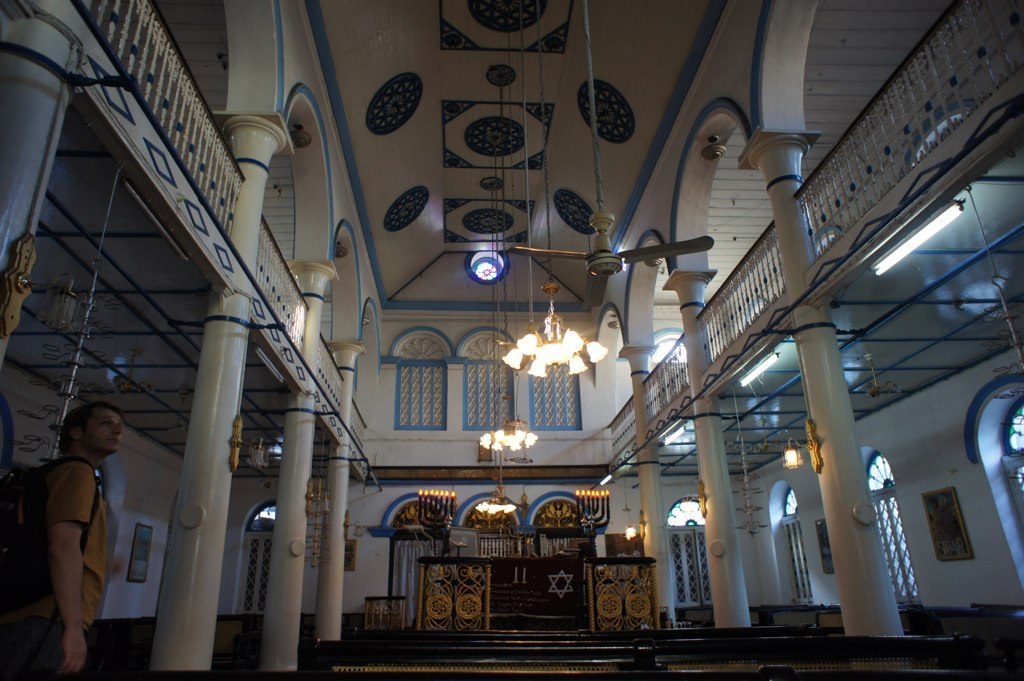
Ohel Leah Synagogue
The foundation stone was laid in 1901 and the synagogue completed in 1902, on the junction of Robinson Road and Castle Road in the Mid-Levels. The brothers Jacob, Edward and Meyer Sassoon funded it and named it Ohel Leah - "the tent of Leah" - for their mother, Leah Sassoon. Designed by the firm Leigh and Orange, it is still in weekly use. A 1998 restoration won an award at the 2000 UNESCO Asia-Pacific Heritage Awards, and the building is listed as a Grade I historic structure.
Ohel Leah SynagogueThe other great name is Kadoorie. Elly Kadoorie left Baghdad as a young man and made a fortune in the Far East; his sons Lawrence and Horace turned it into an institution. The family controlled China Light and Power, opened the Peninsula Hotel in Kowloon in 1928, and ran the Hongkong and Shanghai Hotels. After the war they founded the Kadoorie Agricultural Aid Association in 1951 to help refugees from China onto their feet, and established the Kadoorie Farm in the New Territories in 1956. Lawrence Kadoorie was made a life peer in 1981 as Baron Kadoorie - the first Hong Kong-based businessman raised to the British peerage. A Baghdadi merchant's grandson sat in the House of Lords. Diaspora has its own kind of arithmetic.
A Jewish governor on the Peak
Sir Matthew Nathan, a British soldier and colonial administrator of Jewish descent, served as the thirteenth Governor of Hong Kong from 1904 to 1907 - described as the colony's first and only Jewish governor. He served as honorary president of Ohel Leah Synagogue during his tenure. Nathan Road, the great commercial spine of Kowloon, still carries his name. Few diaspora communities of a few hundred people can say the Crown's own representative kept their synagogue's honorary chair.
Jewish Virtual Library; Matthew NathanOccupation, and after
The Japanese invasion came in December 1941, and the colony surrendered on Christmas Day. Allied nationals, the Kadoories among them, were interned at Stanley camp; Ohel Leah was put to use as a warehouse, and the Jewish club was looted. Elly Kadoorie died in 1944, with his family behind wire. When the war ended the community gathered itself again, restored its institutions, and carried on. By the 1950s it numbered a few hundred, roughly half Sephardi and half Ashkenazi, the latter having arrived after the Russian Revolution.
Today's community is larger than it has ever been and stranger in its make-up - several thousand people, drawn from Israel, America, Britain, France and beyond, worshipping across an Orthodox congregation at Ohel Leah, a Sephardi synagogue, a Chabad house and a Reform-aligned congregation. It is an expatriate community now, not a mercantile dynasty. But it prays in a building a Baghdadi merchant raised for his mother, and that continuity is the whole point.
A community of a few hundred merchants left a synagogue, a cemetery, a power company and a peer of the realm. Small does not mean slight.
Further reading
Story & Stone · Atlas Places Nº 19
Next on the shelf: Essaouira: The Sultan's Port →