There is a story that the Jews of Tlemcen liked to tell about how they came to be allowed in. A holy man arrived at the gate of the Berber city riding a lion, with a live serpent for a bridle. The sultan, reasonably impressed, lifted the ban on Jewish residence and gave the newcomer leave to settle his people. The holy man was Rabbi Ephraim Alnaqua, also called Encaoua, a physician and scholar who had fled Spain. The lion is legend. The community he founded was not.
Tlemcen stands in north-western Algeria, near the Moroccan border, and from the late fourteenth century it became one of the great rabbinic addresses of the Maghreb. It was not made Jewish by the catastrophe of 1492. It was already a centre when the Spanish exiles arrived, and what those exiles found was not empty ground but a working community with its own court, its own saint and its own confidence. They joined a structure rather than building one.
That distinction matters, because the lazy version of North African Jewish history treats every inland community as a passive shelter for refugees from Spain. Tlemcen rebuts it. Here the older Maghrebi world and the incoming Sephardim met as something closer to equals, and the meeting produced a place scholars cited for authority, not merely for survival.
The saint at the city's edge
Ephraim Alnaqua was born in Toledo around 1359 and fled the wave of massacres that tore through Spanish Jewry in 1391, the same violence that drove so many southward across the strait. He reached the Maghreb, and at Tlemcen he set up a community where Jews had not been permitted to live. He worked as a physician as well as a rabbi, and tradition credits him with curing a daughter of the ruling house, which is the sort of service that tends to be rewarded with a quarter to live in. He died in 1442.
What he left behind outgrew him. His tomb in the cemetery on the edge of Tlemcen became the most important Jewish pilgrimage site in North Africa. Every spring, at Lag ba-Omer, pilgrims converged on it in numbers that could rival the city's own population, Jews and Muslims together, because a saint's grave in the Maghreb did not always observe the boundary between faiths. The man who had been let in on the strength of a lion became, in death, a reason the whole region looked to Tlemcen.
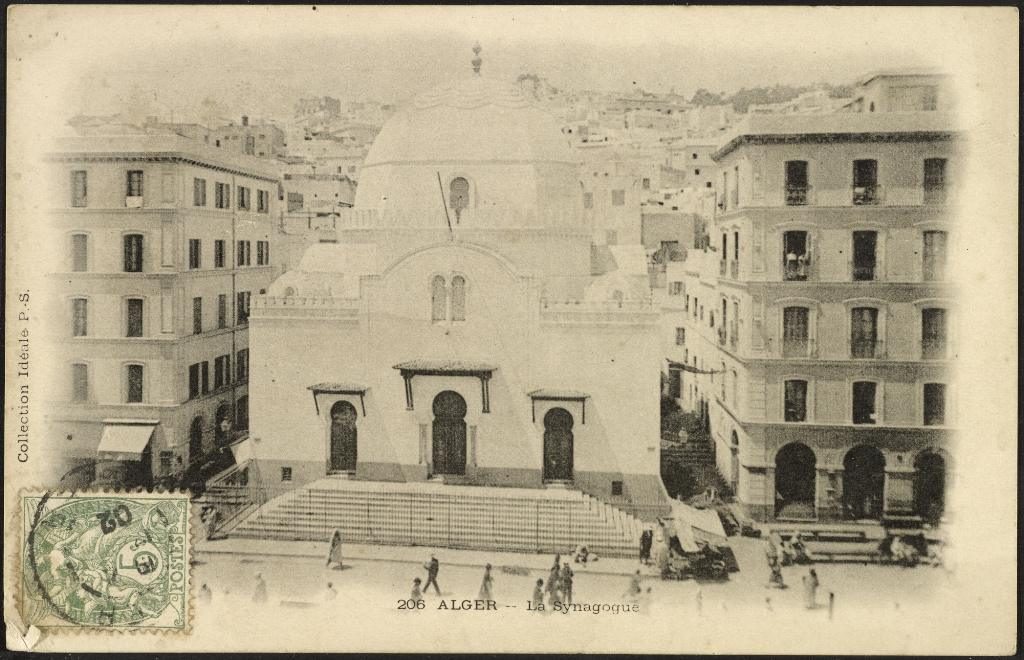
Around that devotional centre grew the ordinary furniture of a serious community: synagogues, a rabbinical court, schools, a merchant class trading across the western Maghreb and into the Mediterranean. When the great expulsion of 1492 sent a fresh wave of Sephardim into Algeria, Tlemcen was one of the cities that absorbed them, and the city's learning sharpened again on contact with the new arrivals.
Ephraim Alnaqua founds the community
Rabbi Ephraim ben Israel Alnaqua, born in Toledo around 1359, fled the Spanish persecutions of 1391 and established the Jewish community of Tlemcen, where Jews had previously been barred from settling. A physician as well as a scholar, he died there in 1442. His tomb became the principal Jewish pilgrimage site of North Africa, drawing crowds at Lag ba-Omer well into the twentieth century.
Encyclopaedia Judaica · Jewish Virtual LibraryA court of the Maghreb
Tlemcen's weight in Jewish history is partly a matter of rabbinic authority. The generation of scholars who settled in Algeria after 1391, men like Isaac ben Sheshet Perfet and Simon ben Zemah Duran, the Rashbatz, made Algiers and the cities around it into a court whose legal rulings carried across the Maghreb. Tlemcen sat squarely inside that scholarly orbit, a place named when later writers meant settled authority rather than mere presence. Its responsa and its teachers fed the wider North African tradition for generations.
The community lasted until the great unwinding of the twentieth century. Under French rule the Crémieux Decree of 1870 made Algeria's Jews French citizens, which tied their fate to France in ways that grew dangerous. After Algerian independence in 1962, almost the entire Jewish population of the country left, most of it for France, some for Israel. Tlemcen's living community went with them. The cemetery, the tomb and the memory stayed.
A refugee was let through the gate on the strength of a story about a lion. Five centuries later, the city he founded was still a name scholars said with respect.
The pilgrimage to the tomb
By the nineteenth and twentieth centuries the tomb of Ephraim Alnaqua at Tlemcen drew very large crowds each spring at Lag ba-Omer, with reports of more than ten thousand pilgrims, Jewish and non-Jewish, gathering at the cemetery. After Algerian independence the pilgrimage lapsed; a brief revival permitted from France in 2005 was suspended again the following year. The site remains, documented by heritage surveys, even though the living community has gone.
Diarna · Jewish Virtual LibraryFurther reading
Story & Stone · Atlas Places Nº 16
Next on the shelf: Belgrade: Dorćol by the River →