They did not storm the Temple. They did not petition the king or organise a protest. They simply stopped going. Somewhere around the middle of the second century BCE, a group of priests and scholars - probably led by a figure the community's own texts call the Teacher of Righteousness - concluded that the Jerusalem Temple had fallen into the hands of men who had no right to run it. The Hasmonaean dynasty, which had won its freedom fighting the Seleucids, had also taken control of the priesthood, and the dates and calendar they used for the great sacrifices were, in this community's view, wrong. An offering made on the wrong day was not an offering at all. A Temple run by the wrong priests, on the wrong calendar, was not performing atonement. It was theatre. And so they left.
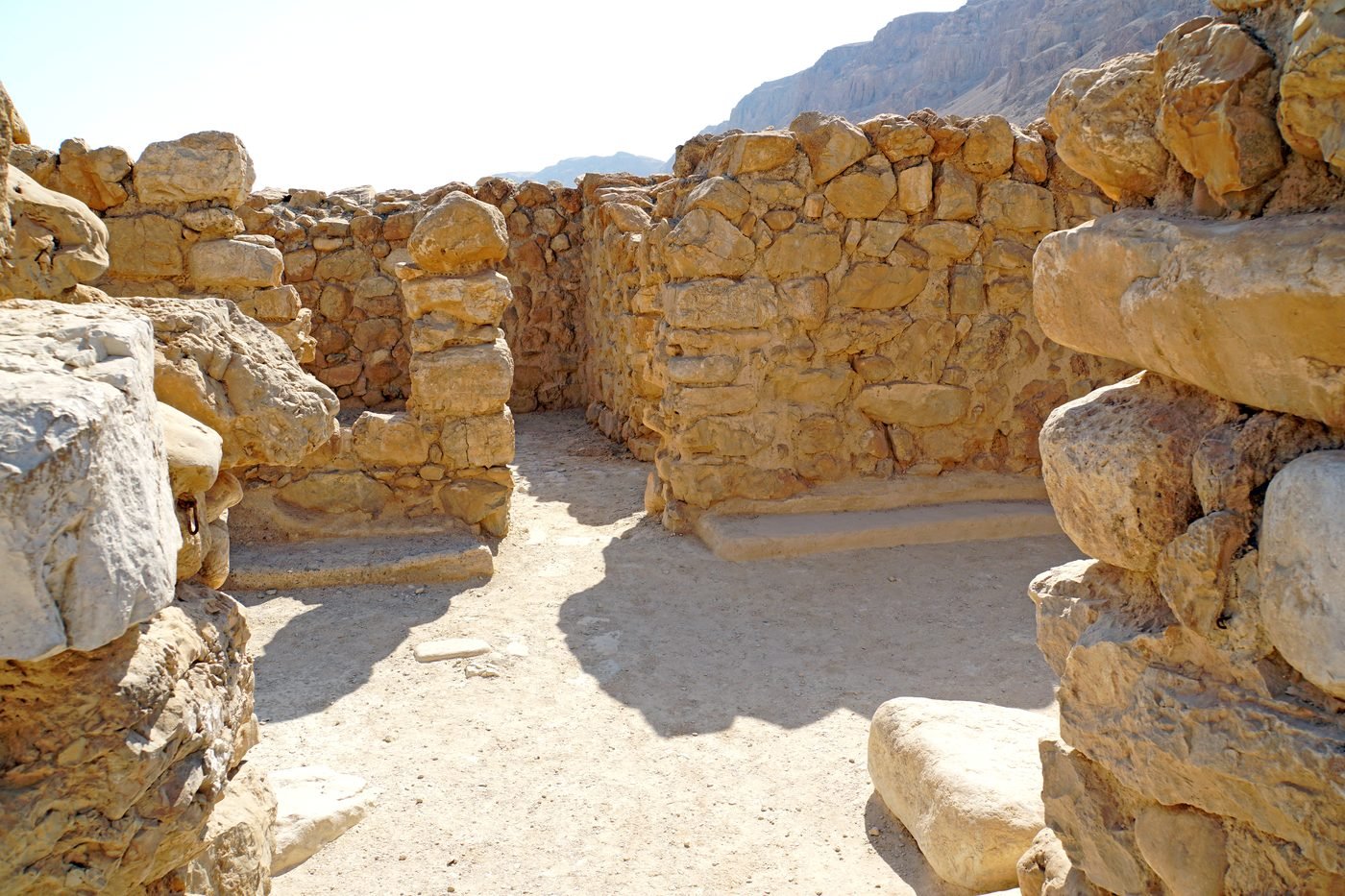
They went to the cliffs above the north-western shore of the Dead Sea, to a place called Qumran, and they built. A scriptorium for copying texts. Ritual baths - mikvaot - cut into the bedrock, fed by a system of plastered channels that caught the rare desert rain and held it. Communal dining rooms. Storage jars. A cemetery of more than a thousand graves. What they built was not a temporary refuge but a permanent alternative - a community organised around prayer at the correct hours, study of the law in its most demanding form, and the conviction that they, not the priests in Jerusalem, were the true Israel keeping the true flame. They called themselves the yahad - the community, the togetherness. They are known to history as the Essenes.
The record
Between 1947 and 1956, eleven caves near Qumran yielded approximately 900 manuscripts, now known collectively as the Dead Sea Scrolls. They include the oldest known complete scroll of the book of Isaiah (the Great Isaiah Scroll, 1QIsa-a, dated by palaeography and radiocarbon to c. 125-100 BCE), sectarian rule-books - most importantly the Community Rule (Serekh ha-Yahad, 1QS) - and biblical commentaries called pesharim in which community history is read into prophetic texts. The Great Isaiah Scroll is held at the Israel Museum, Jerusalem, and displayed in the Shrine of the Book. The full digital archive of the scrolls is maintained by the Israel Antiquities Authority and the Israel Museum at The Leon Levy Dead Sea Scrolls Digital Library.
The Community Rule is one of the strangest and most compelling documents to come out of the entire Jewish world of the Second Temple period. It is a constitution for a society without a king, without a Temple, and without compromise. Members handed over all their property on joining. They ranked themselves by seniority and knowledge. They ate together, studied together, prayed together at precisely the times the solar calendar mandated. A man caught spitting during a session of the community court could be penalised. Falling asleep during a communal reading cost him thirty days of reduced rations. Laughing loudly and foolishly: ten days. The punishments are specific enough to suggest real episodes behind them - someone did spit, someone did nod off, and the community decided what that meant. The rigour was not cruelty. It was a statement about what mattered: that the boundary between the holy and the ordinary had to be maintained at every moment, in every gesture, because the priests in Jerusalem were no longer maintaining it.
The record
The ancient Jewish historian Josephus describes the Essenes at length in two major works - The Jewish War (Book II, chapters 8.2-13) and Antiquities of the Jews (Book XVIII, chapter 1.5) - written in the 70s-90s CE. He numbers them at about four thousand, notes their practice of communal property, their rigorous purity rules, their avoidance of oil (considered defiling), and their daily immersion in cold water before meals. Josephus himself, writing as a young man's exercise, claims to have lived with Essene-adjacent teachers for a period - his account is the most detailed external description of the group to survive, and it corroborates, in broad terms, what the scrolls say about community life. The Roman writer Pliny the Elder, in his Natural History (Book V.17, written c. 77 CE), places the Essenes on the western shore of the Dead Sea, "above En-gedi" - a location consistent with Qumran.
What the community at Qumran was waiting for was not nothing. Their texts are saturated with expectation - of a final war between the Children of Light and the Children of Darkness, of the coming of two Messiahs (one priestly, one royal, in that order of precedence), of a renewed Temple that would be run correctly at last. The War Scroll (1QM) is a detailed battle plan for an eschatological conflict, forty years long, against the Kittim - a code word that appears to mean Rome. They were not retreating from history. They were positioning themselves to be ready when history arrived at its decisive moment. In 68 CE, when Roman legions under Vespasian swept through the Jordan Valley ahead of the siege of Jerusalem, someone at Qumran hid the community's library in the surrounding caves. The community was destroyed. The scrolls lay untouched for nearly nineteen centuries, until a Bedouin shepherd named Muhammad edh-Dhib threw a stone into a cave in 1947 and heard something break.
The record
Archaeological excavation of the Qumran settlement, conducted primarily by Roland de Vaux of the École Biblique et Archéologique Française between 1951 and 1956, revealed occupation in two main phases spanning roughly 100 BCE to 68 CE, with a short gap possibly corresponding to the earthquake recorded by Josephus in 31 BCE. The site includes a scriptorium identified by the discovery of plastered writing tables and inkwells, ten ritual baths (mikvaot), a cemetery of over 1,100 graves, and a sophisticated water-management system fed by an aqueduct from Wadi Qumran. The site is administered by the Israel Antiquities Authority and the Israel Nature and Parks Authority; excavation reports are published by the École Biblique. Debate continues among scholars over whether the Qumran settlement was inhabited by Essenes or by a related but distinct group, but the community-rule texts found in the caves are broadly accepted as Essene or Essene-adjacent in character.
The Essenes did not win. The Judaism that survived the destruction of 70 CE was Pharisaic - the tradition that became rabbinic Judaism, the tradition that eventually became us. But the Essenes left something that no other group from that world left: their library, buried and intact. Most of what the Pharisees wrote, most of what the Sadducees argued, most of what the ordinary Jewish family in first-century Jerusalem believed and debated - it is gone, reconstructed only by inference. The scrolls from Qumran are primary sources, in the handwriting of the people who lived them. They show a Judaism of enormous ambition and seriousness, one that took the question of how to live correctly so seriously that the answer was: leave the city, build a desert community, and do it right. That is a choice. It is not the only choice the tradition offers. But it is not an unimpressive one.
A Bedouin teenager throwing stones into a cliff-face cave changed the history of biblical scholarship overnight. That the scrolls survived at all - wrapped in linen, stored in jars, in a cave in the desert with virtually no moisture - is close to miraculous in a purely physical sense. The community that hid them was destroyed within months of hiding them. Their argument about the correct way to worship, the correct calendar, the correct priests, was cut short by Roman siege engines. But the library endured. Whatever one thinks about their theology, the people who built Qumran were serious. The scrolls are proof that the Jewish world of the Second Temple period was not one thing. It was an argument, conducted at high volume, by people who cared enormously about getting it right.