He left no name. The scrolls his community wrote refer to him only as the Moreh ha-Tzedek - the Teacher of Righteousness - and that title was enough. Around 150 BCE, during the turbulent years after the Maccabean revolt had scrambled the old priestly order, a priest of uncommon learning decided that the Jerusalem Temple had gone wrong: wrong leadership, wrong calendar, wrong understanding of the covenant. The men who now controlled the altar were, in his reading, wicked. The proper Israel was not the crowd in the city. It was a remnant, willing to go into the desert to wait, study, and live by the full rigour of the Torah as he understood it.
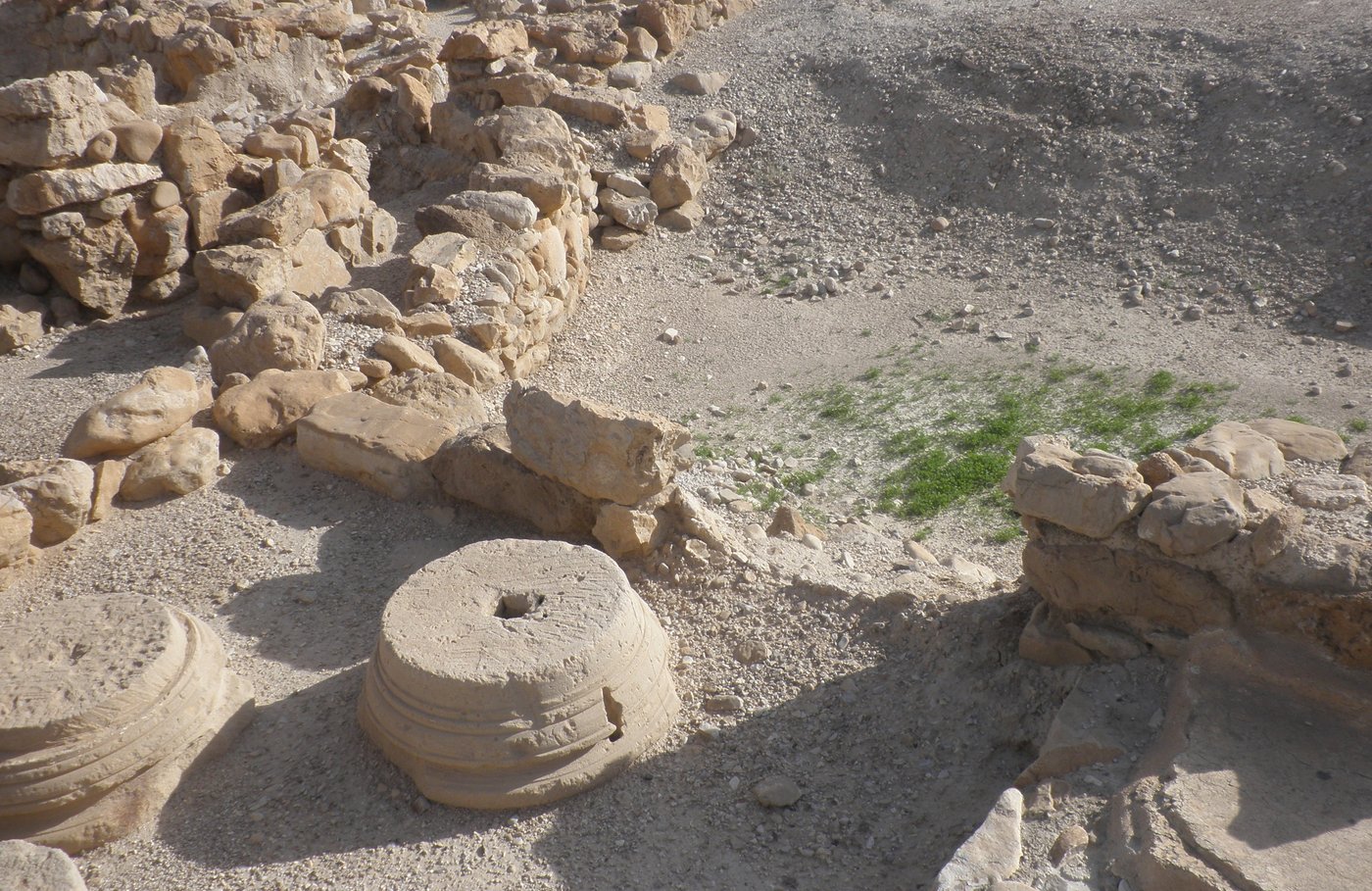
This was not despair. It was precision. The Teacher of Righteousness was not retreating from Judaism - he was practising it at a temperature he believed the Jerusalem establishment could no longer sustain. His community settled at Qumran on the north-western shore of the Dead Sea, surrounded by cliffs and heat and silence, and there they wrote. Rules for communal life. Biblical commentaries that read current events as the fulfilment of ancient prophecy. Hymns of thanksgiving composed, many scholars believe, by the Teacher himself. A Community Rule so detailed and so serious about purity, study, and shared discipline that reading it still gives the impression of a people who thought the stakes could not be higher.
The record
The Dead Sea Scrolls - discovered in the caves above Qumran between 1947 and 1956 - include the Damascus Document, the Community Rule (Serekh ha-Yahad), the War Scroll, and the Hodayot (Thanksgiving Hymns). The Community Rule describes a structured sect, admission procedures, ranked membership, and communal meals. The Damascus Document names the "Teacher of Righteousness" in contrast to a "Wicked Priest" and a "Man of Lies," evidently referring to real opponents in the mid-second century BCE Jerusalem priesthood. The scrolls are held at the Israel Museum, Jerusalem, in the Shrine of the Book, and at the Jordan Archaeological Museum in Amman. Critical editions have been published in the Discoveries in the Judaean Desert series (Oxford University Press, 1955-2010), the standard scholarly reference.
The argument he was making was essentially calendrical as well as spiritual. The Teacher held to a solar calendar of 364 days - an ancient priestly reckoning found also in the Book of Jubilees and in 1 Enoch - while the Jerusalem Temple had shifted to a lunar calendar. This was not a minor liturgical dispute. If your calendar differs from the Temple's, your festivals fall on the wrong days; you cannot participate. The Teacher's community was therefore structurally unable to join the national feast cycle. They had not been thrown out. They had concluded that the feast cycle no longer meant what it was supposed to mean, and had rebuilt the whole schedule from scratch. The Qumran year was its own world.
What came of it? The community endured at Qumran - and in related communities the Damascus Document suggests were scattered in camps across Judaea and Damascus - for roughly two centuries. Then the Roman legions came. By 68 CE the settlement had been abandoned or destroyed. The scrolls were hidden in the cliff caves above the site, wrapped in linen, stored in jars. There they stayed for nearly nineteen centuries, until a Bedouin shepherd looking for a lost goat found the first cave in 1947. The Teacher's writings survived the Romans, the Byzantines, the Umayyads, the Crusaders, the Ottomans, and the British Mandate. Almost nobody else's did.
The record
The Pesher Habakkuk (1QpHab) - a commentary on the biblical prophet Habakkuk found in Cave 1 at Qumran - applies Habakkuk's oracles directly to the Teacher of Righteousness and his opponents, reading the ancient text as prophecy about the sect's own crisis. It names the "Wicked Priest" as someone who initially walked in truth but turned to wealth and corruption - almost certainly a Hasmonaean high priest, most likely Jonathan (d. 143 BCE) or Simon (d. 134 BCE), though this identification is debated. The pesher form - verse-by-verse application of scripture to contemporary events - is one of the sect's most distinctive literary inventions and influenced later Jewish and early Christian biblical interpretation. The text was published and translated by Millar Burrows in The Dead Sea Scrolls (Viking Press, 1955) and subsequently in the standard DJD critical edition, volume I (Oxford, 1955).
The Teacher of Righteousness is one of those figures who shaped history without anyone knowing his name while he was doing it. He taught his community that the covenant was real, that it demanded everything, and that if the institutions around you had been captured by compromise, the answer was not to lower your standards but to go further in. The desert, in that reading, was not punishment. It was the only serious place left. Two thousand years later the scrolls his community wrote are still being studied, still being argued over, still surprising scholars with what they reveal about the range and intensity of Jewish life in the Second Temple period. He never got to see the Temple fall. He never had to know that the institution he refused to serve would not, in the end, outlast his community's library.