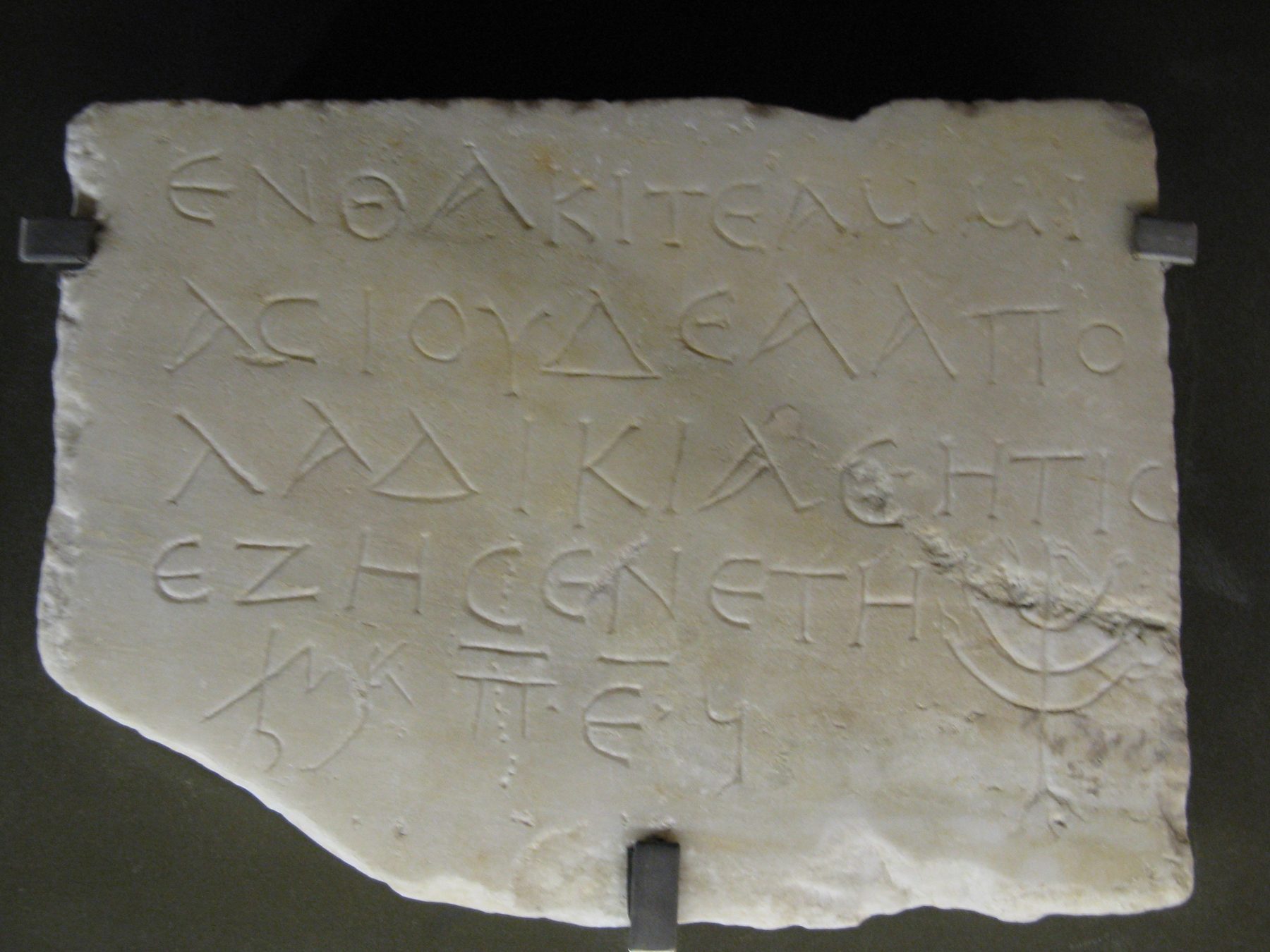
There is a name on one of the inscribed marble plaques in the Jewish catacombs of Rome: a man described as archisynagogos - head of a synagogue. He is not named for the Temple in Jerusalem. He is not identified by his tribe or by some ancestral village. He is identified by the congregation he served in Rome. That is the detail that rewards a second look. By the first century CE, Roman Jews were so settled, so institutionally organised, that their offices had titles, their titles were engraved, and their congregations had names that their grandchildren would still recognise.
The synagogues of ancient Rome are not one building or one period. They are a network - at least eleven named congregations reconstructed from funerary inscriptions across several centuries. We do not have their walls. Most have not been found above ground. What we have is better in some ways: a long list of names, offices, and honours that the community itself thought worth cutting into stone beside its dead. The synagogues survive as a directory of a self-governing people.
The record
The names of Rome's ancient Jewish congregations are preserved almost entirely through funerary inscriptions recovered from the Jewish catacombs of Vigna Randanini, Villa Torlonia, and the Via Portuense (Monteverde). Scholars working from this corpus - chiefly Harry J. Leon in The Jews of Ancient Rome (1960, revised 1995, Jewish Publication Society) - have identified eleven distinct congregation names. These include the Augustesians (synagoga Augustesion), named after the emperor Augustus or his household, the Agrippesians (named after Agrippa, Augustus's general and son-in-law), the Volumnesians (likely named after a Roman patron, possibly Volumnius, an official in Syria), and several geographic congregations including the Hebrews (synagoga Hebraion), the Tripolitans, and the Eleans. The offices recorded in the inscriptions - archisynagogos (head of the synagogue), gerousiarch (head of the council), archon (councillor) - show a structured communal government running alongside but independent of Roman civic institutions.
The naming pattern is worth pausing over. Some Roman congregations named themselves after emperors and imperial officials - the Augustesians, the Agrippesians, the Iuliesians (after Julius Caesar or his family). This was not servility. It was the confident politics of a community that understood how Rome worked. You built patron relationships; you acknowledged the great houses; you kept your community out of trouble and in good standing. Meanwhile you ran your own council of elders, elected your own heads, honoured your own teachers, and buried your dead under symbols that no Roman emperor ever invented. The menorah on the catacomb wall is not imperial branding. It belongs to something older, and the congregation knew it.
The geographic congregations - the Hebrews, the Tripolitans, the Eleans - hint at a city large enough that Jews from different homelands formed their own prayer groups within it. Rome attracted migrants from across the Mediterranean world, and Roman Jews were not a single community squeezed into one neighbourhood. They were a network of networks, each with its own culture and origin, connected by shared practice, shared symbol, and the shared need to navigate the world's most powerful city without disappearing into it.
The record
The synagogue named for the Hebrews (synagoga Hebraion) appears in the Roman catacomb inscriptions and is generally taken to refer to a congregation that either used Hebrew or Aramaic in its liturgy, or comprised Jews who identified more closely with a Judaean homeland identity, as distinct from the more thoroughly Hellenised congregations around them. The Augustesian congregation is attested in at least three inscriptions from the Monteverde catacomb, making it among the best-documented of Rome's ancient synagogues. The collection of relevant inscriptions is catalogued in Jean-Baptiste Frey's Corpus Inscriptionum Iudaicarum (Rome, 1936), the standard scholarly reference for ancient Jewish epigraphy in the western diaspora, with subsequent revisions and additions by Baruch Lifshitz (1975) and later scholars.
What these congregations were doing, week to week, has to be inferred from later and parallel sources - the Talmud, the Mishnah, contemporary accounts of synagogue practice from Egypt and the Levant. But the framework is not hard to imagine: reading, translation, teaching, communal decision-making, care for the poor, coordination of the holiday calendar. The synagogue as institution was already ancient when these Roman congregations named themselves. It had been the portable engine of Jewish life since Babylonian exile, and it would carry the community across every border that empires drew and erased in the centuries ahead. Rome was just one of its more spectacular performances.
The record
Philo of Alexandria, writing around 40 CE, records in his Embassy to Gaius (Legatio ad Gaium, section 155-158) that Jews in Rome had long inhabited Trastevere across the Tiber and had their own proseukai - prayer houses - there. He is describing a community already established well before the common era, with property, regular meeting places, and enough political standing to send delegations and receive acknowledgment from the princeps. Josephus's later writings confirm the political weight of the Roman Jewish community: when Archelaus of Judaea faced judgement in Rome (around 4 BCE), fifty Jewish ambassadors from Judaea were joined by more than eight thousand Roman Jews in lobbying at the hearing (Josephus, Jewish Antiquities 17.300-301). Eight thousand people do not walk into a Roman political proceeding without communal organisation behind them.
No building survives. No synagogue from ancient Rome has been excavated and identified above ground. What remains are names in stone - the names of congregations, of their officers, of people honoured for their service to a community that intended to be here for a long time. Those intentions were well-founded. Rome's Jewish community is among the oldest continuously documented in Europe, and its ancient synagogues, unnamed on any city map, are the reason it ever had a future to build.